|
The bullring in Ronda, which sees bullfighting annually in early September. The ring is open
year-round to visitors and includes Spain's oldest equestrian school and a small museum.
Bullfighting seems to have begun as a way to train horses and riders for combat. The bullfighters
rode horses as they challenged and eventually killed the bulls. They later fought
on foot and with their famous capes. Orson Welles, Ernest Hemingway and many
other celebrities have been captivated by the sport and its matadors. |
Spain was never a must-see place for us, but we got interested in it as we looked for a spring 2024 vacation. Jane had visited southern Spain years before we met, and the two of us explored northern Spain, from Bilbao to Barcelona, by car in 2003. We've always enjoyed France and Italy, and we thought southern Spain would be similar. It is and it isn't.
In France, the history that's visible on the street and in the culture, seems to start in the early 1500s with Francis I. In Italy, history goes back much further, to the Roman republic if not earlier. In Spain, it's the 700s and the Moorish conquest. Arab fortifications and palaces seem to be everywhere in southern Spain, often substantially altered by the next wave of conquest, the Catholics who in the late 1400s expelled Jews and Muslims from the newly unified country. Then there was the brutal rise of the Spanish Empire, the loss of empire, the Spanish Civil War, the decades of fascism under Franco, and now a monarchy again.
All this is visible in the bricks and mortar and daily life of today's Spain. You've probably heard that the Spanish eat dinner very late. Restaurants start opening for dinner at 8pm, but it's often still daylight when diners sit down because Spain is more or less on permanent daylight savings time. Franco ordered that the time in Fascist Spain be the same as in Nazi Germany. So while the "correct" time zone should be Greenwich Mean Time (most of Spain is actually farther west than Britain), Spain observes Central European Time. Sunlight lingers well into the evenings, which is not necessarily a bad thing.
For this trip, we decided to start with Madrid, which I had thought would be a rather austere city. The idea that Franco ruled from there made me expect a repressed and joyless place. I was so wrong. It's lively city where life is something to be enjoyed. It's a place of great art, great public architecture, lively parks, crowded sidewalks and inviting tapas bars. We took a train to Valencia, our second stop, then rented a car to head south and visit a series of small towns with big histories.
The trip began with an American Airlines flight from our home in San Diego to Dallas/Fort Worth on Sunday, April 7. We were supposed to then continue on with a direct Iberia flight to Madrid. Unfortunately, after we sat in the plane on the runway for a while, the 9:40pm flight was cancelled, but not until well after midnight. Iberia put us up in a rundown Quality Inn and Suites for a few hours before we headed back to the airport Monday morning to try to find a way to Madrid. Eventually we were rebooked on British Air with a several-hour layover in London. We got to Madrid on Tuesday, a day late, and lost one of our days in the city. Click on the city names for a more photos and information.
Madrid: We stayed at the Pestana Plaza Mayor, a hotel carved out of some of the historic buildings surrounding the plaza, considered the heart of old Madrid. Our room looked onto the plaza, where the Madrid Open tennis tournament had set up a clay tennis court, open to the public, to promote the tournament. With only three full days, we managed to visit the Prado, the Museo Reina Sofia, and to thoroughly explore the many tapas bars on Cava Baha. We walked everywhere in Madrid.
Valencia: After a high-speed train ride from Madrid on Saturday, April 13, we arrived at Hotel Puerta Serranos, right at the Serranos Tower that acts as a gateway to Valencia's old quarter, where we stayed four nights. I don't know if Valencia is the culinary capital of Spain, but we had some wonderful meals here in the city where paella originated. Oddly, the paella we had at one of its best-regarded paella palaces was only so-so.
Murcia: Upon leaving Valencia on Wednesday, April 17, we picked up a rental car and drove to Murcia, an inland and decidedly non-touristy but lively town. We stayed four nights at the Hotel Cetina Murcia. Having a car allowed us to visit the nearby coastal town of Cartagena and the mountain town of Lorca. This was the only place where our car didn't sit in a garage for the entire visit. On hindsight, we probably should have taken trains from city to city and done without the car.
Almeria: We drove here on Sunday, April 21, and stayed two nights in this coastal town at Aire Hotel and Ancient Baths. Unfortunately, our one full day here was a Monday, which is the only day the town's sprawling Alcazaba, an ancient Arab fortification, is closed. Poor planning on our part, but we'd see more Moorish architecture elsewhere.
Granada: It was a pretty short drive on Tuesday, April 23, to Granada, where we stayed at the only five-star hotel of this trip, the Palacio Gran Via. We were here four nights, toured the Alhambra, saw a flamenco show and generally enjoyed ourselves. We were even asked to appear as extras in a scene of the Netflix show "The Parisian Agency," which its stars Sandrine and Olivier Kretz were taping at our hotel's rooftop bar. We also visited the tombs of Isabella and Ferdinand, who are usually referred to only as "the Catholic Monarchs."
Malaga: On Saturday, April 27, we drove to this seaside town where Picasso was born and checked into the Icon Malabar for four nights. This was one of the nicest and brightest hotel rooms we had with three large windows overlooking two different streets. This is a city for art lovers. We visited the Museo Picasso Malaga, the Museo Carmen Thyssen, the Museo Casa Natal de Picasso, the Centre Pompidou Malaga, and even the Museo del Automovil y la Moda de Malaga (a unique car and fashion museum).
Ronda: This hilltop town straddling a deep gorge was our next stop, and we stayed two nights at the Catalonia Ronda. The views are magnificent, there is an historically important bullring and equestrian school, and there are hordes of tourists. The town is the gorge, the bullring, hotels, restaurants and tourist shops.
Cadiz: On Friday, May 3, we rolled into Cadiz for three nights at the Hotel Casa Canovas in the heart of the maze of narrow streets that is the old quarter. Here we realized that we had contracted covid and we basically spent most of our time either in the room or at an urgent care center or on a short walk just to see the waterfront. This is the port where much of the gold that the Spanish looted from the Americas centuries ago arrived.
Seville: By Monday, May 6, we were feeling better and made the drive to Seville OK, turned in our rental car at the train station across the street from our hotel, Only You Seville, where we stayed five nights. We rested most of the first day, but soon enough we were exploring the town's large cathedral and even climbing its huge bell tower.
Cordoba: A train on Saturday, May 11, took us to Cordoba, where we stayed three nights at the Hotel Madinat. The singular attraction here is the Mezquita, a gigantic mosque into which a gothic cathedral appears to have been plopped down after the Catholics chased the Muslims out of Spain. The result seems like a mosque's prayer area surrounded by Catholic chapels and shrines, most of them imprisoned by black iron bars.
Toledo: The train trip between Cordoba and Toledo involves taking a train all the way north to Madrid and then heading south on another train to reach nearby Toledo. We arrived Tuesday, May 14, and stayed two nights at the Eugenia de Montijo. The main attraction for us was the small museum dedicated to El Greco, who spent much of his life here, but we were also quite taken by the beauty of the city. I suspect many tourists visit Toledo as an easy daytrip from Madrid; indeed, a double-deck tour bus was waiting to meet the morning train from Madrid on the day we left.
Madrid: Our last two nights in Spain were at the Only You Boutique Hotel in Madrid's trendy and not-so-touristy Salesas neighborhood. We had bought tickets in advance to tour the 3,418-room royal palace, but we got an email saying the palace, which is still used for royal and government functions, would unexpectedly be closed to tourists on May 17 and giving us refunds. Instead, we went to the Templo de Debod, one of the temples that Egypt gave to nations that helped it save temples such as Abu Simbel when the Nile was dammed to create Lake Nasser. It's older, larger and more interesting than the similar Dendur Temple at the Metropolitan Museum of Art in New York.
On Saturday, May 18, we flew home without incident, Iberia to Chicago and then American to San Diego.
Here are a few snapshots:
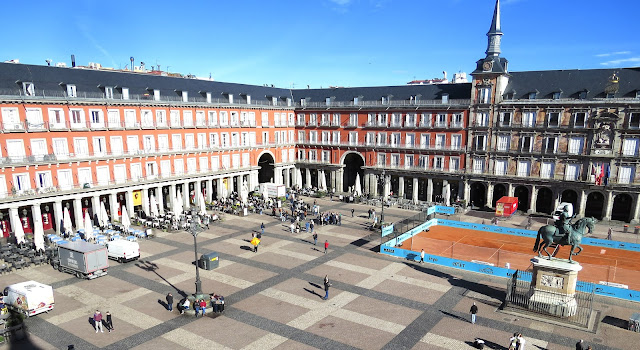 |
The Plaza Mayor in Madrid, as seen from our room at Pestana Plaza Mayor. The clay tennis
court was there when we arrived, open to the public to use for one euro an hour. It was gone
when we revisited the plaza on the last day of our six weeks in Spain,
|
 |
Paella originated in Valencia. Here the iconic
dish is prepared at La Pepica, a beachfront restaurant. |
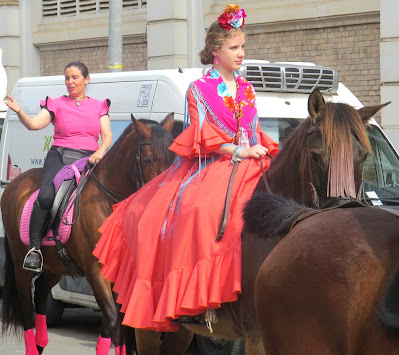 |
On the Saturday that we were in Murcia, costumed
riders and their horses paraded near the central
market ahead of a cart carrying a religious
icon pulled by two oxen. Also in Murcia, we saw
hundreds of roller-bladers race down the
Gran Via, and we saw both stages of the city's
"Pianos in the Street" program with pianists ranging
from small children to extremely accomplished adults.
|
 |
The Monday night that we were there, Casa Puga
in Almeria was packed.
|
 |
That dome is the cathedral in Granada, as seen from the rooftop terrace at
our hotel, Palacio Gran Via. Turn around and the view is the Alhambra.
|
 |
Malaga is a city of art museums, including two featuring native son Pablo Ruiz Picasso, as
well as a sprawling offshoot of a Paris museum, the Centre Pompidou Malaga. There's also
CAC, Malaga, the Centro de Arte Contemporaneo de Malaga. Above are some of the
paintings in "Rehearsal for Joy" by the Baltimore-born artist Theresa Chromati, one
of several captivating works we saw at CAC.
|
 |
The mountain town of Ronda is known for its historic bullring, its ancient equestrian
school, and this amazingly deep gorge that bisects the town. Yes, there is a bridge,
the Puento Nuevo (the New Bridge). It was completed in 1793.
|
 |
The view from our window at our hotel
in Cadiz, the Casa Canovas. We were both
ill in Cadiz and hardly saw the city at all. |
 |
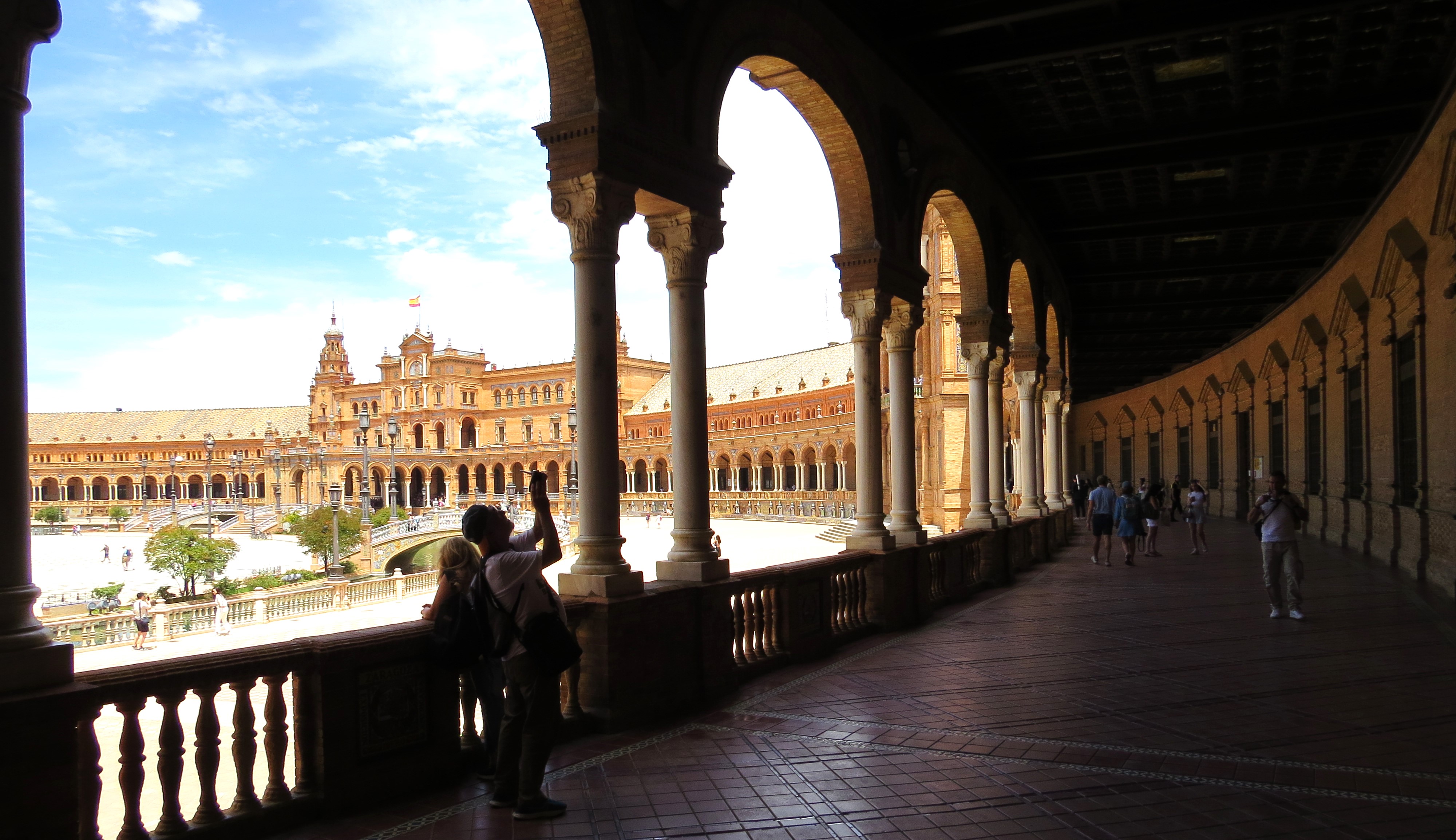
The huge Plaza de Espana in Seville was built in 1928 for the Ibero-American Exposition
of 1929. Government offices fill at least some of the space in the half-circle
building. The plaza in front has sections honoring each of Spain's 50 provinces.
Rowboats can be rented for use on the moat, which is crossed by four
bridges representing four kingdoms of ancient Spain.
|
 |
The Mezquita in Cordorba is a huge mosque
that was converted into a Catholic cathedral,
but the Islamic architecture survived. |
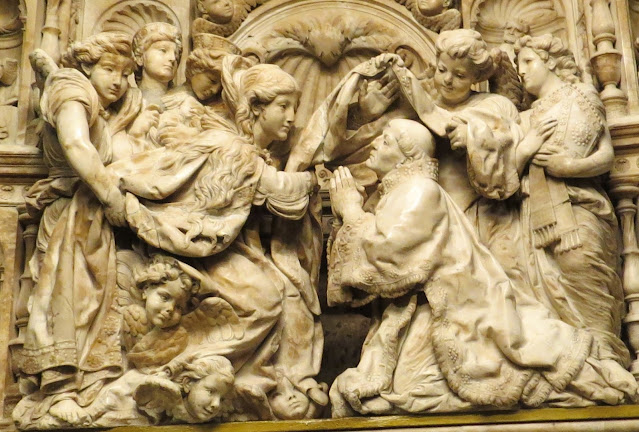 |
This sculpture is part of the Descension Chapel in the cathedral of Toledo. It depicts
the Virgin Mary descending to place a liturgical vestment on a bishop, who is
shown kneeling before her.
|