Tourist First

Travel notes and advice from around the world. Above, the daily flight from Managua at the San Carlos, Nicaragua, airstrip.
Showing posts with label lion. Show all posts

Tuesday, March 8, 2016

Africa: Sabi Sand

Conveniently situated next to the famous Kruger National Park, the private game reserve Sabi Sand is almost as reknowned. It is fenced on the sides that don't border the park, making it seem a bit like a free-range zoo, and it is crowded with safari camps, but it delivers the goods if you want to see the Big Five (lions, leopards, rhinos, cape buffalo and elephants).  The guides (here they're called rangers) stay in radio contact with each other, so if one sees a lion, others will soon know and can bring their passengers.  A rule of no more than three vehicles at a sighting means that you can't sit forever watching a lion -- you get a nice look, but you have to let others have their turn.
    We stayed at Simbambili, a safari lodge with quite large and posh bungalows, complete with decks overlooking an area where the elephants and antelopes play, and plunge pools, which are great during the heat of the afteroon. While we njoyed the other guests who shared our safari vehicle, this isn't the sort of place where everyone gathers in the evening around a firepit, and it's not my idea of a safari camp. The game viewing was excellent, but the over-attentive staff and the hotel-like ambiance weren't what we were looking for. 
     An outline of our six-week African trip (and links to every place we stayed) are in an earlier posting. Keep scrolling and hitting "older post" or click HERE. 

Our deck at Simbambili. We were told not to sleep overnight
on the bed at the other end, but it was good for resting between
game drives.

A hornbill. 

Three hippos share their waterhole with an elephant.


A female kudu.

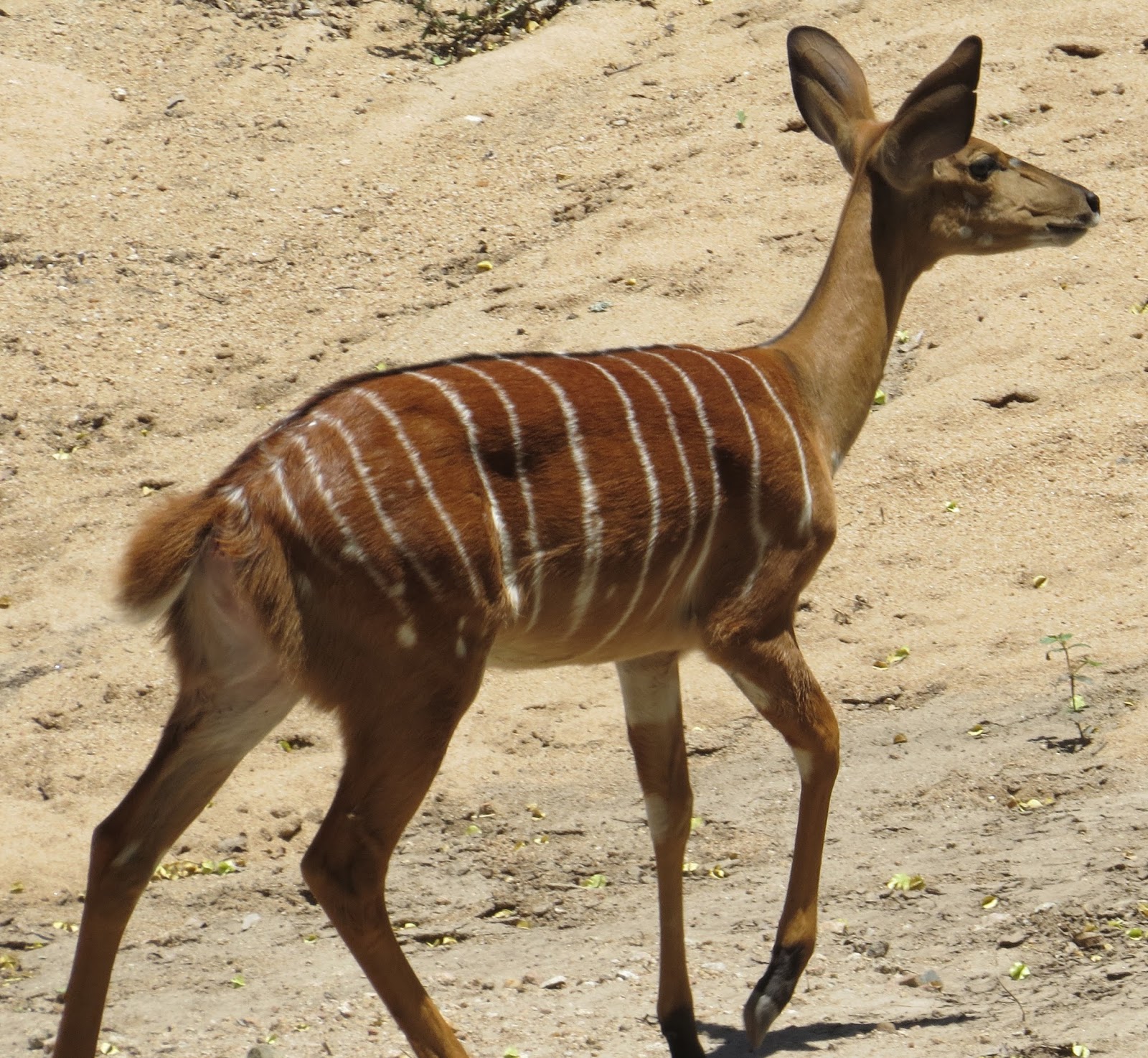
A nyala, one of an almost countless variety
of African antelopes.

I took this photo from our bungalow deck.

This little elephant is probably only few weeks old.

Sabi Sand and Kruger National Park are known
for their leopard populations, and we certainly
saw a number of them.


A cape buffalo.

This spotted hyena has a nasty gash on its neck, but
otherwise it looks healthy.


A white rhino takes on a two-tone look after taking a dip.


This red-billed ox pecker  clings
to a rhino. These birds help control
insects for the big beasts, but they
also keep wounds from healing.

Not sure what this beautiful little bird is.

This is a blue gnu, not the white-bearded wildebeest that we saw in Tanzania.

We saw lilac-breasted rollers at every safari
destination. 

Notice the tongue on this rock monitor lizard. It was running across the trail
and our vehicle would have run over it had our spotter not yelled for the driver to stop.
It quickly climbed into this tree and then remained almost motionless, 

The rock monitor was about a meter long.

A hyena cub steps out of its home, a
tunnel in an old termite mound,

The mother of the previous hyena cub rests with an even younger offspring.

A tree-hugging leopard.

The foreplay.

The act.

The reaction.

Another pair in the same pride. Our guide
said the two males must be brothers
from the same litter. 


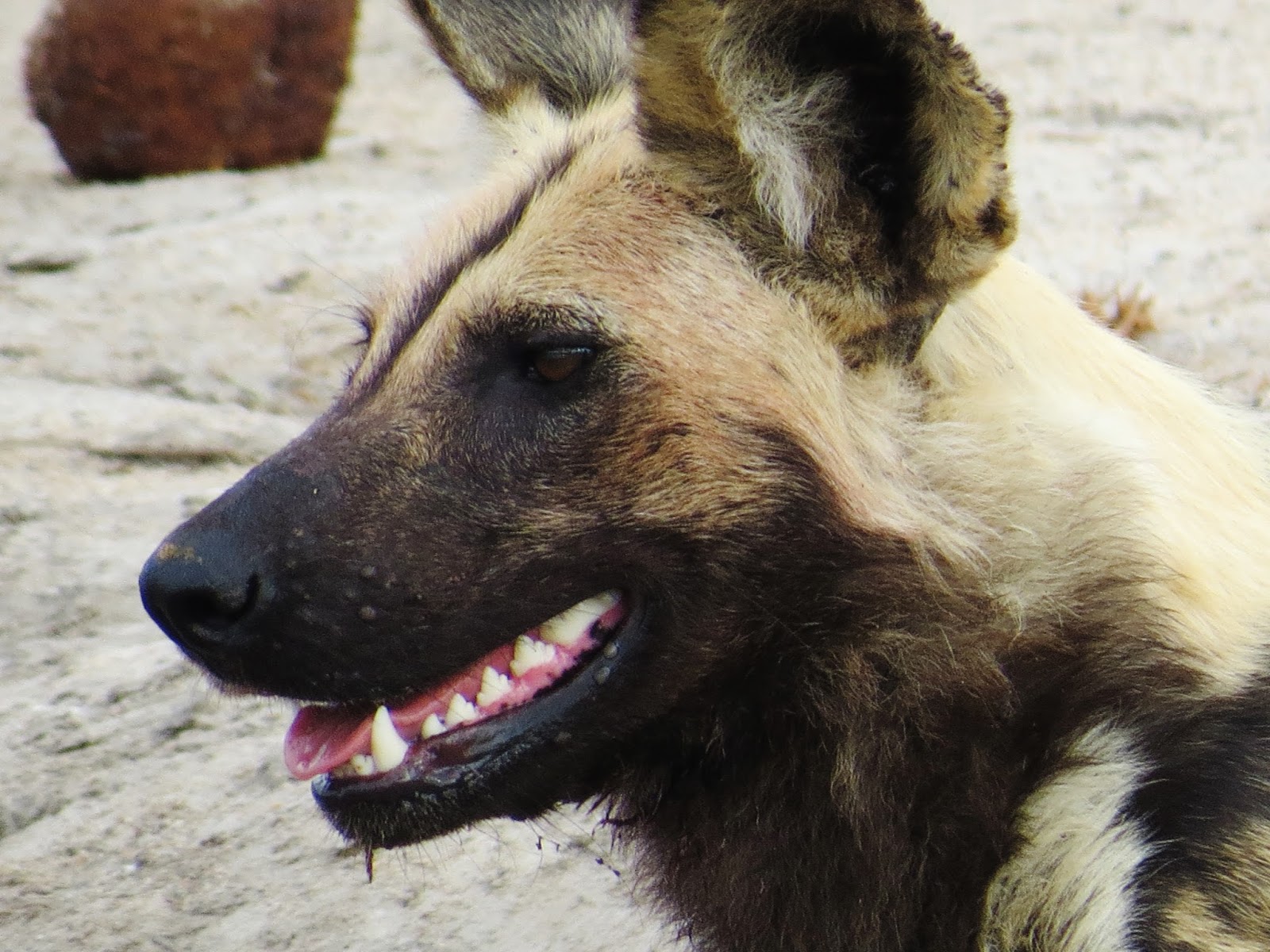
African wild dogs at a waterhole. 

Did you ever see such healthy teeth? They'd help this dog take down a small antelope.

A male nyala. We saw these antelope only at Sabi Sand.

Monday, March 7, 2016

Africa: Safaris in the Serengeti

    One of our best safari experiences came after our Ngorongoro-Ndutu game drives. Our driver-guide took us to the Seronera Airstrip in the middle of Tanzania's Serengeti where we met up with guides from our next destination, Namiri Plains, the only safari camp in the eastern Serengeti. Namiri is operated by Asilia, one of several major safari camp companies (click HERE for its website).
      At this camp we shared a safari vehicle with an Englishwoman whose knowledge of animals, safaris and Africa added a lot to our trip. 
     Our entire January-February 2016 trip to Africa is detailed in an earlier posting (click HERE). 
     Below are some snapshots from our three full days at Namiri Plains.  If you notice any animal misidentified, please email me at stephenmbailey@gmail.com. You can click on any photo to make it larger.


The bare-bones Seronera Airstrip in the central Serengeti.
Single-engine, 12-passenger Cessna Caravans are the work horses of safari air travel.
I believe this is a hawk eagle. 
This rock formation on the plains of the Serengeti is called a kopje. Such stone islands
shelter  a lot of wildlife, from little rodents-like animals to lions and cheetahs. 
A female kori bustard and her chicks
take advantage of the smooth walking
provided by a safari trail.
A male kori bustard puffs up to display his white
feathers, making him more visible to females.
Some of the 200,000 or so zebra who surrounded Namiri Plains during our stay there.
They are the lead animals in the great migration every year. Wildebeests
and Thomson's gazelles would be coming next.
The inside of our tent at Namiri. A full bathroom with indoor
and outdoor showers, hot water, and a flush toilet was attached.
I think this is a tawny eagle. 
Notice the red smear above this cheetah's mouth. It probably had been feeding
recently on something it had killed. Cheetahs eat only their own kills, which they
make thanks to their great speed. A cheetah will easily abandon its kill, we were told,
rather than risk a fight with an aggressive scavenger. It knows that any injury could
hinder its ability to hunt. Lions are among the animals that will bully cheetahs
away from their rightful meals.


A hartebeest, perhaps the most muscular antelope.
We saw many of these chicken-like birds. What were
they called?
Umbrella acacia trees are just about the only tree that can grow in the Serengeti, where
the soil is only inches deep in places. Hard bedrock  is just below the surface.
There are many kinds of vultures ready to feed on the remains
of zebras, wildebeests, antelopes and gazelles. 
The spotted hyena is more of a scavenger than a predator, so these zebra and wildebeests don't
seem to mind the presences of this one.  Plus, several hyena would be required to take down
these much larger animals.
Lionesses take turns feeding on a wildebeest.
Another kind of vulture.
A jackal eating a baby Thomson's gazelle.
A jackal and a marabou stork wait patiently near where a pair of cheetahs are dining on
a kill. Their turns will come when the cheetahs leave. The stork, however, can't eat until
vultures have shown up and shredded some of the meat. It will then steal it from the vultures.
During our safaris we saw a lot of nursing, from warthogs to elephants. This young zebra
is probably four or five months old and walked with mom on the great migration.
Our guide stopped for a coffee and tea break beside this kopje, but
only after driving around it to make sure there were no big cats
hiding out. 
Termite mounds are the furniture of the plains. Here a
cheetah appears as comfortable as if she were on a sofa.
Yes, ostriches are very silly looking. The male is on the left.
Two guinea fowl make their way through tall grass.  
The guinea fowl looks as if it rolled around an an artist's palette.
The main tent's outdoor sitting area at Namiri.
Members of a small breeding herd in the Serengeti. Both smaller elephants are probably offspring
of the large female from different years. 
Another mom nurses her young.
Black cranes took flight just as I was about to photograph
them sitting on the ground. Notice how barren the
Serengeti appears, yet it's full of life.
A heron.
An agama lizard. Less than 10 inches long.
A leopard tortoise. 
You get extremely close to big cats on safari, and as long as you stay seated inside the vehicle,
nothing bad will happen. Or so we were told. We were also told that every animal we saw, except maybe
the lizards and tortoises, could outrun us.  This is a cheetah.
Maybe he's roaring because he's lonely. Guides said that male lions roar to make
contact with their brothers with whom they often share prides. They also roar
to summon their females.
Few things in this world are more magnificent than a healthy mature male lion in profile.
The guides call this one Ziggy.  He has a brother known as Bob Marley because his
black mane resembles dreadlocks.
This lioness and cub are part of the Ziggy-Bob Marley pride.
We were driving pretty fast over a flat and empty plain
when the spotter in our vehicle yelled for the driver to
stop. He had seen this unusual lizard (another agama? I'm not
sure) from several meters away. It's less than 10 inches long, but
impressive nonetheless. It didn't seem to mind my getting on
the ground with it to take this photo. 
This is a lilac-breasted roller; the name comes from a rolling maneuver used to attract or impress
potential mates. It's common at least from Tanzania to Botswana to South Africa. We saw it
everywhere. A very pretty bird.
Bat-eared foxes. They live in interconnected
tunnels. Right after I took this photo, these two
disappeared underground.
An owl. I think this is an
eagle owl.
A wildebeest, also known as a white-bearded gnu, makes the annual great
migration in the Serengeti accompanied by zebra.
Another owl. 
Impala.
The lion known as Ziggy with his ladies.
An African python (I think), another animal found
by our spotter.
The lion known as Bob Marley (note the unkempt mane) with two of his cubs. 
Eland are the largest antelope in Africa, weighing more
than cape buffalo. They are also one of the most difficult
animals to photograph because they run away from
safari vehicles.
A juvenile male lion rests on a kopje, unaware of the natural art installation right behind him,
Elephants cover themselves with dirt to protect
their skin from insects and the sun.
A male lion takes a break from eating a zebra, which was killed the day before.
Umbrella acacia trees at twilight.
After our Serengeti adventures, the pilot of our little plane made a pass over this
active volcano en route from the Seronera Airstrip to the airport at Arusha, Tanzania,
where we had a short layover before a flight to Zanzibar and its warm-water beaches.