Tourist First

Travel notes and advice from around the world. Above, the daily flight from Managua at the San Carlos, Nicaragua, airstrip.
Showing posts with label "Charity Cafe". Show all posts

Saturday, August 4, 2018

Italy: Eating in Rome

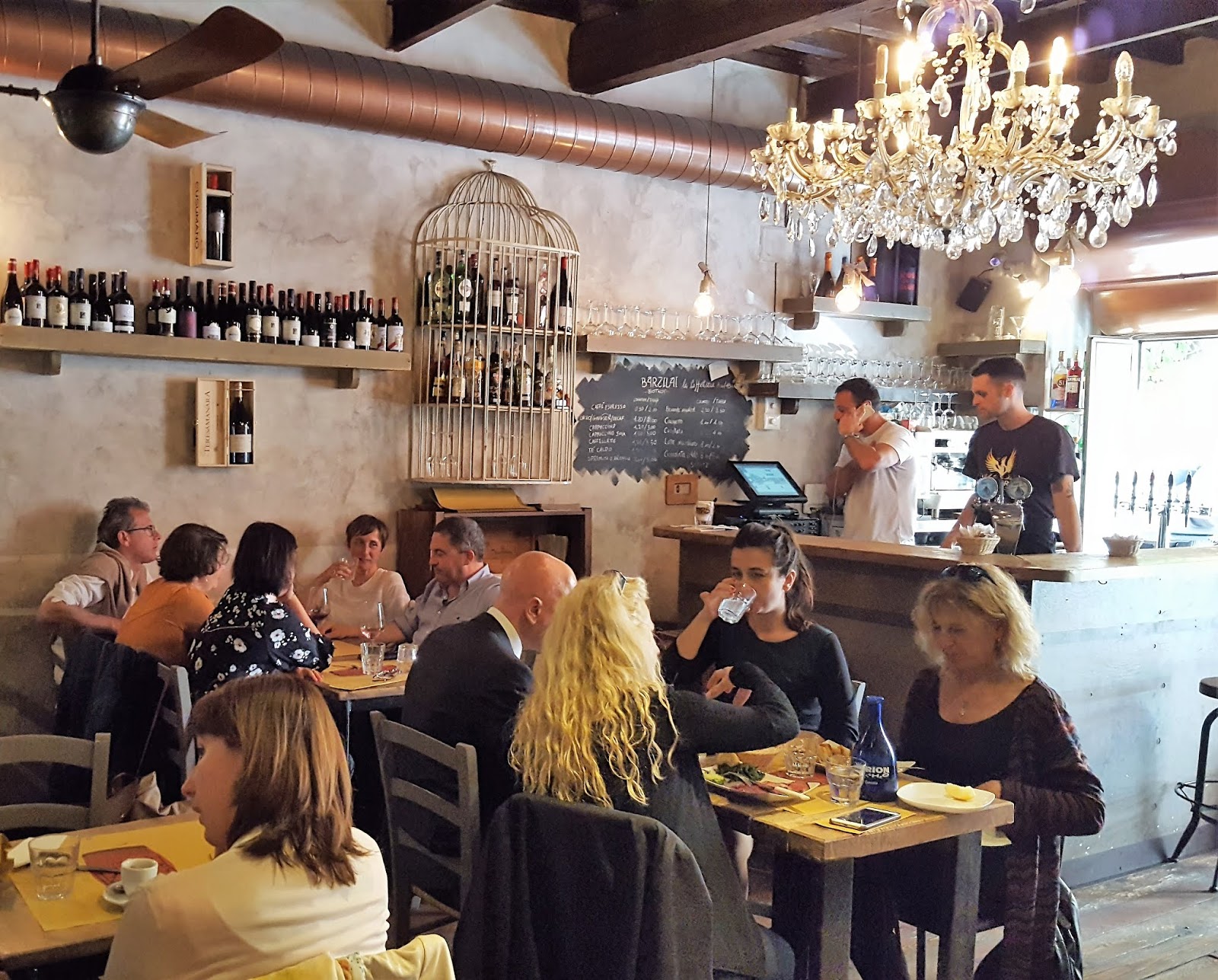
Barzilai on Via Panispurna is, to my mind, an almost ideal Roman bistro.
It offers lunch and dinner specials, has cold beer, a good wine list and
a mostly Italian clientele. The first two times we were there, our original
server had to find someone who spoke English to deal with us. I had
excellent eggplant parmigiana at one lunch and cacio e pepe
one evening for dinner. It's standard Italian fare done well.


Food and wine were, of course, things Jane and I looked forward to as we planned a lengthy trip to Italy.  Italy did not disappoint. When we tired of pizza and pasta, which we did, there was Chinese
or sushi in Rome. Or hamburgers. Or steaks. Or roasted chicken.

Very good wine can be very inexpensive or very costly. We tried to find the former. We discovered an unfamiliar white in Rome that became our go-to white for most of the trip: pecorino, named for the grape in it. It's often from Abruzzo or Marche on Italy's eastern coast. Dry, slightly floral without being fruity. Wine is made from more than 2,000 varieties of grape in Italy, so there's always something new to try. Another good white is grillo, again named for the grape, usually from Sicily. I developed a preference for Sicilian whites and reds. They're almost never fruity and they're usually among the least expensive wines on any list. The ones from Mount Etna vineyards tend to be very minerally, which to me is a good thing.

Although we had an apartment with a full kitchen for six weeks, we didn't eat in except for breakfast -- usually locally baked bread, locally made yogurt and cheeses from our weekend farmers' market. Lunch (pranzo) and dinner (cena) were usually at  restaurants. With more than 40 lunches and 40 dinners, we had the opportunity to return to places that we especially liked.  We ate (or at least drank) at all of the restaurants and bars listed below more than once, and while we can't whole-heartedly recommend each, we can at least say why we went back for another meal.

Most of these offer sidewalk or garden tables, always our first choice.  Although all of these have dining rooms and, I think, all are air-conditioned, between open doors and an Italian reluctance to turn thermostats to temperatures that Americans consider comfortable, we thought we were better off outdoors where there's the chance of a breeze. In April, some evenings could be downright chilly and many sidewalk tables had the familiar propane heaters or offered blankets. By the time we left Rome at the end of May (and when we returned for two nights in mid-July), the city baked during the day and didn't start to cool down until 7 or 8 p.m. Still, even at lunch, a table in the shade of an umbrella was comfortable.

We often relied on Tripadvisor when deciding where to go for dinner (for lunch we just eyeballed menus as we walked around), and found that restaurant ratings are close to meaningless. Jane says the key is to read the most recent reviews. She also discovered that some restaurants offer discounts through Tripadvisor if you make a reservation online, and we took advantage of this when we could. The discounts may be seasonal -- some that had discounts when we were there don't seem to offer them now. Even without a discount, reservations are advisable at most restaurants. Once every table has been booked, restaurants tend to start turning people away even if some diners are near the end of their meals. You'll find that many diners linger at the table long after the last coffee cup or dessert dish has been removed. You get seated at a restaurant and you're welcome to stay at the table all night.

We had many wonderful or at least interesting meals, but details for most are lost in the mists of time. It's hard to remember what was eaten where. We talk about keeping a food diary, but so far neither of us has. We do remember, however, whether we liked or didn't like a place and why. The listings below are merely our impressions.

La Fata Ignorante (click HERE). The names means "The Ignorant Fairy," and I suppose there's a story behind it that I don't know. This is a long walk from central Rome and most diners seem to arrive by car. It's a block south of the Piramide rail station. There are a handful of sidewalk tables, which is where we ate our first time here. Servings are on the small size, but this is Italy and diners are expected to order two or more courses. The second time we were inside. Both times we ordered appetizers and main dishes, skipping the pasta course.  Jane remembers liking a wild boar dish.

Hams ready for the knife at Emma.
Emma Pizzeria with Kitchen (click HERE). This is one of the first places we ate at in Rome, stumbling upon it after buying an Italian smartphone. It's near the Largo Torre Argentina ruins and Campo de'Fiori.  Both times here we were seated in a bright and airy lower-level room. Since this was my first real meal in Rome for this trip, I chose a classic pizza Napoli with anchovies. It was salty beyond the salt the anchovies added, but I came to learn that Italian restaurant food is often over-salted in the kitchen. The specialties here are plates of ham and cheese. The restaurant includes a store selling a range of prepared foods, sauces, cheeses, etc.

Sushi e Noodles Aventino (click HERE). This is on Viale Aventino south of the Colosseum and Circus Maximus area, a long walk from central Rome but not so far from our apartment. The name says it all. I had eel and salmon hand rolls each time I was there. It's on something of a restaurant row with a lot of international choices (French, Brazilian and more), so we felt pretty safe not making reservations. Judging by how many of the other diners seemed to know each other, I'd say this area caters to its locals, not to tourists. We didn't encounter other English speakers here.

Alla Fratte di Trastevere  (click HERE). All visitors to Rome should spend time wandering around and getting lost in Trastevere. There are a number of good places to eat, and this is certainly one of them. I had grilled calamari my first time here (at lunch) and thought it very good until I had the same dish that I liked better elsewhere. We came back for another lunch and I had pasta, which is good everywhere in Rome. Service was fine on the first visit and very slow on the second.

Edoardo (click HERE). This is a quirky place, even overlooking the homoerotic art. Both times we had dinner here, there was a well-worn sign saying that they temporarily could not accept debit or credit cards, so you had to pay in cash. The first time we watched as one table argued with the waiter and insisted on paying by card and it appeared that eventually a card was accepted. During our three months in Italy, we encountered no other restaurant that was cash only, though some museums, galleries and bars accepted only cash. As for the food, this is where I had the best grilled squid and came back for it a second time. It's close to Piazza Campidoglia and Piazza Venezio, hidden in a maze of alleys.

In Roma (click HERE). This was just down the block from our apartment, and we ate here a number of times. It specializes in spaghetti carbonara, the egg-and-bacon-and-cheese dish that every restaurant offers, but here dried pork cheek replaces the bacon. Far too rich to be healthy but very good. My favorite dish was much lighter: spaghetti with smoked swordfish. Never had anything like it anywhere else. The spaghetti with swordfish roe and the pasta Bolognese were also good. Your fellow diners will be a mix of locals and tourists.

A quiet morning at Piazza Pasquino. The umbrella in the distance is Cul de Sac.
Cul de Sac (click HERE). We ate here a couple of time years ago on our first visit to Rome, and we were happy to see it still in business. It's in Piazza Pasquino, just off the southwestern corner of Piazza Navona, and if you can get a sidewalk table, the people watching is great. Better still is its lengthy wine list (with many by the glass) and its staggering list of cured meats and Italian cheeses. Try the beef carpaccio. This is a place where you can go for aperitivos and end up eating so much that you have to skip dinner.

Catinari (click HERE). We found this place by chance when my sister-in-law and niece were visiting. We thought we could waltz into the Jewish Ghetto and find a table anywhere. Well, the one place that could seat us was a place we had tried before and didn't like. Others had waits until, on the western edge of the Ghetto, we came upon Catinari. It shares its sidewalk dining area with a hamburger place and it was unclear at first which of the two we were at. Catinari has most of the standards of southern Italian cuisine, and one dish with a twist: spaghetti with crispy anchovies. My sister-in-law and I were curious and we split an order of it as appetizers. On my second visit here, it was my main dish. The spaghetti with deep-fried anchovies is an intensely flavored dish, satisfying without being too rich. I haven't seen it anywhere else.  Each time we were there, Jane ordered pan-fried fish, which she said was light and perfect.

Max Roma (click HERE). This is one of the places that offered a discount for making a reservation online. Usually, that's a turn off, but it shouldn't be in Italy. Some very good restaurants make the same offer -- discounts of 30 to 50 percent.  Like Sushi e Noodles, this is on Viale Aventino, but closer to the Circus Maximus. It has two or three rows of outdoor tables on decks stepping down  from the sidewalk to the glass-fronted restaurant, which may sound good but actually give it little curb appeal. This is not the place if you're looking for atmosphere, though I found that the company at my own table and the quality of the food made up for its lack of style. We ate here several times and returned again when we had guests. Pasta with red tuna and pistachios, pasta Bolognese and fish were highlights here. The menu lists a fish of the day, but a waiter explained that the fish of the day is always two fish, a tuna steak or a swordfish steak, each coming with the best eggplant ratatouille I have ever had. And the fish were always seared just right and not overcooked. At one meal, our foursome twice had to send back bottles of wine that had gone bad, and the waiter was very gracious about it.

Osteria Circo (click HERE). This uniquely situated restaurant is across the street from the Circus Maximus, where chariots once raced and where scenes for the movie "Ben Hur" were filmed. At least one barrel-vaulted dining room extends into or under the Palatine Hill, where Caesar Augustus held court. Since it was about a five-minute walk from our apartment, we ended up here several times. Oddly, our first meal was our worst, with Jane finding the lamb greasy and me not liking the barbecue sauce on my brisket. But it was so convenient that we gave it another go and never had another disappointing meal. Favorites were hamburgers (the best we had in Italy) and basic pasta dishes. I also remember it as the place that introduced me to Moretti La Rosso beer, a very refreshing and malty amber.

Le Lanterne's outdoor tables turn Via della Pilotte into a one-lane street. On the left
is the edge of the Colonna Garden, connected to the palace by bridges.
Le Lanterne (click HERE). If you visit the Colonna Palace (open only on Saturday mornings), this is the perfect spot for lunch afterward. Via della Pilotte is a quiet street though it's only a few blocks from the Trevi Fountain. Its dining room is in the ground level of the Colonna Palace and bridges that connect the palace with the Colonna Garden are overhead. We had lunch here twice, and both times I had chicken salad ... a large mixed salad with generous amount of warm chicken and a scoop of mayonnaise. Excellent both times.

Barzilai (click HERE). This was another place found by accident. We were wandering around the trendy Monte district with a friend from Colorado and ended up having lunch here. My eggplant parmigiana could not have been better. We came back with our friend's husband for another lunch and, on our return to Rome in mid-July, for dinner. Friendly service, though this place gets few tourists and there might be a wait for them to find an English-speaking server.

Maxella (click HERE). On Via Coppelle a few blocks from the northeast corner of Piazza Navona, this place specializes in aged beef.  Surprisingly for a place that seems quite upmarket, it offered a discount for online reservations.  Some meat dishes are priced by the kilogram, so there's some math involved when you order. Two-hundred grams (about seven ounces) is the minimum order, so figure you'll pay at least a fifth of the per-kilogram price. I've forgotten the cut I had, but do remember thinking it was very good.

Anima Mundi (click HERE). This lounge bar (that seems to be a category of bar-restaurants in Italy) offers flights of Negronis. The classic Negroni is equal parts gin, bitter Campari and red vermouth. One flight here changes the liquor -- one fairly generous drink with the traditional gin, one with mezcal and one with bourbon. The last version is a drink in its own right called the Boulevardier, which I developed a taste for in Rome. The other flight uses three different vermouths. Anima Mundi also has a half-dozen German beers on tap and serves simple food such as grilled chicken with couscous, Caesar salads and hamburgers. Usually OK but once a salad was inedible. The charge was deleted and we got a free dessert. We were there often enough that I was given a "resident" card with a permanent discount on dinners.  The setting is memorable, just off Via d. San Tedoro on Via d. Velabro in a walkout basement, with outdoor tables and lounging furniture overlooking the fourth-century Quadrifronte Arch and the seventh-century Chiesa di San Giorgio al Velabro. Perfect place for raising a glass to the Eternal City.

That's my Boulevardier and Jane's rose wine along with complimentary snacks at
the Otivm Hotel Rooftop Bar. In the distance is the top of the Vitorrio Emanuele II Monument.
Otivm Hotel Rooftop Bar (click HERE; website is for hotel). This is where I had my first Boulevardier (equal parts Maker's Mark, bitter Campari and red vermouth, garnished with orange peel). The hotel had just opened its rooftop bar, under the direction of a Brazilian-Italian named Enrico, when we found it. Its location, on our route walking between central Rome and our rather isolated neighborhood behind the Piazza Campidoglia, made it a great recharging station. The hotel isn't very tall -- six or seven stories -- and the view isn't great. But it is a treat to see a lot of sky, which isn't common in Rome, and there is a unique view of the Piazza Campidoglia and the top of the Vittorio Emanuele II Monument, the big wedding cake of a building that dominates this part of Rome. We think we were Enrico's only customers who weren't hotel guests, and at the time maybe the only customers who came back week after week, sometimes bringing our friends.

Gregory's Jazz Club (click HERE).  This club is off the beaten track a bit, though it's an easy walk from busy Via Tritone and from the top of the Spanish Steps. There's a downstairs bar and some dining tables, and an upstairs listening room with sofas and cabaret seating. The cover charge for upstairs varies by the night and start time and includes your first drink. It's cheaper to go at 7:30 and hear the first two sets, after which you leave, than to go at 9:30 for the final sets with different music. Check out the website to see who's playing and don't skip it if it's "just" a piano player. If it's Leonardo Borghi, you're in for treat. Expect virtuoso riffs, mostly on songs from the great American songbook. Dinner here is a possibility. We ate here the first time at a cabaret table and were not impressed with the typical Roman fare. We were told the menu would be changing to bar food, which may or may not be an improvement. Fortunately there's a good Chinese restaurant around the corner on Via Capo le Case.

Charity Cafe (click HERE). Via Panisperna is a small street with a large number of restaurants (see Barzilai, above) and bars. Although this is a "cafe," I saw no coffee or food served here. It's a tiny space with an eight- or 10-seat bar by the door. Squeeze past it and you'll find three rows of bleacher-style seating at the back facing a stage so small that some musicians end up sitting on wooden blocks intended as tables for the first row of bleachers. There is a one-drink minimum; we were never charged a cover here. Music one night was a three-piece (piano, bass, drums) straight-ahead jazz ensemble. Another night it was two Italians singing blues in English so convincingly that I thought they were Americans until they spoke. The main vocalist stuck with guitar while the other fellow moved from drums to keyboard to trumpet, sometimes playing all three at once. Our last night in Rome we were here for an honest jam session, with audience members and people on stage trading places. The snippet below (this blog platform allows only short videos) was made that night. Music starts around 10, so you can grab an early dinner nearby.


Monday, July 16, 2018

Italy: Three months, Rome to Palermo


A hallway in the Palazzo Doria Pamphilj in Rome. It is still home to family members;  the audio tour
is narrated by a man who grew up in the palace. We wonder if it was his Porsche that was parked in a
ground-floor area of the palace. 
All leisure travel is a splurge, whether it’s a weekend at a country B and B or a grand tour of European capitals. In 2018, Jane and I took our splurging to a new level: three months in Italy. We closed up our apartment in San Diego, turning off the refrigerator and suspending our TV/Internet service to cut costs. Then, early on April 17, we were off.

We started in Rome, renting an apartment through Airbnb for six weeks. During this time we visited every church of any significance except for St. Peter’s Basilica, which we had seen on a previous visit, and we toured palaces and hit many museums, including the Vatican Museums and the Sistine Chapel. We used our two-bedroom apartment (literally steps from the Forum, the Palatine Hill and the Circus Maximus) to host friends from Colorado as well as Jane’s sister from New York and her daughter.

After Rome, we headed south, eventually picking up a rental car that took us as far as Palermo, Sicily. We stopped in several places along the Adriatic Coast and along the instep of Italy’s boot. Here’s an outline of our trip:
Tuesday, April 17: Fly from San Diego to Rome, leaving at 6:25 a.m. and connecting through Dallas/Fort Worth.  Arriving in Rome at 7:15 a.m. on April 18.
Wednesday, April 18: Breakfast in Rome and then meet an Airbnb person at our apartment on Via Dei Fienili.  We are at first disappointed by the condition of the apartment, especially the furnishings, but the Airbnb guy contacts the owner’s representative who makes everything OK – she even got us a new Ikea sofa and end tables.
Tuesday, April 24: Before leaving the U.S., we bought tickets to see an abridged performance of “Rigaletto” at the Stadium of Domitian. 8:30 p.m.  The “stadium” is in the underground ruins of a Roman sports venue; the iconic Piazza Navona was built above it. Four singers and several arias did not tell the opera’s entire story, but it was a pleasant evening in a unique setting.
Saturday, May 12:  Our Colorado friends Mary and Dick arrive late morning bearing tickets for a football (soccer) match the next day.
Sunday, May 13:  We all watched Roma and Juventus of Turin play to a 0-0 tie at Stadio Olimpico. The crowd was as entertaining as the game. The other highlight of their visit was a day in Tivoli and touring the Villa d'Este and Hadrian's Villa.
The most spectacular of many fountains at the 17th-century Villa d'Este in Tivoli.


Sunday, May 20:  Friends leave very early, a few hours before our other guests, Debby and Sharon, arrive. During their stay we toured the Vatican Museums and the Sistine Chapel and had a guided tour of the Borghese Gallery. 
Wednesday, May 30:  We take a train to Naples, where we stay at Hotel Piazza Bellini, Piazza Carita 32. (Click HERE for hotel.) On a previous visit to Italy, we took a train to Naples and immediately picked up a rental car and headed to Pompeii and the Amalfi Coast. This time we wanted to see the city's famous archeological museum and try pizza in the city where it was invented. The museum was great; the pizza wasn't. But we both wished we had another day to explore the city.
The view from our hotel balcony in Capri
included a public beach and the marina
where the ferry from Naples lands.
Thursday, May 31:  Ferry to Capri, leaving from Molo Beverello, the port adjacent to Piazza Municipio.  Three nights on Capri at Capri Inn, Via Marina Grande 222 (click HERE).  At the ferry dock in Capri, we skillfully negotiated a 12-euro fare with the driver of one of  Capri’s unique open-air taxis to take us to our inn. He was all smiles a block later when he dropped us off at the door.  Capri is basically the top of an otherwise undersea mountain.  A funicular railroad or those open-air taxis or tiny, very narrow buses take people up to the town of Capri, which is full of Prada and other super high-end shops, expensive hotels and expensive and not so expensive restaurants. We were eating at one and the owner told us that Adam Sandler had sat at our table recently. We saw no celebrities. From there, you can take the bus or a taxi further up the mountain to Anacapri, a smaller town without Prada shops. It has a chairlift that will take you to the very top of the mountain, from which you can see 360 degrees of sea around the island, the city of Naples in the east and the Sorrento Peninsula to the southeast.  Our inn was the first of several we stayed at in which the inn is merely a floor or even part of a floor in a larger building that may also house another inn, private apartments or businesses. Our room had a balcony looking down at a public beach, the harbor and the open sea.

Sunday, June 3: Ferry to Naples and taxi to airport to pick up our rental car. (We used Hertz because I’d read that, unlike most rental car agencies in Europe, it didn’t tack on added fees. The price you get when you make a reservation is the price you pay when you return the car. That was the case for us, a nice change from recent rental car experiences in Portugal, Mexico and France. )  We drove right away to Pompeii and stayed three nights at La Casa de Plinio, Via Stabiana 3  (click HERE). We spent one day exploring the ruins of ancient Pompeii , one day exploring nearby Herculaneum (the two sites are much more different than one would expect), and every evening finding a new place for dinner amid Pompeii’s new restaurant scene. We were there years ago (1999?) and there was maybe one decent place for dinner. It’s a whole new scene now.
Wednesday, June 6: Drive to Trani, about two and a half hours away on the Adriatic on the other side of the country.  Stay four nights at La Bella Trani, Lungomare Cristoforo Colombo 168 (click HERE). The B&B is on a public beach, making for a lively scene as well as easy access to sand and surprisingly warm water. We were about a half-hour walk from the center of town, where we went for drinks and passegiata-watching and for dinner. We didn’t visit the cathedral or castle in town, but we did drive an hour or so to visit the unique Castel del  Monte, an octagonal medieval  fortress with octagonal towers.
Trulli in Alberobello.
Sunday, June 10: Drive to Alberobello.  Stay four nights at Palazzo Scotto, Corso Trieste e Trento 30 (click HERE). Alberobello is famous for its trulli, dome-shaped houses built originally of dry-stacked flat stones.  We stayed one night here in an over-the-top but small room with a queen-size bed that appeared to float above a glass floor with lighted stones beneath. The next three nights we were in an attached trullo with a good bit more space. The Central Bar in Alberobello is the place for watching the passegiata, the traditional evening stroll before dinner: stylish couples, young people in shredded jeans, elderly women with their mothers on their arms, children kicking footballs (soccer balls) as they walk alongside a parent, lots of handshaking and air-kissing.  Short drives through trulli-studded hills took us to the ancient towns of Ostuni, Ceglie Messapica, Polignano a Mare and Monopoli, the latter two with picturesque ports and beaches.
The beach at Polignano a Mare.

Thursday, June 14: Drive to Lecce and Palazzo Bignami, Via Lombardia 6 (click HERE). Lecce is deservedly celebrated for its Baroque architecture in its historic city center, which is well worth a day.  And from Lecce, we could easily drive to two seaside towns on different coasts, Otranto and Gallipoli, each with fantasy-inspiring castles and their own historic districts of narrow stone-paved lanes.
Sunday, June 17: Drive to Matera. Spend two nights at Il Palazotto Residence and Winery, Via Sette Dolori 39 (click HERE). This is a town where people live in caves, hotels put guests in caves and where restaurants are often in caves. Very unlike the perhaps more famous cave districts in Cappadocia, Turkey, in that it’s pretty much all in one huge, easily carved mountain, and that it seamlessly abuts a modern city with asphalt streets, sidewalks and conventional buildings. We met people who were staying here four and five nights, but we had given ourselves only two.
Tuesday, June 19: Drive about five hours to Maratea.  Stay two nights at Hotel Villa delle Meraviglie, C.da Ogliastro (click HERE). This is a seaside area. Our hotel (the name means House of Wonders) has a nice pool and many, many, many steps down to a very rocky and forbidding shore. There are lidos (beach resorts where you can rent beach lounges, umbrellas and towels and have easy access to a bar and café) nearby with sandy beaches.  

The pool at Blu Infinito. In
the distance is the northeastern
tip of Sicily.
Thursday, June 21: Drive about three hours to Villa San Giovanni. Spend one night at Blu Infinito B&B, Via Petrello 85, Localita Santa Trada (click HERE).  Villa San Giovanni is a gritty little town and there’s little reason to visit except that it’s where we could put the car on a ferry to go to Sicily. Blu Infinito, high on a hill, had views across the Strait of Messina to the northeast tip of Sicily, and a stunning infinity swimming pool that gave the impression one could swim or fly out of it all the way to Sicily. Unfortunately, the water, at about 68 degrees Fahrenheit, was too cold for us.
Friday, June 22:  Take car on a morning ferry from Villa San Giovanni to Messina to be in time to see the Duomo’s bell tower clock strike noon (well worth the search for a parking place).  The tower’s mechanical lion roars, its rooster crows, a “city of God” rises against darkness, and other marvels take place.  Then we drove to Taormina, a resort town not unlike Capri but a tiny bit lower on the economic scale.  We took a scary bus ride up the mountain to the village of Castelmola and we took a cable car down the mountain to the beach. We stayed at Maison d’Art Casa Arico, Via Silipigni 11 (click HERE).
Monday, June 25:  Drive to Catania.  Stay three nights at B&B Sciara Larmisi, Piazza Mario Cutelli 3 (click HERE). Catania has a reputation as a somewhat gritty city. It’s the second-largest in Sicily and has an active port, but it also has beautiful churches, plazas, a long pedestrian-only street, and a large, beautiful and much-used park. We enjoyed Catania very much, and at least partly because it is not filled with tourists. Of all the bars on the mainland and in Sicily where we had aperitivos, Catania was the place where bars gave the most elaborate “no extra charge” snacks: fried rice balls, hams, salami, cheeses, cucumbers, etc.   
Thursday, June 28:  Drive to Siracusa.  Stay three nights at Charme Hotel Henry's House, Via Castello Maniace 68 (click HERE). The historic “center” of Siracusa is Ortygia, an island at the tip of the city. You can walk the perimeter of the island in an hour or so, and on the way look down at public beaches below the seawall. There’s a lively fish and produce market with places to buy plates of ham and cheese and smoked fish. Siracusa is perhaps better known in the U.S. as Syracuse, founded about three thousand years ago by Phoenicians. It later came under the sway of Greek cities, Rome, Arabs and various European kingdoms.  All are reflected in Ortygia’s architectural stew – and at the archaeological park on the mainland, which has a theater built by Greeks (and where Aeschylus himself put on two of his tragedies), an amphitheater built by Romans, the remains of the largest altar to Zeus ever built, and other ruins.  
The 440 B.C.E. Temple of Concordia in the Valley of the
Temples at Agrigento. This is the view from the Hotel Villa
Athena, which has a private entrance to the archeological
park.
Sunday, July 1:  Drive to Agrigento for three nights at Villa Athena, Via Passeggiata Archeologica 33 (click HERE). The attraction here is the Valley of the Temples, a collection of Greek temples dating to 500 B.C.E. or so. One, the Temple of Concordia, is considered the best-preserved Greek temple anywhere, more complete than any on the Acropolis in Athens.  For several centuries, it was used as a Christian church, which meant that it was not used as a source of stone for other buildings. In the 1800s, as Italy was rediscovering its past, the Christian elements were removed, leaving the original temple in amazing condition. Out hotel was about 300 meters from Concordia with a direct view from the swimming pool, bar and restaurant. It is dramatically lighted at night. From our hotel, we could walk to the temples or go the other way to the town’s archaeological museum, which does a fantastic job of explaining the temples, especially the one most in ruins, the Temple of Olympian Zeus, which was unlike any other Greek temple anywhere. It’s a five-minute drive to San Leone, a beachfront town with sandy beaches and inexpensive lidos.
Wednesday, July 4: Drive to Marsala. Stay three nights at Hotel Carmine, Piazza Carmine 16 (click HERE). We've never been fans of Marsala wine; it's too much like Madeira without being as good as Madeira. But we thought that, as in Porto, Portugal, a town known for its fortified wines would also be good for unfortified wines. We found what we were looking for about an hour out of town at Gorghi Tondi, which does not make any fortified wines but does use the popular grillo grape to make an excellent dessert wine using botrytis, the same "noble rot" used in France to make sauternes. Its standard grillo and its several reds are also very good.
View from the roof of Santa Caterina
d'Alessandria in Palermo.
Saturday, July 7:  Drive to Palermo. Stay three nights at Palco Rooms and Suites, Via Camillo Cavour 118 (click HERE). We returned the rental car as soon as we had dropped our luggage at Palco, another B and B on one floor of a large building. Palermo is a crowded, busy and lively city. The drivers are as foolishly aggressive as those in Rome, but from our hotel we could walk to many major attractions, to excellent restaurants, to the harbor and even to a beachfront bar. It was very hot and humid during our stay, but I bet in mid-spring or mid-fall, Palermo would be very pleasant.
Tuesday, July 10:  Fly Palermo to Rome on Alitalia, a one-hour flight. Alitalia is not a pleasant experience, especially boarding; people seated in the rear put their bags in the overhead bins at the front of the plane. Several people seated toward the front who boarded late had to put their bags in bins at the rear, meaning they had to wait for everyone to get off before they could retrieve their bags, and the flight attendants had no problem with this, happily watching people fill the forward bins first. And, although there are “boarding zones” on the boarding passes, they weren’t called. It was a mad rush to board with a mob where there should have been a line.  Once in Rome, we stayed two nights at the Hotel Stendahl on Via Tritone (click HERE), convenient to the Monti, Spanish Steps and Borghese areas.
Thursday, July 12: Fly Rome to San Diego. Leave Fiumcino Rome at 11:40 a.m., transit at Heathrow and arrive in San Diego at 6:45 p.m.

Telephone
At home, Jane and I each use a Samsung smart phone from Verizon. The phones are locked, so we can’t simply insert a foreign SIM card. Our Verizon plan lets us use those phones abroad for 24 hours for $10. Since we would need a phone almost daily, it was cheaper for us to buy an Italian smart phone. We spent 150 euros for a Vodaphone smart phone including three months of service within Italy. We couldn’t use it to call the U.S., but we could use it to make restaurant reservations, etc., and to use GPS when we were driving. We used our U.S. phones for taking pictures, posting on Instagram and Facebook (using wifi, which is available almost everywhere; Palermo seems to have free citywide wifi), and calling the U.S. using Whatsapp.  When we got home, I took the battery out and stored the phone in hope of using it again on our next trip abroad. All I would have to do is get a country-specific SIM card.

Music
I had never thought of Rome as a destination for music, but it is. Many churches, such as the gigantic St. Agnes in Agony in Piazza Navona, and some palaces offer operatic music in the evenings. We heard “favorite arias” well performed at such venues. Usually a tenor, a soprano and maybe a baritone, accompanied only by a piano or perhaps by a string quartet.  Admission was between 10 and 20 euros.

We also found more jazz than in most U.S. cities. We went several times to Charity Café in the Monti neighborhood (click HERE for website) and to Gregory’s near the Spanish Steps (click HERE).  It was either a one-drink minimum or a small cover that included one drink.  The music was first-rate, especially our last night in Rome when there was an open jam at Charity. Heard a Roman singer do a good job with Nina Simone’s “Feeling Good (It’s a New Day),” the song to which I walked my daughter down the aisle at her wedding.

Dancing in the moonlight: Tango enthusiasts meet
at the cathedral plaza in Catania on a Monday evening.

The music was recorded one Monday night at the main piazza in Catania, Sicily, and it was tango music. Couples did their complicated footwork as they clung to each other and swirled in the plaza between the city cathedral and a large fountain. It was an almost surreal scene that we happened onto by chance. Most of the women were dancing in high heels and were not dancing with a “date.” It seems the plaza attracts men and women who like to dance and they partner-up once they’re there and then change partners during the evening.

It was live music one night in Siracusa, Sicily, again in front of a cathedral. The city band (a city band!) performed the overture from “William Tell” and other familiar pieces.  In what I saw as a political comment in a country that had just installed an anti-immigrant government, the band played “We Are the World,” with many people (I guessed an audience to be about 300 locals and tourists) singing along. Toddlers were set free to dance and hop around in an open space at the foot of the cathedral steps.