Tourist First

Travel notes and advice from around the world. Above, the daily flight from Managua at the San Carlos, Nicaragua, airstrip.

Tuesday, February 28, 2012

Nicaragua: Selva Negra Offers a Coffee Plantation Experience (and More)


AT LEFT, a mural at Selva Negra depicts the coffee harvest.

During our three weeks in Nicaragua in January, Jane and I tried to see as much of the country as we could. One place we're particularly happy to have visited is Selva Negra, a coffee plantation a two-hour drive northeast of Managua. It's in a cloud forest in the mountains above Matagalpa, itself a pretty neat destination with a large cathedral, decent shopping and good restaurants and coffee bars.

AT LEFT, a path leads to one of the guest cabins.

Selva Negra (CLICK HERE) is a largely self-contained plantation, producing its own foods, housing its own workers and showcasing an amazing natural environment. Its coffee beans (most of its production is purchased by Whole Foods for sale in the U.S.) grow on bushes spread out as understory plants in the cloud forest.

AT LEFT, a variety of flowering plants occupy the top of the double roof on our one-bedroom cabin.

Selva Negra was founded more than a century ago by German immigrants and is today owned and operated by two of their descendants, Eddy Kuhl and his wife, Mausi Hayn.

AT LEFT, Mausi Hayn explains to us how coffee beans are processed at Selva Negra.

Lodging options range from beds in shared rooms in a hostel to multi-bedroom private chalets. Meals are served in a big dining room overlooking an artificial pond. Selva Negra makes its own cheeses and the large but inexpensive cheese plate may be the best food value in Nicaragua. Most of the food on the fairly extensive menu comes from Selva Negra's farming operations.

AT LEFT, a wild orchid blooms at Selva Negra.

Guests are offered a range of activities: tours of the coffee operation (the coffee estate is often referred to by its original name, La Hammonia), horseback riding, birding walks, hikes and more. We were fortunate in having Mausi Hayn show us around the property herself. There are tree-hung swings scattered around the property, which is a popular weekend getaway for people from Managua and elsewhere in Nicaragua.

AT LEFT, an open-air stone chapel that the Kuhls built in 2000 for the marriage of one of their daughters. Selva Negra now offers it to guests for their weddings.

Selva Negra is a model of environmental sensitivity. It uses human and animal waste to create methane gas, which it uses. Taking advantage of its rainy location high in mountains, it has created its own hydroelectric system to capture the energy of water that flows from the plantation to the valley below. Even paper waste there is recycled -- magazine pages and other pieces of paper are folded into impossibly tight strips that are woven to form purses, tote bags and other products. Plastic water bottles are used as insect traps among the coffee plants.


Sunday, February 19, 2012

Nicaragua: Volcano Vacation


Atop Masaya Volcano, northwest of Granada and southeast of Managua, Nicaragua, the visitor is rewarded by the smell of sulfur. This active volcano, which we visited at sunset with Tierra Tour out of Granada (CLICK HERE), has a huge crater, shown in the top two photos here, that emits noxious gases. Sometimes after sunset red molten lava is said to be visible at the bottom, but it wasn't on the night we were there.
The third photo is from the top of another volcano, Mombacho, which is also an easy half-day visit out of Granada.
Masaya's rocky top and deep crater make it seem bigger than it is. Masaya is a mere 2,083 feet high.
From Mombacho, one can see the city of Granada and a chain of tiny islands in Lake Nicaragua. Mombacho, at 4,409 feet, is visible from the streets of Granada.
Fortunately for the old and the lame, there are roads right up to the tops of these two volcanos. Once you're there, though, there are quite challenging trails that take you to a peak above the Masaya crater and actually into the jungle-filled Mombacho crater.
The bottom photo is of Concepcion, an active volcano on Ometepe Island. Concepcion is 5,282 feet high. The photo is taken from the bar at Totoco Eco-Lodge, which is on the slopes of 4,573-foot (and dormant) Maderas Volcano.
There are no roads to the tops of Ometepe's two volcanos, although there are trails. The trail to the top of Maderas passes through a plantation that grows coffee in the shade of the jungle, and the coffee workers' paths intersect with the path to the top, making it easy to lose one's way. The close-up photo of a howler monkey in an earlier posting was taken on this trail.

Tuesday, February 14, 2012

Nicaragua: Monkey Business

Like lots of other tropical countries, Nicaragua has jungles and monkeys. Three kinds of monkeys, to be exact: white-faced capuchin, Central American spider monkey, and the manteled howler monkey. Unless you spend all your time in the cities, you're likely to encounter monkeys.
We saw spider monkeys only at the park office at the Indio-Maiz Biosphere Reserve where a mother and an infant lived more or less as pets. The only capuchin we saw was on a leash on someone's front porch in the village of Balgue on Isla Ometepe.

Howler monkeys, however, were wild, free and everywhere. We saw them at Sabalos Lodge (bottom photo) on the Rio San Juan. We saw them on the slopes of Volcano Maderas on Ometepe (middle two photos). And we saw them at Morgan's Rock (top photo), a Pacific Coast resort north of San Juan del Sur.

You may not always see howler monkeys, but it's hard not to hear them. They're loud, one of the loudest animals on earth, with an unearthly howl that can be heard for over a mile. On our first night at Sabalos Lodge, in an open-air treehouse cabin, we felt like we were surrounded by creatures from Jurassic Park. They howl but they don't otherwise bother people. They stay high in trees, jumping from one treetop to another often with a baby clinging to an adult's back.

Often all that's visible are dark silhouettes high in the trees, but sometimes they're close enough that you can see the brown fur on their backs.

At Sabalos one afternoon, we were in our cabin when we realized that the monkeys we had seen in a riverfront tree close to the front of our cabin were moving away from the river.

"Ping, thud, plop," we heard as the monkeys passed over our metal roof. Then there was a less than pleasant barnyard odor.

We think we got dumped on by family of monkeys.

Thursday, February 9, 2012

Nicaragua: Toilet Training

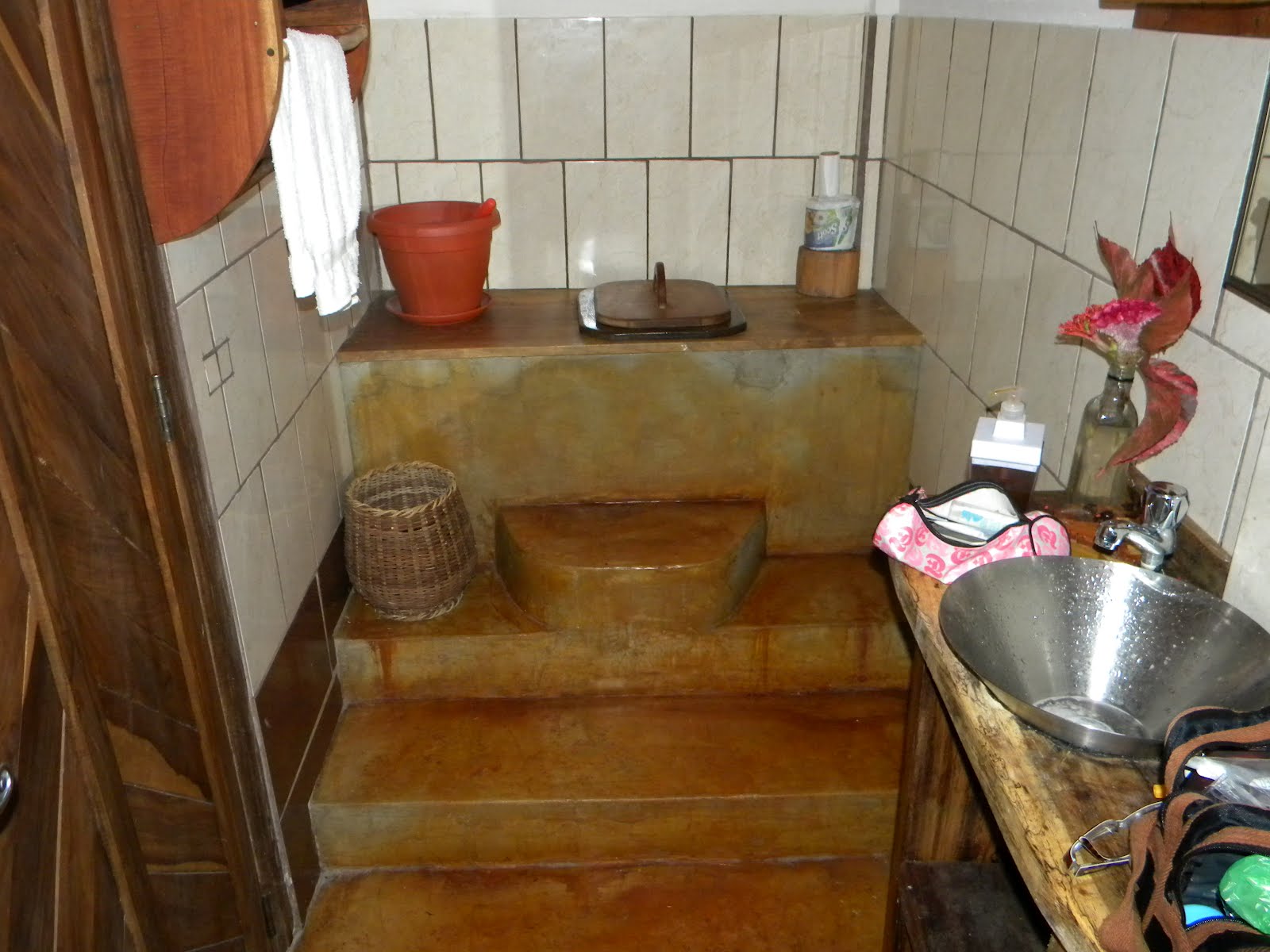
At Totoco Eco Lodge on Isla Ometepe in Nicaragua, the toilets come with instructions:


--Please only urinate into the front separator (smaller hole).

--Toilet paper can be put down the larger hole.

--If used, please always throw 3 scoops of sawdust down the larger hole.

--Please avoid any sawdust getting into the front urine separator.


Top photo: view of the toilet in our cabin at Totoco.

Middle photo: it's not sawdust but coconut fibers that we were tossing into the "large hole."

Bottom photo: I'm sure you wondered what a urine separator looks like. Here it is.


Composting toilets have been around for a while -- you'll find them in rural areas of Europe and North America where there's no sewer service and where for one reason or another a septic system can't be installed. But Totoco's toilets are not composting toilets in the usual sense; the composting is done elsewhere. The solid waste and sawdust go into a big bucket that twice a day is emptied into a compost area somewhere out of sight of guests. It wasn't apparent what happened to the urine that is so carefully kept separate.


There was no odor -- either in our own bathroom or in the toilets shared by the dining room and the hostel. TotocEco Lodge has a handful of cabins like ours and eight or so hostel beds in a large room beside the dining room. If you're going to stay at a hostel, it's hard to imagine one with better views, nicer common areas (there's a pool) or more interesting toilets.

Nicaragua: Isla Ometepe

Isla Ometepe is a large island in Lake Nicaragua, one of the world's largest freshwater lakes. It is shaped like the numeral "8," with a volcano in the middle of each half and a swampy area along the Rio Istian in the middle.
At left are two of the many howler monkeys we saw on Volcano Maderas, the smaller of the two volcanoes. We stayed at Totoco Eco-Lodge (CLICK HERE), which is on the slopes of Maderas.


This shot of Maderas was taken while kayaking on the Rio Istian. (You may have noticed that I'm not bothering with accent marks on these Spanish names. You're right. I'm not.)


This is a tiger heron that was wading along the Rio Istian.


And this is Volcano Concepcion, the other volcano, which is a mile high and very active, as seen from Totoco Eco-Lodge.


Sunday, February 5, 2012

Nicaragua: A Not-So-Nice Capital City


Managua, Nicaragua's capital city, is a dirty and unpleasant place.
It has more or less recovered from the 1972 earthquake that killed 10,000 people and destroyed 50,000 homes.

Eternally vulnerable to another quake (there had also been a major quake in 1931), it's largely a city of one-story buildings, open street drains that the unwary can fall into, horse-drawn carts and
.

overcrowded buses that were probably school buses in the U.S. decades ago.


Knowing all this, we planned to stay in Managua only our first night in Nicaragua, waiting for a flight the next day to San Carlos, and our last night in Nicaragua, since we had an 8 a.m. flight back home.
We did find nice restaurants in the area where we stayed both nights, the Los Robles district, which has a number of hotels, including a multistory Hilton. We stayed first at Los Robles (CLICK HERE) which was in the process of putting in a very nice looking pool area and patio.
Our last night in Nicaragua was at the nearby Casa Naranja (CLICK HERE). Of the two hotels, I would have to recommend Los Robles over Naranja, though both are nice. The common courtyards and pool area at Los Robles are much nicer than those at Naranja, and the rooms are bigger and brighter. But both are well-located, have helpful, English-speaking staff and can help arrange airport transfers.

I didn't carry my camera around in Managua (it's a city with few Kodak moments), but here are two shots from the highest point in the city, the Parque Historica.

At the top is a fellow zip- lining above the Laguna de Tiscapa, the water-filled crater of an extinct volcano. The other is a giant silhouette of Sandino, the ruthless freedom-fighter whose name was appropriated by the Sandinista guerillas.

Not shown but nearby is a monument to the people killed in the 1970s uprising against the Somoza dictatorship. It bears a poem called "Epitaph for Adolph Baez Bone" by Ernesto Cardenal. Here's an English translation by Andrew McKenna:

They killed you and / didn't tell us where / they buried your body.
But ever since that day / the whole country/ has been your grave.
or rather / in every part of the / country that
does not hold your body / you have risen again.
They thought they had / killed you with their order / of fire!
They thought they / were burying you
And what they were doing / was planting a seed.


Nicaragua: Rain Forests to Cloud Forests

Nicaragua is a startlingly diverse country -- tropical rain forests, soaring volcanoes, mountainous cloud forests, big cities and tiny isolated communities. Jane and I got a taste of all these during our January 2012 visit.
I'll be writing more later about each place we visited: Managua, the Rio San Juan, the Solentiname Archipelago, the Selva Negra coffee plantation, the colonial city of Granada, Ometepe Island, and San Juan del Sur.
In the meantime, here are some photos. From the top:
-- Concepcion Volcano on Ometepe Island (seen from the air on a fight over Lake Nicaragua).
-- The small La Costena airplane that took us from Managua over Lake Nicaragua to San Carlos, where Lake Nicaragua drains into the Rio San Juan.
-- The balcony of our treehouse cabin at Sabalos Lodge on the Rio San Juan, a neat eco-lodge with a focus on helping the local community, which is very poor.
-- The Rio San Juan as seen from El Castillo, an old Spanish fort built above rapids on the Rio San Juan. It was meant to help protect Spanish shipments of gold from Granada to the Caribbean, where the treasure was transferred to larger ships to be sent to Spain.


Monday, November 28, 2011

Maryland: Assateague in the Fall


The Saturday after Thanksgiving 2011, Jane and I went with a couple of friends to Chincoteague and Assateague, two Atlantic Ocean barrier islands off the coast of Virginia at the Maryland line. In fact, part of Assateague is in Maryland, though you have to leave Maryland to drive to it.
We went because it was supposed to be the height of the autumn bird migration. Indeed, this time of year is usually so good for birding that the wildlife refuge on Assateague opens a long back road to the public -- the only day of the year it does this -- to accommodate the crowds of people with expensive cameras, tripods, telescopes and binoculars.
But this fall is not like other falls. It's been a lot warmer and the birds are late. So we saw many of the same sorts of birds -- egrets, herons, bald eagles, mallards, black ducks -- that we see at home by the Chesapeake Bay. We did see a few of the wild ponies that have been famous ever since the 1947 publication of the book "Misty of Chincoteague." The lack of fowl did not mean the cameras weren't used. Lots of birds or few birds, Assateague is a beautiful place.

Monday, November 14, 2011

Canada: Toronto Revisited

Photos top to bottom: an art school near the Ontario Gallery of Art; the financial district along King Street; outside the Rex, a jazz and blues bar on Queen Street; the Queen Mother Cafe on Queen Street; a gallery in the Ontario Gallery of Art on Dundas Street.


A November 2011 trip to Toronto was very different from our June 2011 trip. For one thing, we flew this time. Air Canada's Jazz service flies a turbo prop on the 90-minute trip between Baltimore Washington International airport and Toronto's Pearson International. We also stayed in the heart of downtown, not going as far west as some of the restaurants we visited in June, and not using the city's neat streetcars nor its modern subway. We walked everywhere from our fairly conveniently located hotel, One King West.


Downtown Toronto, at least the heart of downtown, can be thought of as three east-west corridors: King Street, a few blocks north of the waterfront; Queen Street, a few blocks north of King; and Dundas Street, the next big east-west street to the north of Queen.


King Street is the financial district. Our hotel was at the corner of King and Yonge, which divides downtown into east and west. To the east on King was the auction house that was the purpose of our visit, an auction of Inuit art at which we were fortunate to win some interesting inventory for our Inuit art business, BaileyMajorArt.com. Head west on King, cross the major artery Spadina, and you come to Crush, an excellent if rather pricy wine bar.


Queen Street has loads of Indian Restaurants, though no one would confuse it with Brick Lane in London or East 6th Street in Manhattan. It also has the Rex, a jazz and blues bar with a handful of hotel rooms upstairs. Another favorite on West Queen Street is the Queen Mother Cafe, which can have long lines at breakfast but is also a great choice for lunch. The Bloody Caesar is a generous take on the Bloody Mary with clam juice.


Dundas has a string of small Chinese restaurants and the Art Gallery of Ontario, a major museum. It's basement has a glass wall allowing visitors to see its shelves and shelves of stored Inuit carvings. We caught an exhibition on Marc Chagall and the Russian avant garde. It also has a large gift shop that stocks a number of good books on Inuit art, a stylish but friendly bar, and a large restaurant.


Jane and I were lucky in that the weather was perfect for walking during this visit. We also benefited from a very slightly weaker Canadian dollar -- something like 98 U.S. cents would buy a Canadian dollar. Back in June, it went the other way.


Though we had no amazing restaurant experiences and our hotel was decidedly unremarkable, we still had a great time. This may have been a business trip, but there was a lot of pleasure.

Friday, October 21, 2011

Nevada: Nights in Vegas, Days in the Mountains and Desert


You've probably heard that Nevada has been hit harder than most states in the current economic downturn. It's not just the housing market -- it's everything.

And just as bad news for a foreclosed homeowner can be good news for a home buyer, the slowing of Las Vegas tourism is good news for anyone who goes there now.

Everything that anyone goes to Vegas for is still there -- the casinos, the shows, the spectacle and the amazing desert wilderness outside town.

It's not hard to find hotels deals. In addition to the usual suspects like hotels.com, take a look at SmarterVegas.com, which offers all sorts of tips for holiday and other trips to Vegas. For example, there are some holidays that don't attract many visitors at all --Thanksgiving, for one -- and that's when you can get the best deals.

If you go to Vegas, don't spend all your time in a windowless casino. Did you know there's skiing nearby? Check out SkiLasVegas.com. And there are a number of companies that offer ATV excursions and other activities in the desert. If you're interested in hiking, you probably can't do better than Red Rock Canyon National Conservation Area.

What happens in Vegas may stay in Vegas, but get out of town a little and have an experience worth talking about.

Sunday, October 16, 2011

Ole Miss: It's Complicated


There's an interesting article in the Travel section of the New York Times for Sunday, Oct. 16, 2011. The article, by Dwight Garner, is nominally about a football weekend at Ole Miss, but it's really a portrait of the campus and the town of Oxford, Miss. I have long thought that the more one knows firsthand about a subject, the more inaccuracies one will see in any newspaper article on that subject. That's not the case here.

Of course, the Oxford and the Ole Miss that I knew firsthand no longer exist. I entered Ole Miss as a freshman from Jackson, Miss. (hey, Dwight, try to wring a travel article out of Jackson), in 1969 at the height of the Archie Manning era and left with a B.A. in journalism in 1972. My last semester, fall of 1972, I worked at the local paper, the Oxford Eagle.


I've been back to Oxford three times since. Once in the mid-90s with a former roommate and his wife; once with my kids around 2002 or so, and once in 2008 with my wife, Jane. The last time was to do an article about Oxford as a weekend-home destination for the New York Times. If you click on that link, please be assured that I also wince at the headline, which should say the streets are lined with magnolias, not paved.


Like Dwight Garner's article, mine begins with the importance of Faulkner to the town's current cachet. And bookstore owner and then-Mayor Richard Howorth. My article suggests Oxford as a weekend destination for people who already have a reason to want to go there: kids in school, old-school ties, affinity for Southern culture, etc.


His article touches on something I hear a bit about (thanks to a couple of nephews who went to Ole Miss, not to mention their mother and two uncles): that Ole Miss no longer cares about football. The party is more important. When I was a student, everyone seemed to take the football very seriously, the parties in the Grove were relatively modest (no chandeliers, no fine china that I recall), and after a loss, there would be a lot of profoundly sad people. I found out just how seriously people took football when I wrote an editorial in the student newspaper calling for the end of varsity sports there -- I was upset that athletes had air-conditioned dorms and I didn't. I was the object of some abuse for a while, but it wasn't as if I had suggested banning Bourbon-soaked picnics in the Grove.


Today's focus on parties? Just shows that, even in Mississippi, progress is possible.

Friday, September 23, 2011

The Best Ways to Fly

It's a commonplace observance these days that flying isn't much fun. It isn't what it used to be. Part of that is due to the security practices put in place since 9/11. Most of it is due to cost-cutting by the airlines. And why are they cutting costs? Because most of us shop for flights solely on price, and to get that low price we're willing to put up with cramped seating, carrying on our bags and other inconveniences.
If you're like me, virtually all of your flights are on American carriers. I remember a few years ago that a friend who had just flown on Virgin Atlantic for the first time said that it was "like flying used to be."
Recently, its U.S. sibling, Virgin America, came in at No. 5 on Travel & Leisure's listing of "the World's Best Airlines." One other U.S. carrier cracked the top 20, JetBlue at No. 17. Most of the "best" airlines are Asian, none of which I've flown. Two of my favorite foreign carriers, Air France and Lan, did not crack the top 20.
A lot of people seem to like Southwest -- and I count myself in their number, mainly because it offers a direct flight between Baltimore, the closest airport to where I live, and Jackson, Miss., my hometown. I particularly like that it allows you to check two bags at no additional charge.
I also am learning to like its boarding procedure: passengers line up in the order in which they printed out or received their boarding passes and then can sit wherever they choose. What I don't like is the personality overload that afflicts some flight attendants. I want my drink and my bag of pita chips with no jokes or stories. The safety talk before the flight should not resemble open-mic night at a comedy club.
But, you know what they say: flying isn't what it was.

Thursday, August 25, 2011

Virginia is for ... what, exactly?

I'm not a huge fan of Virginia. Sure, it has some pretty scenery. That's a vineyard at Barboursville, right, about two hours from Washington, D.C. And there are loads of charming small towns, good restaurants and beautiful drives. Both Washington's Mount Vernon and Jefferson's Monticello are in Virginia.
What I don't like about Virginia is its political climate. It's one of the states that is suing to prevent implementation of the Affordable Care Act, better known as Obama's health reform bill. The current governor and attorney general have also done everything they can to knock down anti-discrimination policies that benefited gay people. Overall, it's a state that in some ways seems determined to return to the 1950s if not the 1930s.
That said, not everyone there is politically regressive. The state went for Obama in 2008 and given rising voter remorse about electing so many Republicans in 2010, there's a chance it will stay blue in 2012. I don't think visiting Virginia is on a level with taking a golf vacation to Haiti during the Duvalier regimes.
If you're a lover, Virginia may well be for you after all. Here are a couple of the state tourism board's web sites. CLICK HERE for wine travel; CLICK HERE for autumn travel ideas.

Tuesday, July 19, 2011

Turkey: Seth Kugel's Istanbul

Seth Kugel is blogging his way through foreign countries as the New York Times Frugal Traveler. Click HERE for his July 17, 2011, article about a $100 weekend in Istanbul.
This was possible because he couch-surfed, which means he stayed for free with someone he contacted through www.couchsurfing.org. This may seem sketchy, but loads of people, most of them younger than Seth, do this. My daughter, who lives in Wisconsin, has played host to couch surfers and has couch-surfed herself, staying a night or two this summer with a young woman in France.
Spending a weekend and only $100 in Istanbul meant that Seth's visit to the Grand Bazaar, shown here, ended with no shopping bags and no rugs for the trip home.
My wife and I really enjoyed Istanbul on a trip to Turkey last year. Earlier posts on this blog discuss Istanbul, the baths there, and other aspects of a vacation in Turkey -- but not on Seth Kugel's meager budget.
Seth doesn't mention visiting the great archaeological museum in Istanbul, which was a highlight of our visit. Its collection of artifacts far outshines anything you'll see in New York or London.

Sunday, June 26, 2011

Canada: Montréal on the Run


Perhaps if we had been there longer than two nights, I would have fallen for Montréal the way most people seem to.
My Francophile daughter liked the city so much that she almost ended up going to college there.
As it was, my first-ever visit there, in June 2011, was sort of a disappointment.
My wife, Jane, did find us a cool hotel, the Gault (click HERE for its English-language web site), which is in the old quarter of the city and just a couple of blocks from the lively waterfront (where the red high heels were walking). Our very sleek room was "open format," which meant that everything but the toilet was out in the open, though there was a floor-to-ceiling curtain that could be drawn to separate the sleeping/living area from the bathing/dressing area. Although the area rug in our room needed a good cleaning, I'd recommend the hotel for its location and its friendly staff and would stay there again. But I'd ask for a room on a higher floor. Ours was on the first floor (which, in U.S. terms, would be the second floor) and had no view.
For one lunch, we took a city bus many, many blocks north of the waterfront to the Plateau-Mont-Royal neighborhood and Om, a Tibetan-Indian restaurant (4382 St. Laurent; 514-287-3553). It was friendly, inexpensive and served good food. The shrimp, veggie and cheese momos (steamed dumplings) and the steamed bread were particularly good. I also enjoyed sha ka tsa, a beef dish. Jane had a soup with noodles and chicken.
We had two dinners in Montreal, one at a "new Canadian" place in a basement and one at a large Chinatown eatery. L'Orignal (click HERE for web site) was busy midweek and was quite expensive with entrees as much as $40. And although the restaurant's name means moose, the menu was no more adventurous than lamb sliders as an appetizer. L'Orignal has the advantage of being just a few steps from the Gault, but I'd not go back.
The Chinese place was several blocks north of the waterfront. The walk may have taken 20 minutes. It was La Maison Kam Fung (click HERE for web site) and it's upstairs in a Chinatown shopping complex. The sprawling dining room has large windows and loads of fast-moving servers. We had steamed dumplings, crispy spinach, Peking duck and a beef dish. Way too much food, as the waiter who took our order told us. But the total bill was less than an entree at L'Orignal. For the most part, the food was what you'd expect at any big Chinatown restaurant anywhere. That means it was a bit greasy, perhaps, but also very good.
Had we stayed in Montréal a third night, we could have gone to the opening of a new Cirque du Soleil production at the troupe's home base. If we're ever back, we'll try to time it to see Cirque du Soleil. We were told that elsewhere in Quebec Province we might run into language problems, but in Montréal virtually everyone spoke English. Only at the Tibetan restaurant did anyone even ask if we spoke French.
Maybe that accounts for my lack of enchantment with the city -- it did not seem as foreign as I had expected.

Tuesday, June 21, 2011

Canada: Toronto, That Toddling Town


What do you think of when you hear someone mention Toronto? I know it's a large city, that it's used in movies as a stand-in for New York, and that it's not Montreal, the other big city and the one where people speak French.
My wife and I spent three days there in June 2011 on business. It was my first visit to Toronto -- we were there in connection with our new Inuit art gallery -- and I had almost no preconceptions.
I was pleasantly surprised to find that is has many interesting neighborhoods, intriguing restaurants, good public transportation, etc. It's also the main marketplace for Inuit art, so there are important Inuit collections in museums and many, many galleries to visit.
We stayed at the Radisson Harbourfront hotel on Queens Quay West. Unfortunately, we booked too late to get a room with a harbor view -- our window looked down on the street with its convenient streetcars and north to the nearby Rogers Centre, where the Red Sox were playing a weekend series with the Blue Jays (and that's why the hotel was full).
There's little to recommend this hotel and many petty things to complain about -- such as the low water pressure in the old-style not-terribly-clean tub/shower with a shower curtain that did not contain the water. It's within walking distance, though, of many downtown attractions, and the streetcar system can take you where your legs won't. We parked in the adjacent garage and didn't use our car at all while we were there.
Two of the restaurants we visited are worth mentioning: Foxley (416-534-8520, 207 Ossington Avenue) and Black Hoof (416-551-8854, 928 Dundas Street West). Neither takes reservations and both are small and crowded. Each offers offer an unusual small-plates menu. I bet that at either you'll have the chance to try something you've never tasted before.
At Foxley, we had wild Nunavut arctic char ceviche (the fish was not chopped as it would be in a South American ceviche), lamb and duck prosciutto dumplings, grilled spiced venison wrapped Vietnamese-style in la lot (wild betel) leaf and tea-smoked sturgeon with sauteed fiddle head ferns (which my wife, Jane, especially liked). The venison and the sturgeon were the standouts, but all was very good. With wine, this was a $140 meal for two.
The next night, a Sunday, we tried Black Hoof, which is in roughly the same shabby-chic-trendy-moving-up neighborhood and was recommended by the bartender at Foxley. The charcuterie is made in house; our plate included thin slices of smoked or dried duck breast, an excellent salami, a good sopressa and very thinly sliced horse salami. Yes, horse, and it was very good. Other dishes we tried included miniature pork tacos (very good), crispy sweetbreads with asparagus (excellent) and sauteed pork belly (who knew pork belly could be so good?). The service bordered on excessive: new dishes and flatware with each dish and a parade of people to keep the wine and water glasses full. With wine, this was a $160 meal for two. And it could be paid for only in cash or with a Canadian debit card.
Now when someone mentions Toronto, I'll think of it as the Carnivore Capital.

Monday, June 20, 2011

Falling for Niagara

The photo at right shows one of the Maid of the Mist boats nudging close to the Horseshoe Falls (also called the Canadian Falls) at Niagara Falls. The photo was taken from the Rainbow Bridge, which connects Niagara Falls, ON, and Niagara Falls, NY.
My wife and I visited the falls in June 2011 and took this boat ride, which is something everyone should do. Our trip was guided by Barbara Ireland's "36 Hours in Niagara Falls" article in the May 29, 2011, New York Times. Click HERE to see the article.
There are several things first-time visitors should know about Niagara Falls.
(1) The best views are from the Canadian side, where many hotels offer rooms with views of one or both falls (the two are Horseshoe Falls and the American Falls).
(2) Neither the American side nor the Canadian side is a particularly nice town, but the American side has a small state park with up-close views of both falls. The Canadian side has the bigger hotels, a big area with amusement park attractions, and a long waterfront promenade that takes pedestrians close to the precipice of Horseshoe Falls.
(3) A few minutes' drive on the Ontario side will take you to a relatively charming town called Niagara-on-the-Lake and to Ontario's wine country. Dozens of mostly small wineries produce excellent ice wines using vidal, riesling, sémillon and gewürztraminer grapes. Many of the wineries have excellent restaurants with more interesting menus than you'll find in either of the Niagara Falls towns. Much of the wine that these small operations produce is not sold outside Ontario -- indeed, the wine bar mentioned below did not offer any ice wine at all -- and many sell their wines only at the wineries. So taste and buy as much as you can!
We stayed in Niagara Falls, NY, at the newish Giocomo hotel, which takes up a half-dozen floors in one of the tallest buildings in town, a 1920s office tower, which means that when you're walking around, it's easy to find your way back to the hotel. Click HERE for the hotel's web site. We were there for two nights mid-week and, after complaining about the view, were upgraded from a room that looked directly into another room at another hotel to a room from which we could see the mist rising above the falls. The hotel with its over-the-top flocked wall coverings has a delightful Dom Deluise ambiance; clearly, someone had a lot of fun designing it. We walked to everything on both the American and Canadian sides.
Our only notable meal at the falls was a small-plates dinner at Wine on Third, a wine bar and tapas place in Niagara Falls, NY, a few minutes' walk from the Giacomo. Click HERE for its web site. We really liked the heirloom tomato salad, the chorizo and manchego empanadas, and the artichoke and prosciutto crostini.
For us, two nights was enough, but we didn't visit the amusement park area, we didn't go to the casinos, and we visited only a few wineries. More determined tourists could probably keep themselves occupied for another day.

Friday, June 3, 2011

A Few Travel Snapshots


Before your next trip, you can search the Internet for images of any location. By the time you go to that obscure Italian village, you can have a pretty good idea of what it looks like.  And, oddly enough, the photos that you take there are likely to be much like the ones you saw online.

Scientists at Cornell University analyzed data from 35 million Flickr photos and made some surprising discoveries: Not only did the world's most photographed cities (and the most captured landmark in each) emerge, but also so did the most common angles for shooting each place. The study, released in 2009,  suggests that through their cameras, tourists "vote" for favorite places, things, and the best representation of them—and, by and large, they agree. Everyone takes photos of the Eiffel Tower, the Leaning Tower of Pisa, and palm trees at sunset. 

Here are some of my favorite photos from trips taken before I started this blog. If you've been to the same places, the odds are your photos are very similar to mine. 


The lighthouse at Isle Au Haut, Maine. Acadia National Park
 shares this beautiful island with a small lobstering and fishing
 community (along with a number of vacation homes).


Is anyplace else on earth as wonderful at sunset as
the Southern Caribbean? This is a cove on the
 west side of St. Vincent.

Bartolomé Island is a volcanic islet in the Galápagos.
Pinnacle Rock is one of the most-photographed
 features of the island chain.

Cameras are a must for hikers atop Perito
Moreno Glacier in southern Argentina.

This is what you see from the London Eye, the gigantic
 Ferris wheel that's England's newest landmark. The building
 below houses an aquarium; the water is the River Thames.


Monday, March 14, 2011

Another writer on Tilghman

Frank Starr, a friend of mine and a weekender on Tilghman Island, where I live fulltime, has started a blog. Frank is a former Moscow correspondent for the Chicago Tribune and a former foreign editor of the Baltimore Sun (back when the Sun rivaled the New York Times and the Washington Post in its international coverage). You can read about geese in winter, geese in summer and about Frank's dog, Sam, by clicking here.