|
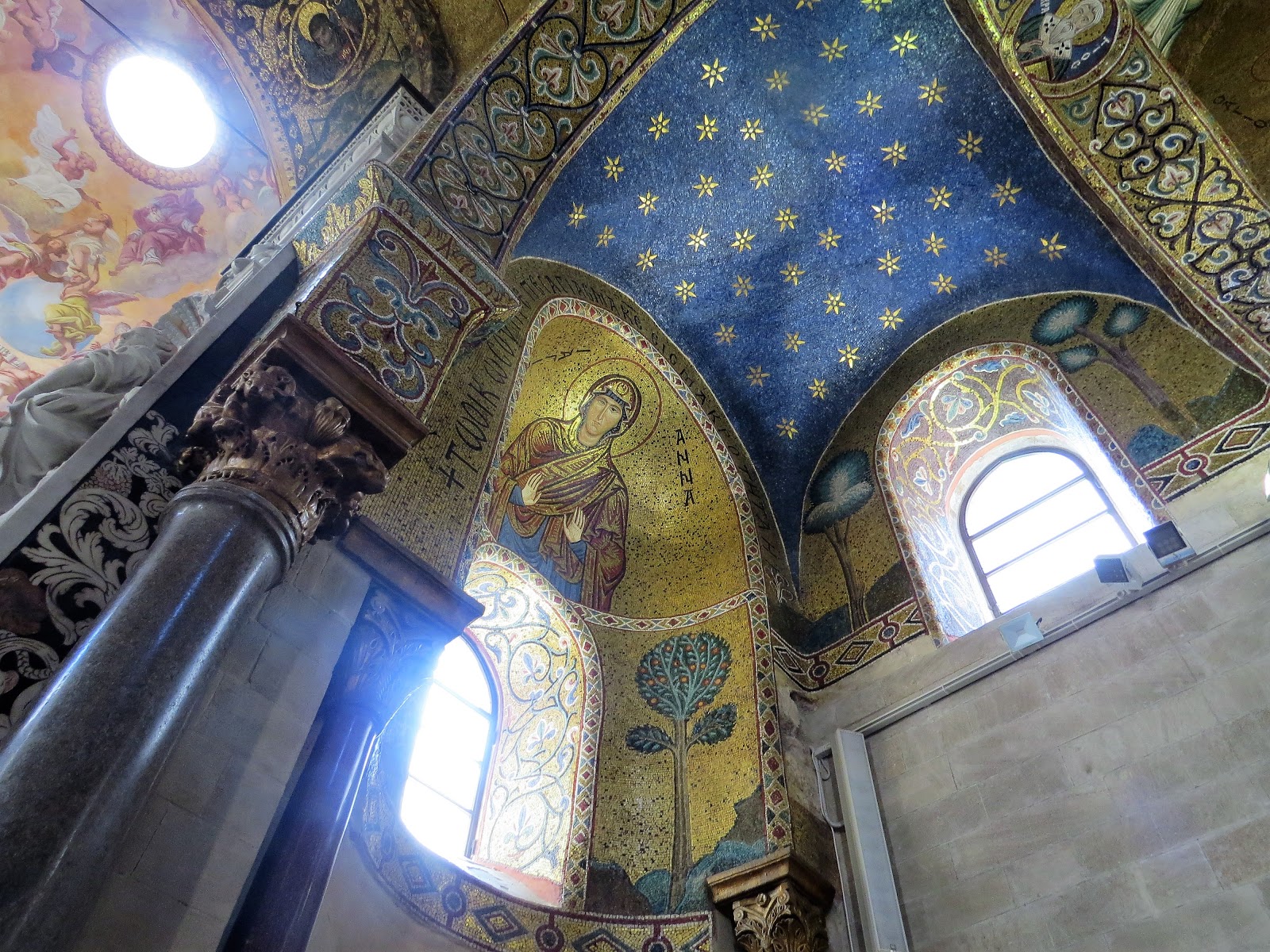
Amazing mosaics adorn the Palatine Chapel in the Royal Palace of Paleremo (also known
as the Palace of the Normans). The palace began as a 9th-century Arab fortress and was converted
into a royal residence in the 11th century after Normans conquered the island. It was the site
of the court of the cultured but brutal Frederick II, king of Sicily (and later Holy Roman
Emperor, among other titles) who reigned here for more than 50 years, ending with his
death in 1250. Architecturally it is a blend of Islamic and Romanesque styles. The Palatine
Chapel is the crown jewel of the Medieval period in the Mediterranean.
It exists today virtually unchanged over the centuries. |
Palermo was our last stop after three months in Italy. From there we returned to Rome for two nights and then flew home. After a relatively short and pleasant drive from Marsala, we arrived in Palermo, dropped our luggage at our hotel, Palco Rooms & Suites across the street from the Teatro Massima, returned our rental car to Hertz and set out to explore the city on foot.
Buildings in the central (and historic) district reflect the city's unusual history, ruled by Rome, Byzantines, Arabs, French Normans and more. Churches incorporate Arab and even Islamic motifs, sometimes behind a Spanish Baroque facade. The center city is a swirl of singular buildings and amazing art.
Our room at Palco looked out on the Teatro Massima, one of Europe's largest opera houses. The late 19th-century theater was the setting for the final scenes in "The Godfather Part III" when murder was accompanied by an opera performance on stage. The building is open for tours, which we took, and we got to see the hallway where the murder took place, the royal box where actors sat, as well as the backstage area. The impression is that you're in a giant jewelry or music box.
The Palco's location, at the intersection of the uninteresting Via Cavour and the must-walk Via Maqueda, is close to ideal. North on Maqueda is the "new" city with expensive shops, lovely apartment or condo buildings and few tourists. Via Principe di Belmonte, a pedestrian area of bars and restaurants just off Maqueda, is great for people watching during passeggiata. Go south on Maqueda for ancient and unique churches and the intersection with Corso Vittorio Emanuele, another must-walk street and one that takes you to a small-craft harbor and a tiny beach.
For us, three nights in Palermo at the end of a long trip through southern Italy was enough, but some people make it their only stop in Sicily. We met two young men who were staying in Palermo and had gotten up at 4 in the morning to make it to Catania in time for a Mount Etna tour. They returned to Palermo after the tour. Palermo, as intriguing as it is, is a very busy and not always pleasant city, but it's a must on any tour of Sicily. I'd say the same about every other city or town we visited on this island. Each had its own unique attractions and its own appeal.
 |
A narrow street off Via Maqueda south of Via
Cavour is lined with sidewalk restaurants,
most with people stationed outside trying
to catch the interest of passers-by. |
 |
| Looking south on Via Maqueda. It looks like the street dead-ends at a mountain. |
 |
There are four of these Spanish-Baroque facades,
one at each corner of the intersection of Via Maqueda
and Corso Vittorio Emanuele, more or less the
heart of Palermo's historic district. |
 |
Dining al fresco on a small piazza off Vittorio
Emanuele. The piazza had several vendors
offering fried and grilled seafood. |
 |
The same small piazza was also prepared
to provide your dessert. Nutella, anyone? |
 |
| A bistro window on Via Maqueda. |
 |
The Palermo Cathedral is impressively large, but its interior is not particularly interesting. It dates
to the late 12th century, but the history of the site goes back to a 4th-century basilica, then a
6th-century basilica, which was converted into a mosque, then converted back to Christian use
in 1072, then rebuilt and modified over the centuries. It contains the tombs of kings and
emperors. |
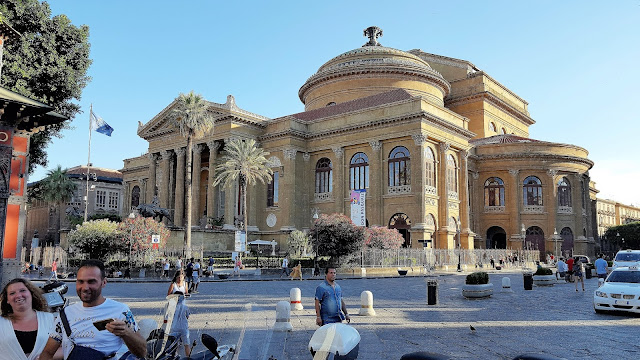 |
At the intersection of Via Maqueda and Via Cavour, the Teatro Massimo has become a tourist
attraction due to its appearance in "The Godfather Part III," in which the camera lovingly
shows the elaborate interior. |
 |
| The theater's steps figure in the movie's final scene. |
 |
| The royal box, where we were told Al Pacino sat in the movie. |
 |
The small panels in the ceiling slide open to
allow natural ventilation to cool the theater. |
 |
These two churches are at Piazza Vincenzo Bellini, just off Via Maqueda. The Church of
Santa Maria Dell'Ammiraglio (left) is also known as Martorana. The little one on the right
with the three red domes, is the Church of San Cataldo. Each is considered an important
example of the blending of Arab and French Norman styles. This photo was taken
from the roof of the Church of Santa Caterina d'Alessandria. |
 |
Looking up into the domes of San Cataldo, which was built around 1160. It reflects the reign
of Roger II (1095-1154), king of Sicily, who embraced diversity and encouraged Muslim
artisans to remain in Sicily and included Englishmen and Greeks in his government,
which consolidated all of the previous Norman conquests on the Italian mainland
as well as on Sicily. He was considered one of the greatest kings of Europe at the time. |
 |
Catalda is a surprisingly small and rather simple on the inside,
despite the complicated stonework. Today it is not used as
a church and is owned by the Equestrian Order of the Knights
of the Saint Sepulchre of Jerusalem. |
 |
The Martorana's elaborate mosaics rival those of the Palatine Chapel. They were
completed between 1143 and 1148. |
 |
Stars adorn the ceiling. Martorana still has its original
wooden door with Islamic carvings. Unfortunately, the
glass that protects it made it impossible to photograph. |
 |
Across the Piazza Vincenze Bellini from Martorana and Cataldo is the Church of Santa
Caterina d'Alessandria (Saint Catherine of Alexandria). It is larger than either
of the other two and once had its own convent. The convent preceded the church, founded in
the 1300s and built where Roger II's greatest admiral had lived. The church,
in full Sicilian Baroque extravagance, came in the late 16th century. |
 |
Jonah is about to be swallowed by the whale
in one of several plaques telling Bible
stories at Santa Caterina. |
 |
Nuns from the convent observed services from the choir loft high at the rear
of the church. The grating, including that above where they sat, was
apparently intended to prevent nuns from hurling themselves to
the church floor far below. A docent told us that suicide was not
uncommon among the cloistered nuns, some of whom had been
pressured to become nuns by their families. |
 |
| The ceiling of Santa Caterina goes Baroque in a big way. |
 |
Santa Caterina sits between the Piazza Bellini and the Piazza Pretoria,
both of which can be seen from its roof. This fountain is the
centerpiece of Piazza Pretoria. The street on the other side
of the fountain is Via Maqueda. On the other side of Maqueda
is yet another massive church, one that we did not visit. |
 |
| This courtyard is the heart of Palermo's Royal Palace. |
 |
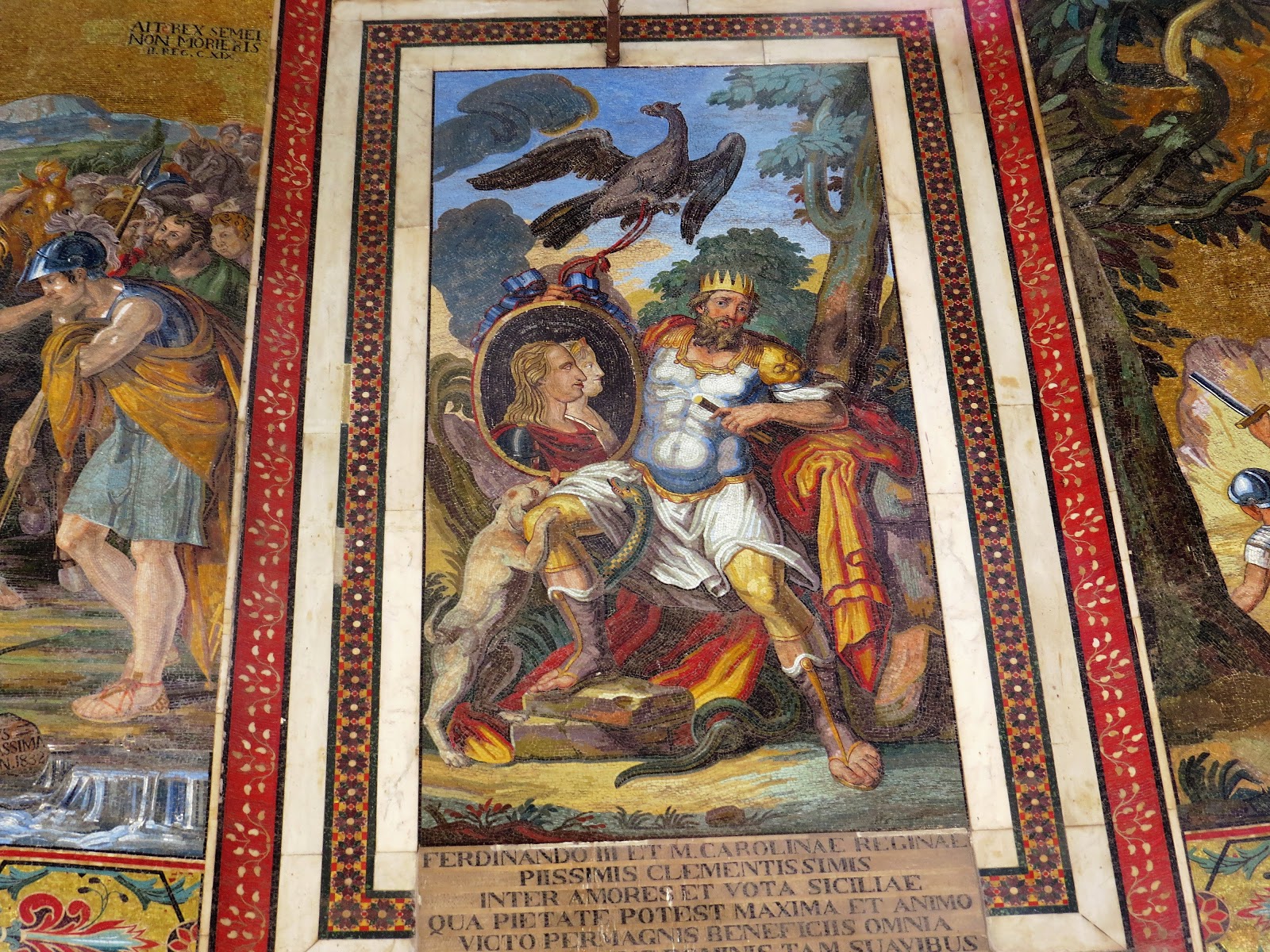
Mosaics in the corridors around the courtyard
depict scenes from Sicilian history. |
 |
| Another courtyard mosaic. |
 |
Biblical scenes are depicted in the mosaics
of the palace's famous Palataine Chapel. |
 |
| Eve is created from one of Adam's ribs in this Palatine Chapel mosaic. |
 |
What is known as Roger's Room or the Room of the Winds is covered with mosaics
that represent King Roger II's scientific and intellectual curiosity. |
 |
| One gets the impression that mosaic artists had little contact with real lions. |
 |
Palermo's Royal Palace, in addition to being the home of the regional
legislature (which meets in a large room with depictions of the labors
of Hercules), Roger's Room and the Palatine Chapel, also has exhibition
space. We were there during a showing of Medieval and Renaissance
Sicilian art. This work particularly caught my eye: "Pieta e Simboli della
Passione" by Ignoto Pittore Fiammingo. It was painted in the late
15th century, but the disconnected and floating icons
reminded me of a 20th-century artist: Salvadore Dali. |