Tourist First

Travel notes and advice from around the world. Above, the daily flight from Managua at the San Carlos, Nicaragua, airstrip.

Saturday, August 4, 2018

Italy: Eating in Rome

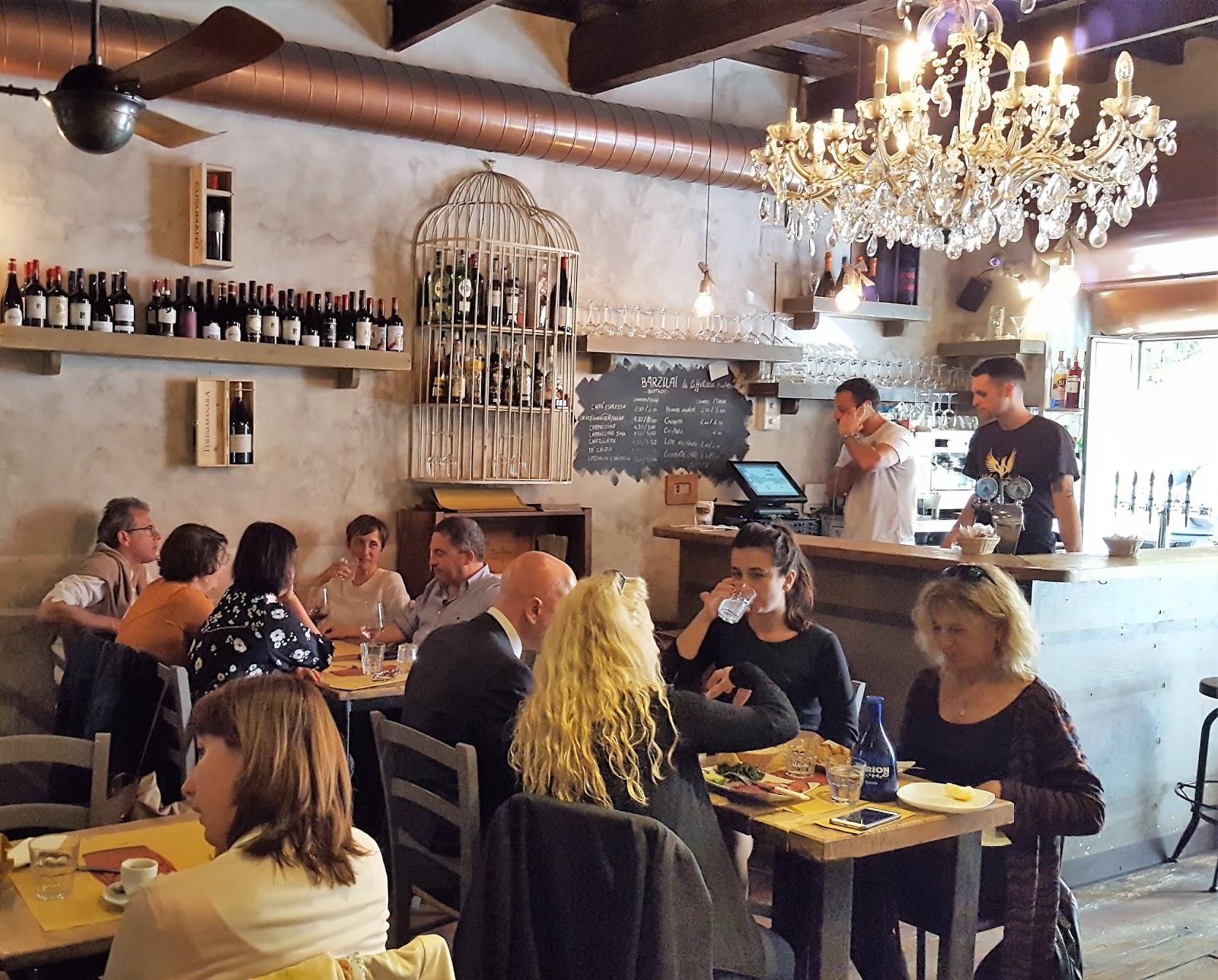
Barzilai on Via Panispurna is, to my mind, an almost ideal Roman bistro.
It offers lunch and dinner specials, has cold beer, a good wine list and
a mostly Italian clientele. The first two times we were there, our original
server had to find someone who spoke English to deal with us. I had
excellent eggplant parmigiana at one lunch and cacio e pepe
one evening for dinner. It's standard Italian fare done well.


Food and wine were, of course, things Jane and I looked forward to as we planned a lengthy trip to Italy.  Italy did not disappoint. When we tired of pizza and pasta, which we did, there was Chinese
or sushi in Rome. Or hamburgers. Or steaks. Or roasted chicken.

Very good wine can be very inexpensive or very costly. We tried to find the former. We discovered an unfamiliar white in Rome that became our go-to white for most of the trip: pecorino, named for the grape in it. It's often from Abruzzo or Marche on Italy's eastern coast. Dry, slightly floral without being fruity. Wine is made from more than 2,000 varieties of grape in Italy, so there's always something new to try. Another good white is grillo, again named for the grape, usually from Sicily. I developed a preference for Sicilian whites and reds. They're almost never fruity and they're usually among the least expensive wines on any list. The ones from Mount Etna vineyards tend to be very minerally, which to me is a good thing.

Although we had an apartment with a full kitchen for six weeks, we didn't eat in except for breakfast -- usually locally baked bread, locally made yogurt and cheeses from our weekend farmers' market. Lunch (pranzo) and dinner (cena) were usually at  restaurants. With more than 40 lunches and 40 dinners, we had the opportunity to return to places that we especially liked.  We ate (or at least drank) at all of the restaurants and bars listed below more than once, and while we can't whole-heartedly recommend each, we can at least say why we went back for another meal.

Most of these offer sidewalk or garden tables, always our first choice.  Although all of these have dining rooms and, I think, all are air-conditioned, between open doors and an Italian reluctance to turn thermostats to temperatures that Americans consider comfortable, we thought we were better off outdoors where there's the chance of a breeze. In April, some evenings could be downright chilly and many sidewalk tables had the familiar propane heaters or offered blankets. By the time we left Rome at the end of May (and when we returned for two nights in mid-July), the city baked during the day and didn't start to cool down until 7 or 8 p.m. Still, even at lunch, a table in the shade of an umbrella was comfortable.

We often relied on Tripadvisor when deciding where to go for dinner (for lunch we just eyeballed menus as we walked around), and found that restaurant ratings are close to meaningless. Jane says the key is to read the most recent reviews. She also discovered that some restaurants offer discounts through Tripadvisor if you make a reservation online, and we took advantage of this when we could. The discounts may be seasonal -- some that had discounts when we were there don't seem to offer them now. Even without a discount, reservations are advisable at most restaurants. Once every table has been booked, restaurants tend to start turning people away even if some diners are near the end of their meals. You'll find that many diners linger at the table long after the last coffee cup or dessert dish has been removed. You get seated at a restaurant and you're welcome to stay at the table all night.

We had many wonderful or at least interesting meals, but details for most are lost in the mists of time. It's hard to remember what was eaten where. We talk about keeping a food diary, but so far neither of us has. We do remember, however, whether we liked or didn't like a place and why. The listings below are merely our impressions.

La Fata Ignorante (click HERE). The names means "The Ignorant Fairy," and I suppose there's a story behind it that I don't know. This is a long walk from central Rome and most diners seem to arrive by car. It's a block south of the Piramide rail station. There are a handful of sidewalk tables, which is where we ate our first time here. Servings are on the small size, but this is Italy and diners are expected to order two or more courses. The second time we were inside. Both times we ordered appetizers and main dishes, skipping the pasta course.  Jane remembers liking a wild boar dish.

Hams ready for the knife at Emma.
Emma Pizzeria with Kitchen (click HERE). This is one of the first places we ate at in Rome, stumbling upon it after buying an Italian smartphone. It's near the Largo Torre Argentina ruins and Campo de'Fiori.  Both times here we were seated in a bright and airy lower-level room. Since this was my first real meal in Rome for this trip, I chose a classic pizza Napoli with anchovies. It was salty beyond the salt the anchovies added, but I came to learn that Italian restaurant food is often over-salted in the kitchen. The specialties here are plates of ham and cheese. The restaurant includes a store selling a range of prepared foods, sauces, cheeses, etc.

Sushi e Noodles Aventino (click HERE). This is on Viale Aventino south of the Colosseum and Circus Maximus area, a long walk from central Rome but not so far from our apartment. The name says it all. I had eel and salmon hand rolls each time I was there. It's on something of a restaurant row with a lot of international choices (French, Brazilian and more), so we felt pretty safe not making reservations. Judging by how many of the other diners seemed to know each other, I'd say this area caters to its locals, not to tourists. We didn't encounter other English speakers here.

Alla Fratte di Trastevere  (click HERE). All visitors to Rome should spend time wandering around and getting lost in Trastevere. There are a number of good places to eat, and this is certainly one of them. I had grilled calamari my first time here (at lunch) and thought it very good until I had the same dish that I liked better elsewhere. We came back for another lunch and I had pasta, which is good everywhere in Rome. Service was fine on the first visit and very slow on the second.

Edoardo (click HERE). This is a quirky place, even overlooking the homoerotic art. Both times we had dinner here, there was a well-worn sign saying that they temporarily could not accept debit or credit cards, so you had to pay in cash. The first time we watched as one table argued with the waiter and insisted on paying by card and it appeared that eventually a card was accepted. During our three months in Italy, we encountered no other restaurant that was cash only, though some museums, galleries and bars accepted only cash. As for the food, this is where I had the best grilled squid and came back for it a second time. It's close to Piazza Campidoglia and Piazza Venezio, hidden in a maze of alleys.

In Roma (click HERE). This was just down the block from our apartment, and we ate here a number of times. It specializes in spaghetti carbonara, the egg-and-bacon-and-cheese dish that every restaurant offers, but here dried pork cheek replaces the bacon. Far too rich to be healthy but very good. My favorite dish was much lighter: spaghetti with smoked swordfish. Never had anything like it anywhere else. The spaghetti with swordfish roe and the pasta Bolognese were also good. Your fellow diners will be a mix of locals and tourists.

A quiet morning at Piazza Pasquino. The umbrella in the distance is Cul de Sac.
Cul de Sac (click HERE). We ate here a couple of time years ago on our first visit to Rome, and we were happy to see it still in business. It's in Piazza Pasquino, just off the southwestern corner of Piazza Navona, and if you can get a sidewalk table, the people watching is great. Better still is its lengthy wine list (with many by the glass) and its staggering list of cured meats and Italian cheeses. Try the beef carpaccio. This is a place where you can go for aperitivos and end up eating so much that you have to skip dinner.

Catinari (click HERE). We found this place by chance when my sister-in-law and niece were visiting. We thought we could waltz into the Jewish Ghetto and find a table anywhere. Well, the one place that could seat us was a place we had tried before and didn't like. Others had waits until, on the western edge of the Ghetto, we came upon Catinari. It shares its sidewalk dining area with a hamburger place and it was unclear at first which of the two we were at. Catinari has most of the standards of southern Italian cuisine, and one dish with a twist: spaghetti with crispy anchovies. My sister-in-law and I were curious and we split an order of it as appetizers. On my second visit here, it was my main dish. The spaghetti with deep-fried anchovies is an intensely flavored dish, satisfying without being too rich. I haven't seen it anywhere else.  Each time we were there, Jane ordered pan-fried fish, which she said was light and perfect.

Max Roma (click HERE). This is one of the places that offered a discount for making a reservation online. Usually, that's a turn off, but it shouldn't be in Italy. Some very good restaurants make the same offer -- discounts of 30 to 50 percent.  Like Sushi e Noodles, this is on Viale Aventino, but closer to the Circus Maximus. It has two or three rows of outdoor tables on decks stepping down  from the sidewalk to the glass-fronted restaurant, which may sound good but actually give it little curb appeal. This is not the place if you're looking for atmosphere, though I found that the company at my own table and the quality of the food made up for its lack of style. We ate here several times and returned again when we had guests. Pasta with red tuna and pistachios, pasta Bolognese and fish were highlights here. The menu lists a fish of the day, but a waiter explained that the fish of the day is always two fish, a tuna steak or a swordfish steak, each coming with the best eggplant ratatouille I have ever had. And the fish were always seared just right and not overcooked. At one meal, our foursome twice had to send back bottles of wine that had gone bad, and the waiter was very gracious about it.

Osteria Circo (click HERE). This uniquely situated restaurant is across the street from the Circus Maximus, where chariots once raced and where scenes for the movie "Ben Hur" were filmed. At least one barrel-vaulted dining room extends into or under the Palatine Hill, where Caesar Augustus held court. Since it was about a five-minute walk from our apartment, we ended up here several times. Oddly, our first meal was our worst, with Jane finding the lamb greasy and me not liking the barbecue sauce on my brisket. But it was so convenient that we gave it another go and never had another disappointing meal. Favorites were hamburgers (the best we had in Italy) and basic pasta dishes. I also remember it as the place that introduced me to Moretti La Rosso beer, a very refreshing and malty amber.

Le Lanterne's outdoor tables turn Via della Pilotte into a one-lane street. On the left
is the edge of the Colonna Garden, connected to the palace by bridges.
Le Lanterne (click HERE). If you visit the Colonna Palace (open only on Saturday mornings), this is the perfect spot for lunch afterward. Via della Pilotte is a quiet street though it's only a few blocks from the Trevi Fountain. Its dining room is in the ground level of the Colonna Palace and bridges that connect the palace with the Colonna Garden are overhead. We had lunch here twice, and both times I had chicken salad ... a large mixed salad with generous amount of warm chicken and a scoop of mayonnaise. Excellent both times.

Barzilai (click HERE). This was another place found by accident. We were wandering around the trendy Monte district with a friend from Colorado and ended up having lunch here. My eggplant parmigiana could not have been better. We came back with our friend's husband for another lunch and, on our return to Rome in mid-July, for dinner. Friendly service, though this place gets few tourists and there might be a wait for them to find an English-speaking server.

Maxella (click HERE). On Via Coppelle a few blocks from the northeast corner of Piazza Navona, this place specializes in aged beef.  Surprisingly for a place that seems quite upmarket, it offered a discount for online reservations.  Some meat dishes are priced by the kilogram, so there's some math involved when you order. Two-hundred grams (about seven ounces) is the minimum order, so figure you'll pay at least a fifth of the per-kilogram price. I've forgotten the cut I had, but do remember thinking it was very good.

Anima Mundi (click HERE). This lounge bar (that seems to be a category of bar-restaurants in Italy) offers flights of Negronis. The classic Negroni is equal parts gin, bitter Campari and red vermouth. One flight here changes the liquor -- one fairly generous drink with the traditional gin, one with mezcal and one with bourbon. The last version is a drink in its own right called the Boulevardier, which I developed a taste for in Rome. The other flight uses three different vermouths. Anima Mundi also has a half-dozen German beers on tap and serves simple food such as grilled chicken with couscous, Caesar salads and hamburgers. Usually OK but once a salad was inedible. The charge was deleted and we got a free dessert. We were there often enough that I was given a "resident" card with a permanent discount on dinners.  The setting is memorable, just off Via d. San Tedoro on Via d. Velabro in a walkout basement, with outdoor tables and lounging furniture overlooking the fourth-century Quadrifronte Arch and the seventh-century Chiesa di San Giorgio al Velabro. Perfect place for raising a glass to the Eternal City.

That's my Boulevardier and Jane's rose wine along with complimentary snacks at
the Otivm Hotel Rooftop Bar. In the distance is the top of the Vitorrio Emanuele II Monument.
Otivm Hotel Rooftop Bar (click HERE; website is for hotel). This is where I had my first Boulevardier (equal parts Maker's Mark, bitter Campari and red vermouth, garnished with orange peel). The hotel had just opened its rooftop bar, under the direction of a Brazilian-Italian named Enrico, when we found it. Its location, on our route walking between central Rome and our rather isolated neighborhood behind the Piazza Campidoglia, made it a great recharging station. The hotel isn't very tall -- six or seven stories -- and the view isn't great. But it is a treat to see a lot of sky, which isn't common in Rome, and there is a unique view of the Piazza Campidoglia and the top of the Vittorio Emanuele II Monument, the big wedding cake of a building that dominates this part of Rome. We think we were Enrico's only customers who weren't hotel guests, and at the time maybe the only customers who came back week after week, sometimes bringing our friends.

Gregory's Jazz Club (click HERE).  This club is off the beaten track a bit, though it's an easy walk from busy Via Tritone and from the top of the Spanish Steps. There's a downstairs bar and some dining tables, and an upstairs listening room with sofas and cabaret seating. The cover charge for upstairs varies by the night and start time and includes your first drink. It's cheaper to go at 7:30 and hear the first two sets, after which you leave, than to go at 9:30 for the final sets with different music. Check out the website to see who's playing and don't skip it if it's "just" a piano player. If it's Leonardo Borghi, you're in for treat. Expect virtuoso riffs, mostly on songs from the great American songbook. Dinner here is a possibility. We ate here the first time at a cabaret table and were not impressed with the typical Roman fare. We were told the menu would be changing to bar food, which may or may not be an improvement. Fortunately there's a good Chinese restaurant around the corner on Via Capo le Case.

Charity Cafe (click HERE). Via Panisperna is a small street with a large number of restaurants (see Barzilai, above) and bars. Although this is a "cafe," I saw no coffee or food served here. It's a tiny space with an eight- or 10-seat bar by the door. Squeeze past it and you'll find three rows of bleacher-style seating at the back facing a stage so small that some musicians end up sitting on wooden blocks intended as tables for the first row of bleachers. There is a one-drink minimum; we were never charged a cover here. Music one night was a three-piece (piano, bass, drums) straight-ahead jazz ensemble. Another night it was two Italians singing blues in English so convincingly that I thought they were Americans until they spoke. The main vocalist stuck with guitar while the other fellow moved from drums to keyboard to trumpet, sometimes playing all three at once. Our last night in Rome we were here for an honest jam session, with audience members and people on stage trading places. The snippet below (this blog platform allows only short videos) was made that night. Music starts around 10, so you can grab an early dinner nearby.


Wednesday, August 1, 2018

Italy: Walking in Rome

We walked along Clivo d. Scauro going from the
Colosseum area to San Giovanni in Laterano. The
flying buttresses supported a building associated
with the church of Sts. John and Paul.
Everyone has heard about the crazy traffic in Rome. Whatever you've heard is true, but there is a positive note. Traffic does stop for pedestrians in crosswalks, which means you don't have to be a daredevil to walk in Rome.

During our six-week visit in spring 2018, we walked between six and 10 miles most days, according to my Fit watch. We bought a Vodaphone smart phone, so always could get walking directions and maps, and before we left the U.S. we ordered "Streetwise Rome,"  a hardy plastic-coated folding map from Michelin North America. It was easy to carry and had the name of every street and piazza in central Rome, and an enlarged map for the historic center. Our street, Via dei Fienili, was at the edge of the enlarged section and easy to find on the broader map.

Once in Rome, we promptly visited the Forum, Palatine Hill and the Colosseum, both very near our house. They and other tourist destinations are discussed in other posts.

Once we had ticked off our must-sees, we often simply wandered around, picking a street to follow or an unfamiliar piazza as a destination. We found that Piazza Venezia made a good hub for our explorations. It's at the foot of the Vittorio Emanuele II Monument, the gigantic (and rather pointless) wedding cake building that's visible from many points in Rome. Venezia is the also one of the ends of Via Corso, the busy shopping street that every tourist crosses to go from the Pantheon to the Trevi Fountain. At the northwestern end of Venezia, hang a left onto Plebiscito, which turns into Vittorio Emanuele II and takes you within a couple of blocks of Piazza Navona and to a bridge across the Tiber River to the Vatican neighborhood. From Venezia, head northeast and you can cut across the Forum of Trajan and the Markets of Trajan to reach Via Nazionale, which will take you to Piazza della Repubblica, Termini (the main train station), the Baths of Diocletian and what I think is the city's best museum for antiquities, the Palazzo Massimo.

Using map apps on our iPad and our phone, we discovered that even the somewhat remote Villa Borghese art gallery was less than an hour's walk from our apartment. Some walks were along tree-shaded avenues or the shady banks of the Tiber; many were on streets lined with sidewalk cafes; others were less pleasant. But even in somewhat grubbier districts, we never felt unsafe. We walked home sometimes around midnight and there were always other people around.
This white marble hulk is officially known as the Altare della Patria (and shown on most maps as
 the Vittorio Emanuele II Monument), but Romans and tourists alike call it the wedding cake
building. There's a nice observation area at the top, reached via an external elevator at the 
back of the building. A museum inside focuses on the unification of Italy in the 1800s.
 We skipped the museum, but the observation area is worth a visit.


This photo shows something of the immense scale of the Altare della
Patria, designed in 1885 and completed in 1925. As the "altar of the
fatherland," the building is the site of the tomb of an unknown
Italian soldier from World War I. The building  is dedicated to
Vittoria Emmanuele II, the first king after Italy was
 finally unified in the 19th century. 


..


One afternoon we were headed home, walking along the long northern side of the Circus Maximus
when we encountered several groups of re-enactors. I think these are supposed to be Roman
soldiers, not gladiators, though we did see a mock gladiator fight there, too.

We happened to be in Rome in the spring when the Spanish Steps are lined with azaleas. When
we were back in Rome in July, the steps were bare.

Segway tours, bridal parties posing for photos, and hordes of tourists can all be found at Piazza di
Campidoglia, which was designed by Michelangelo. The building is one of two that frame
the plaza and contain the Capitoline Museum, which holds many relics of ancient Rome.


A coffee/wine bar on the Piazza Navona.

The Ponte Vittorio Emanuelle connects Corso Vittorio Emanuelle II with Via San Pio X and
the Vatican. In the background is Castel Sant'Angelo, built as a tomb for the Emperor Hadrian
and later fortified and used by popes as a place of greater safety during war times or civil
unrest. The 800-meter fortified Passetto di Borgo connects the fortress with the Vatican so that popes
could flee to safety. The popes Alexander VI and Clement VII both used it to escape
capture by foreign armies. On a tour of Sant'Angelo, we got to walk the passage
as well as see the papal apartment hidden deep in the fortress. 

Wisteria has taken over the intersection of Via Panisperna and Via del Boschetto. This is in the
Monte district, home to a lively nightlife scene.

Another view of Piazza del Campidoglio. This building is called
the Senate palace and houses Rome's municipal government.
The other side of the building has commanding views of the Forum.

The Borghese Art Gallery, which contains the very best works by Bernini and Caravaggio along
with major works by others, including Titian, sits in the Borghese family's former park, now
a public park within walking distance of much of central Rome.

On the other side of that low wall are the remains of three temples and the theater where
Julius Caesar was assassinated. This ancient complex, among the oldest ruins in Rome,
is called the Area Sacre, Largo di Torre Argentina. The streets around it contain a large
bookstore, banks, cellphone stores and fast-food restaurants. 

This driver and his Jaguar are waiting for a bridal couple to finish posing for photos
at Piazza del Campidoglio. Go down the sidewalk to the left and you'll find
the Hotel Otivm, home to our favorite rooftop bar.

This is the back way to Piazza del Campidoglia, an uphill path from
Via de Fori Imperiali that snakes behind the wedding cake building
and the Capitoline Museum. 

A family makes its way past the eastern end of the
Circus Maximus. Romans once flooded the Circus Maximus
for mock naval battles. When dry, it was used for chariot
races. Scenes for the movie "Ben Hur" were filmed here.
The high point on the left is the Aventine Hill. The high point
on the right is the Palatine Hill with the ruins of Augustus's villa,
though what's seen in the photo are other ruins.


Not everyone tosses a coin in the Trevi Fountain, but just about everyone takes a photo.

That's the dome of the Pantheon, photographed with a
long lens from Mount Garibald on the other
side of the Tiber. It's 1,900 years old, saved from
ruin by being converted into a Christian church.

Italian police don't really drive Lamborghinis, so I assume
this was some sort of promotion. In the background
is a black Lotus similarly outfitted as a police car.
This was at the Piazza Navona.

Mounted police were also at Navona
the same day as the police cars.


The wedding cake building in a photo taken with a long lens from Mount Garibaldi,
far away on the other side of the Tiber.

The word "Gloria" seems ironic on the front of what looks like an
abandoned church. It's opposite a great little cafe called
Cul de Sac Wine Bar on Piazza Pasquino.


This arch connects the area north of Piazza Navona with Piazza di San Agostino, site
of a church dedicated to Saint Augustine.

These steps lead from the busy Via Cavour to Piazza
di San Pietro in Vincoli, home to the church of the same
name, which means St. Peter in Chains. The church displays
chains that supposedly once shackled St. Peter.

A small street southwest of Piazza Navona, complete with outdoor dining, motorcycles and a hardware store.


You don't see a lot of police on foot in Rome.
These two are on Via S. Ignazio just east
of the Pantheon.


In this view from the top of the wedding cake building, you can see Via Corso
connecting with Piazza Venezio. At the other end of Corso is Piazza del Popolo.
There has been no new construction in the central part of Rome (other than one
small museum) since Mussolini's time. The Eternal City seems to want
to freeze itself in time. But who'd want a glassy high-rise here anyway?


The Jewish Quarter, which consists of just a few blocks, is a dining destination in Rome
for "Jewish-style" fried artichokes. It's just steps from the Tiber and practically
in the shadow of the Capitoline Hill. Its historic synagogue and Jewish Museum
are well worth visiting. Jews have been in Rome for millennia. 

Everything from flip-flops to clothes-drying racks and planters
can be had at this shop on Via d. Coppelle, northeast
of Piazza Navona.


The Arch of Constantine is fenced off, but the Colosseum is open to visitors. The
surrounding streets are usually crowded with tourists and often with "Roman
soldiers" who will pose with you for a photo -- if the price is right.

Saturday, July 28, 2018

Italy: Catholic Rome


This is what you see if you look up in the Sistine Chapel, which is accessed through
the Vatican Museums, not St. Peter's Basilica. The paintings show scenes from
various parts of the Bible but not in a sequence that I understand. I think Michelangelo
intended each section to be viewed and appreciated separately.

This part of the ceiling shows the Garden of Eden and God giving life to Adam,
perhaps the most famous of the many famous elements of this gigantic work.


"Moses" by Michelangelo at San Pietro in
Vincoli. This huge work (see it in full below)
was intended for the tomb of Michelangelo's
great patron, Pope Julius II, but work on the Sistene
Chapel intervened and the tomb was never
completed, though Julius II is interred
in this church. I'm not sure why this
muscular Moses has horns.
As someone who is not religious, I sometimes wonder why I'm drawn to churches when I travel, especially extremely ornate ones such as are found throughout Rome and most of Italy. I'd probably have the same curiosity if intact, still-functioning Greek or Roman temples were around, and in some ways, the Catholic church seems almost a continuation of those "pagan" religions. Just as Hadrian declared his young lover Antinous a god and built temples to him, the Catholic church decides some people are saints and builds churches in their honor. All of the churches we saw were named for saints.

The stories of gods, saints, their deeds, their miracles and their sufferings have been told in paintings and sculpture for thousands of years, and religious buildings are often repositories for wonderful, other-worldly art. In my posts on ancient Rome (click HERE) and on Roman palaces (click HERE), there are many photos of art depicting ancient gods as well as Christian figures, but none of those deal with the amazing art and architecture of Rome's many churches.

During our six weeks in Rome, Jane and I visited many churches and basilicas, most quite grand and some rather modest. We skipped St. Peter's Basilica because the lines were extremely long. Years ago we got in with only a short wait when Benedict XVI was pope, but the crowds drawn to the popular Pope Francis mean that one waits on line hours to get into St. Peter's. (Click HERE for how we spent three months in Italy.) I don't include addresses of the churches here -- they're all easily found on the Internet, on tourist maps and in guidebooks.  I hope this posting will encourage you to visit some of them.

 I did not take any photos in the Catacombs of San Sebastian, a basilica on the Appian Way a short taxi or bus ride from central Rome. The maze-like, multi-level catacombs were used during the centuries of Christian persecution for Christian burials and for worship. There is a small chapel carved from stone deep underground that was used for clandestine worship services. It is marked with an anchor, which was the symbol for Christianity before the cross was adopted. Above the chilly and winding catacombs is a rather conventional church dedicated to Saint Sebastian, who is interred there. I mostly but not always conformed with "no photo" signs; in the catacombs, our guide enforced the no photo rule. Given an opportunity, though, sometimes one just can't help oneself. Most churches allow photos, though not flash photography. All my photos were taken using available light.

Michelangelo's "Moses" at San Pietro in Vincoli, a rather minor basilica in Rome, despite
having a Michelangelo, the tomb of a pope, and the chains that supposedly once
bound St. Peter (below). 

"San Pietro in Vincoli" means "St. Peter in Chains." The
church was originally completed in the year 440 to house
the chains. Additions and renovations were made
through the centuries so one cannot tell what the
original basilica looked like.


San Sebastiano is built above extensive catacombs
that were used by some of the earliest Christians
in Rome. The church, miles from central Rome
on the Appian Way, is also the saint's burial
place and contains what it says are the arrows
that killed him. This was the only church in Rome
that we didn't walk to from our apartment below
the Palatine Hill.
The Archbasilica of St. John in Lateran is the oldest public church in Rome (and thus in the Western
world). It is the cathedral of Rome and the ecclesiastical seat of the pope. Its name comes
from the Lateran Palace, which was given by the emperor Constantine I to the church of Rome
around 313.  It became the seat of Pope Silvester I and was dedicated in 324. It was the
seat of the papacy until it moved to France in 1309. By 1377, when the papacy returned to Rome,
the Lateran was in bad repair; the papacy found homes in two other churches before finding its
permanent home in the Vatican.

St. John in Lateran today is quite grand, rebuilt and restored over the centuries. 

A cross tops
an Egyptian
obelisk in the plaza
outside St. John in
Lateran.

Mosaics tell Bible stories at St. John in Lateran.
Basilica di Santa Maria Maggiore or Basilica of St. Mary Major is another of the churches that once housed
the papacy. Construction of the church is thought to have begun in the late 430s under Pope Sixtus III. It has
been enlarged and modified over the centuries, particularly after an earthquake in 1348. Today its stunning
and ornate spaces are admired by hundreds of visitors every day. The canopied high altar,
above, is reserved for use by the pope, who is said to visit the church often.

Pope Pius IX is a large presence at Maggiore.

One of the chapels at Maggiore.

The wonderful mosaics at Maggiore date to the fifth century.

A closer look at one of the mosaics.

The great artist Bernini was also a great architect, designing this
stairway at Maggiore as well as the columned porticos that surround
St. Peter's Square at the Vatican. He and his family are buried
at Maggiore.

Santa Maria in Trastevere seems rather modest
on the outside, but it is considered one of Rome's
grandest churches, and one of its oldest.

Mosaics dating back 800 years make Santa Maria in Trastevere a must-see for
many tourists in Rome. The interior columns were taken from the Baths
of Caracalla. Some guidebooks say the church does more to conjure up the grandeur
of ancient Rome than anything else in the city.


Basilica di Sant'Agostino, near the famous Piazza Navona, is one of many almost hidden churches
in Rome that are well worth seeking out. There's a Caravaggio painting ("Madonna de Loreto")
and other magnificent art. Unfortunately, the painting was in too much shadow for me
to photograph it.

Another church, another Madonna. At Sant'Agostino.
This ornate ceiling is in Basilica San Clemente, a 12th-century
church built above the ruins of a 4th-century church, which itself
was built above the ruins of a first-century villa that contained
a temple to Mithras, a Persian god whose male-only cult
was a rival to early Christianity.

The 4th-century church, filled with rubble when the newer San Clemente
was built above it, has been excavated and opened to visitors. Murals
such as these survived, along with a simple altar (not shown).

Water that once supplied the Roman villa still flows, presumbably
tapped into a spring. Like the 4th-century church, the ruins of the
villa were once filled with rubble that has now been removed.

This is the temple to Mithras, which was in the Roman villa. Hundreds of similar temples, mostly
underground, were scattered around Rome. In the center is the altar and on the sides are
areas where the worshipers could recline. San Clemente does not allow visitors to enter the temple. 
The door to San Giorgio opens onto an interior
with little adornment. 

Jane and I rented an apartment for six weeks on Via dei Fienili in a tiny neighborhood surrounded by history: the Forum to the north, the Capitoline Hill to the west, the Palatine Hill to the east, and the Circus Maximus to the South.  To walk anywhere from there, we often had to pass by three very different and interesting churches.

One, the Chiesa di San Giorgio al Velabro, dates to the 7th century. It is a relatively simple and plain structure with little adornment. In fact, it seems to have been built using mismatched columns of different sizes and stone recycled from older buildings. (The fact that stones used in ancient buildings were reused centuries later for construction projects elsewhere is a major reason why so many ruins are incomplete.)

Another rather modest church practically abuts the Forum. It is Santa Maria della Consolazione. The church is named after an icon of the Virgin Mary that was placed here in the 1300s to console criminals who were thrown to their deaths from the cliff above the church; in ancient Rome, the cliff was called the Tarpeian Rock and was used for the same purpose. Today the church is one of the few obviously still functioning as a neighborhood church. It drew a congregation on Sundays complete with a priest standing by the door greeting worshipers as they left.

The grandest of our "neighborhood" churches is Santa Maria in Aracoeli, which overlooks the Piazza Venezia and is adjacent to the Michelangelo-designed Piazza Campidoglia as well as a huge white building that resembles a wedding cake and is officially known as the Altare della Patria (and shown on most maps as the Vittorio Emanuele II Monument). Walking west into central Rome most days, we passed through Campidoglia and looked up at Aracoeli, which sits at the top of 124 steep steps constructed in the 14th century of white marble. The church itself dates to the 6th century and replaced a Byzantine abbey.  For centuries Aracoeli housed a olive-wood figure of the Baby Jesus, known as the Aracoeli Bambino, which supposedly could ensure pregnant women that their babies would be healthy and was also believed able to resurrect the dead. The original 15th-century Bambino was stolen in 1994 and never recovered; the replica on display now appears to be just as venerated. Over the centuries the church has been owned by Benedictines and Franciscans and in the late 18th century was deconsecrated and used as a stable. Today its interior is probably grander than ever, with many elements from the church's long history well conserved and displayed.


The altar canopy at San Giorgio.

San Giorgio al Velabro is one of the few Roman churches, I think, where a Mennonite or an Amish
person might feel at home.  The mismatched columns were recycled from ancient ruins.

Santa Maria della Consolazione overlooks Piazza Consolazione
just east of the Capitoline Hill.
On Sundays these pews at Consolazione are occupied by worshipers.


Romans say that if you climb the 124 steps to Santa Maria in Aracoeli on your knees, you'll win the lottery.

View from the top of the Aracoeli stairs.

It's hard to believe that little more than 200 years ago Aracoeli was used as a stable.

Macabre exhibits, such as this at Aracoeli, are not uncommon in
Roman churches.

Various miracles are attributed to the Aracoeli Bambino.


15th-century frescoes by Pinturicchio in one of the chapels at Aracoeli. The frescoes
survived the church's deconsecration and its rehabilitation. 
Santa Maria della Vittoria, grand as it is, is known mainly for one small chapel. 
In Bernini's Cornaro Chapel at Santa Maria della Vittoria, members of the Cornaro family
(some dead, some alive at the time it was built) watch the "Ecstasy of St. Teresa" from
a theater box. Frescoes, sculpture and architecture combine
to create a work considered the apex of the Baroque style.
St. Teresa swoons during an encounter with an angel. The chapel was
undergoing restoration when I was there and scaffolding obscured
much of it. I've cropped the scaffolding out of my photos.
This painted pieta is at San Marcello al Corso, a venerable
but easy-to-overlook church on Via Corso, the busy shopping
street that runs in a straight line between Piazza Venezia and
Piazza del Popolo. The church dates to the 4th century
but much of today's structure is from the 1500s. Worth
at stop on your way to Ferragamo or The Gap.
The Chigi Chapel at Santa Maria del Popolo was designed by Raphael around 1513, but he's
hardly the only famous artist represented here. In the 1600s, Bernini added oval medallions
on tombs and two statues. He also designed the organ case. In a surprisingly dark corner,
to the left of the high altar, are two characteristically dark works by Caravaggio, "The
Crucifixion of St. Peter" and "Conversion of St. Paul."  They were almost impossible to see
and impossible to photograph. I assume there are times when the church illuminates them.