Tourist First

Travel notes and advice from around the world. Above, the daily flight from Managua at the San Carlos, Nicaragua, airstrip.

Thursday, August 8, 2019

Croatia: Surprising Zagreb

In the old town, everything seems to be in the same direction.
Walking in the old town usually involves long
flights of stairs and steep hills, but look at all
the places you'll go! 
Somehow Zagreb doesn't sound like an inviting city. It sounds like a remnant of the Cold War. Before going there, we knew only one interesting thing about Zagreb: it is the home of the Museum of Broken Relationships.

Turns out that it's also home to a large Museum of Contemporary Art, a plaza called Victims of Fascism Square, small but world-class Botanical Gardens, and the wonderful Croatian Museum of Naive Art. At first we thought maybe four nights here were too many, but we had no trouble filling our three full days here.

We arrived by air from Split and a taxi took us to our hotel, Esplanade Zagreb, a rather formal and old-school five-star hotel opened in the 1920s to cater to the wealthy passengers of the Orient Express trains. Only a shady, small square separates it from the train station. After one night in a large room with a view of a giant air shaft, we were relocated for our last three nights to an even larger room with a view of the shady square and the train station.

We spent our days exploring the city. The central part of the city is more or less defined by geography. There is Lower Town, a flat area with many tree-filled squares and palace-like government buildings, an opera house and the Museum of Arts and Crafts on Marshal Tito Square. There was an evening folkloric performance in one of the squares while we were there. Most streets here accommodate cars and often electric streetcars, and form a conventional city grid.

To the north, in the older  Upper Town, streets are not so straight, tend to be pedestrian-only, and lead to small museums and restaurants. It took us maybe 15 minutes to walk from our hotel the several blocks to the first hill leading to the old town. Walking here involves a lot of stairs or steep hills. But the payoff is in where your walk ends. A couple of times for us, it ended just north of the pedestrian district at Wine Bar Bornstein, a wine bar and wine shop in a 200-year-old cellar. It has only a small sign on Kaptol Street; you enter by finding your way around to the back of the building and down a steep flight of stairs. On our first visit, we had a well-informed waiter who took time to discuss the wine list with us. On our second visit, that waiter was busy elsewhere and we got the understudy, who seemed barely willing to take our order, which included a much-too-generous platter of meats and cheeses. I'd recommend this place (click HERE) to anyone visiting Zagreb.

Another evening we took a streetcar a few stops west of our hotel to Tian Tan  (click HERE), a far-off-the-beaten-track Chinese restaurant on a commercial side street a short walk from a streetcar stop. We almost always have duck at Chinese restaurants, and the duck here was wonderful. Don't expect your hotel to know about this place, though. The Esplanade certainly didn't.

Here are some photos.


"Gypsy Wedding" (1936, oil on canvas) by Ivan Generalic
is among the works by untrained artists at the
Croatian Museum of Naive Art.

"Portrait of Mate Bujne" (1959, oil on glass) by
Dragon Gazi is among many works painted
in reverse on glass. All the paint is on the
other side of the glass, meaning that details
in the foreground, such as the flute and the
fingernails, are painted first.

"Luxury Boat" (1974, marker and oil on paper) by Drago Jurak reminded me of works
by other untrained artists at the Visionary Arts Museum in Baltimore.

This toaster is one of the most famous exhibits at the
Museum of Broken Relationships, which accepts
donations of many types of objects that symbolize
a former relationship. The donors provide information,
including the duration of the relationship,
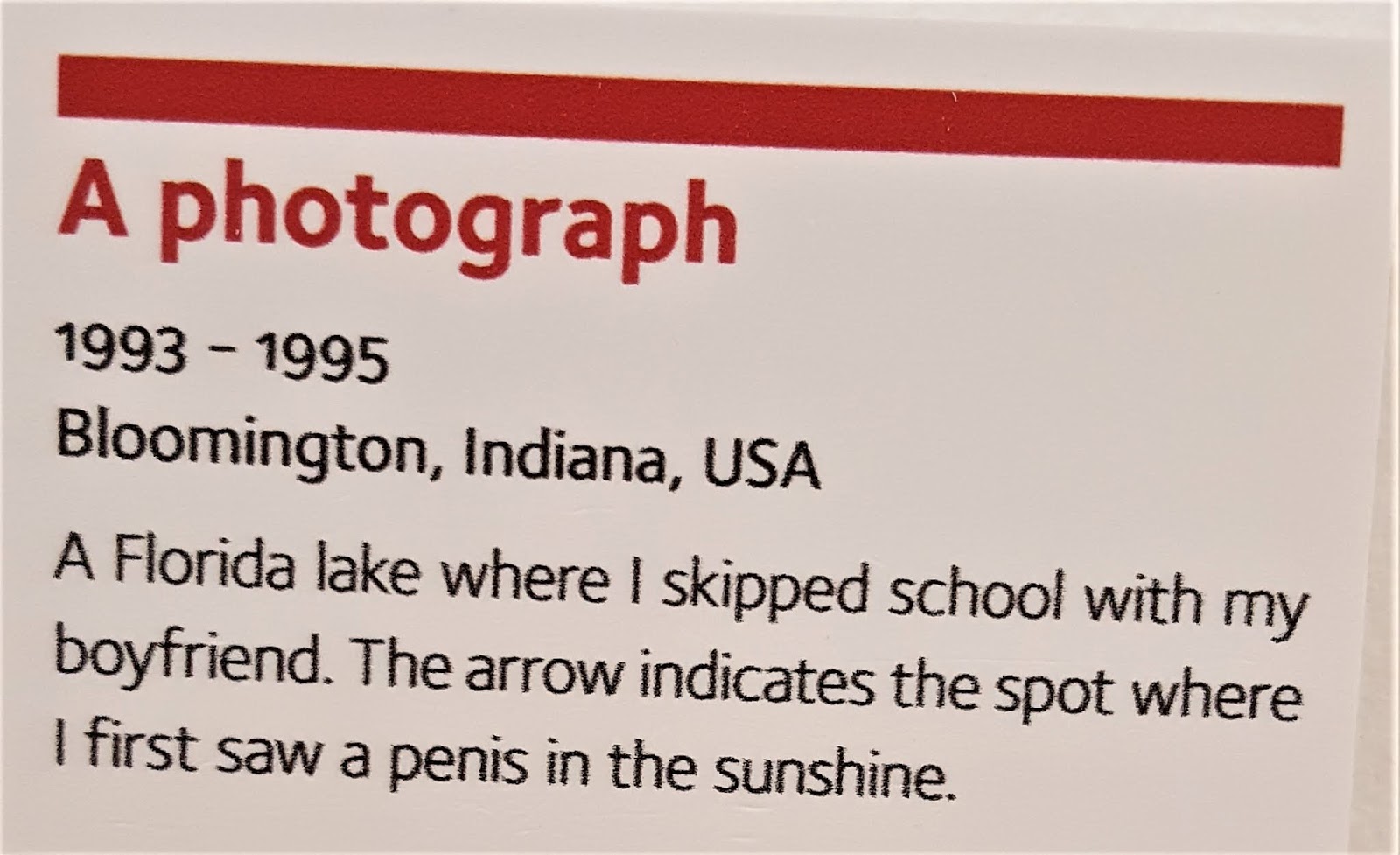
as is seen on the museum note card below.


This photo is explained below.


This bicycle is the subject of a poem, below.


Meanwhile, south of the new town is the Museum of  Contemporary Art. We took a streetcar
to reach it, but returned to our hotel in much less time by taking a more direct city bus. This
work is "I Spit on My Own Tomb" (2007) by Jan Fabre. Looks a bit like Boris Johnson, I think.

This work is little more than its own title. (1993)  Mladen Stilinovic, who died in 2016, was
one of Croatia's most prominent conceptual artists.


Stairs at the Mestrovic Studio in the old town.  We were
introduced to this prolific artist at his former villa (now
a museum) in Split.

Everything I saw by Mestrovic was representational, nothing
abstract. Many of his works have Croatian themes or
subtly promote Croatian national identity.

Motherhood figures frequently in his work.


Towers of the southern reaches of the Lower Town can be seen in this view to the south, over the
red tile roofs of the Upper Town from a high plaza in the Upper Town.

Streetcars are easy to use. Just buy tickets at any newsstand.


The Zagreb opera house. We didn't get inside, but I bet it's as ornate as the exterior.

Zagreb is sometimes described as a gallery
of Secessionist architecture. I'm not a student
of architecture, but I would guess these buildings,
above and below, are examples of that.


This round exhibition hall is in the center of Victims
of Fascism Square. We thought it would have something
about Croatia under fascist rule, but inside was one
large conceptual art installation, with the rest of the
space closed awaiting another contemporary
exhibition.

Dress properly to enter Zagreb's Cathedral of the
Assumption of the Blessed Virgin Mary. And don't smoke,
be a dog, use a phone, or eat ice cream, either!
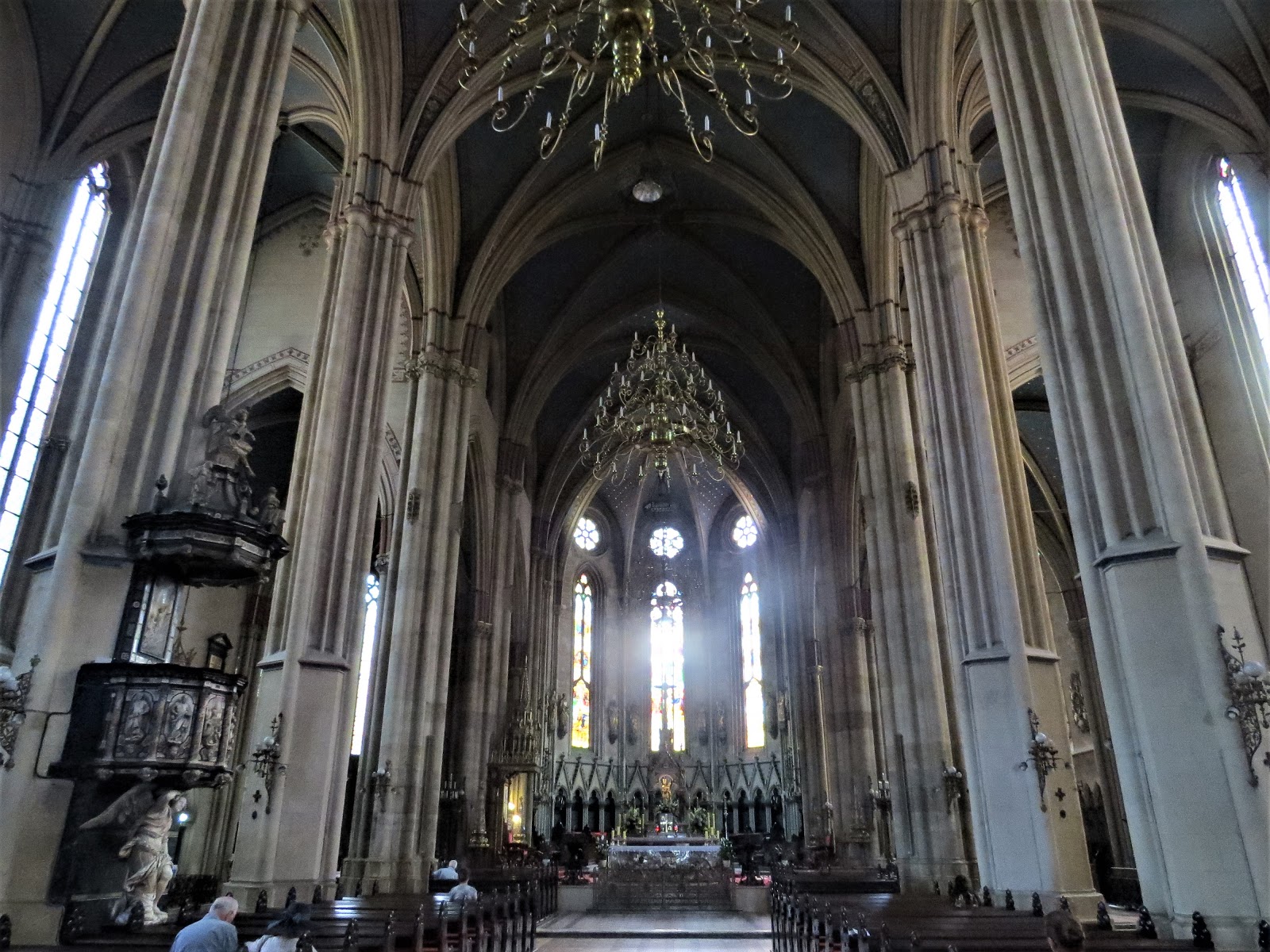
Inside the cathedral, which dates to 1217, though much of
the current structure is the result of a rebuilding after
an earthquake in 1880. The building was neglected
during years of communist rule and is having much
of its elaborate exterior stonework cleaned or replaced.
The cathedral soars above the roofs of the Upper Town. Scaffolding around the right steeple
has been there for years as stonemasons repair the damage of years of neglect and air pollution.
This is not a criminal tree at the Botanical Gardens.
It is a rare Wollemi Pine from the Blue Mountains
of Australia. The species was discovered in 1994
and is one of the world's most rare and sought-after
trees. The cage is for its own protection, though
we happened upon another of these trees elsewhere
in the garden that was not caged.
Wine Bar Bornstein is a great place to sample the many good wines of Croatia.

Tuesday, August 6, 2019

Croatia: Palatial Split

Like portals to a different time, covered passageways
take visitors through the maze of Diocletian's Palace.

The big attraction in Split, in terms of popularity and size, is Diocletian's Palace, a sprawling structure that was part palace and part military garrison or fortress. Over the centuries it has been overtaken by the city that surrounded it. What had been walls inside the palace were integrated into otherwise new structures. Interior courtyards became public squares. Amazingly, the palace's basement is still largely intact, giving visitors an idea of the size and grandeur of the rooms that once were above it.

Diocletian, whose parents were slaves, may have been born near Split. He rose through the Roman military to be in a position to have himself proclaimed emperor in 284 C.E. when the previous emperor mysteriously died. In his 60s in 305, he retired to Split where he died in 312, possibly at his own hand and presumably in the palace that was probably still under construction. The palace remained an imperial residence and fortress well into the fifth century. In the seventh century, the palace was turned into shelter for local residents when Slavs and Avars ransacked the nearby towns and countryside. It has been occupied continuously since then, with medieval and even Renaissance elements added as the centuries passed.

Today its narrow streets (hallways?) lead to restaurants, shops, hotels and even a church. Its footprint takes up about half of Split's old town, though pedestrian streets seem to extend the old town into newer areas. The palace fronts the Riva, Split's huge harborside plaza, and when we arrived by ferry from Hvar, we walked the length of the Riva to reach our small inn, Heritage Hotel 19, tucked away in the pedestrian zone beyond the Riva's western end. Split was probably the most relaxed, easiest to navigate and most friendly of the cities we visited on our seven-week, five-nation Balkans tour.

From the hotel, we could walk to the palace and all the shopping and restaurant streets that surround it. Split attracts a lot of tourists, many of them visiting before heading to Hvar or other islands, but the town itself seems to have a life apart from tourism. We visited the rooftop wine bar Paradox twice, and each time I would guess that a third to a half of the patrons were local in that they weren't speaking English to the servers. Just outside the eastern side of the palace, there's a large public market selling all manner of meats, cheeses and produce, clearly aimed at residents. Just beyond the food vendors is a street of shops selling clothing (I bought a pair of cargo shorts for about the same price I'd pay at Marshalls) and housewares.

When we headed in the other direction from our hotel, going west onto the Marjan Peninsula, we came to the Ivan Mestrovic Gallery, housed in the artist's palatial villa. Mestrovic (1883-1962) was and is the most famous Croatian sculptor. He built this mansion in the 1930s and in the 1950s he donated it to the nation as a gallery for his work. There are 190 sculptures and more than 500 drawings here. His sculptures reminded me of Rodin's, though with less sensuality.  In Zagreb, his former workshop is also now a gallery devoted to his work, and examples of his work can be seen in other public places in Split and in Zagreb -- and even in Chicago's Grant Park (a bronze of a native American on horseback).

Here are some photos.
A chamber in the basement of Diocletian's Palace.

The central passage in the basement is home to a variety of craft and souvenir vendors.

The ceiling in a portion of the basement.

A bust of Diocletian is displayed in the basement.

The Golden Gate is at the northern end of the palace and was the grandest of the
original four gates. After 17 centuries, it remains surprisingly intact.

A courtyard within the palace. To the left is the Cathedral of St. Dominus,
which was once Diocletian's mausoleum. To the right is a restaurant. One
evening this place, called the Peristyle, was filled with people listening
to two street performers, both guitarists, perform  "Hotel California," "Hey
 Mr. Tambourine Man" and other songs, all in English.

Many parts of the palace area look like ruins, which they are.

The streets in Split stay busy well into the night.

Inside the Cathedral of St. Dominus.

Ivan Mestrovic's monumental statue of
Gregor Ninksi, a bishop in the 10th
century who defied the pope to allow
the Croatian language to be used in
Catholic services. He is a national hero
and the sculpture had political meaning
before Croatia gained independence
from Yugoslavia.

A view of the Adriatic from Mestrovic's former home,
now a galley dedicated to his works.

The Cyclops is about to hurl a stone as Odysseus escapes in this work by Mestrovic.

A Mestrovic work.

One of many nudes at the Mestrovic Gallery.

Giant yachts such as the Solo here are frequent sights in the Adriatic.

The road to the Mestrovic Gallery overlooks Marjan Peninsula beaches such as this one.
 It had a lot of people on a Sunday afternoon.

This street connects the old town with the Marjan Peninsula.

Marmontova Street, with the old town on the right, and new neighborhoods on the left.

This fountain is on the harbor at the western end of the Riva.


Monday, August 5, 2019

Croatia: Away from the Madding Crowd on Hvar

Think you could hang out here for a few days? This terrace was the last in a string
of such lounging spots along a cove at Villa Jagodna. That's the open Adriatic in the distance.

One of the problems of visiting the Balkans during the summer is that everyone else is visiting the Balkans during the summer. The Acropolis was crowded in Athens. Narrow sidewalks on Santorini were more packed than New York subway cars. The old town in Dubrovnik had Disney World lines for just about everything. And the Rialto and St. Mark's Square in Venice, well, you get the idea.

On the little Croatian island of Hvar, however, the only crowd was in Hvar Town itself. There the restaurants, bars, waterfront promenade and the square had about as many people as could be shoehorned in. We went through town coming and going because that's where the ferries dock (we arrived on a ferry from Dubrovnik and left on a ferry to Split), and we went into town one evening for drinks and dinner. Other than that, we stayed at our little inn, Villa Jagodna, on a quiet cove with loads of privacy and excellent swimming.

The family that owns Jagodna is part of a larger family group that owns other property around the cove, a mix of another inn or two and private homes. Most of Jagodna's rooms and its restaurant are in one multi-story building, with the top floor at parking-lot level and the bottom floor still a flight of stairs from the water.

Our first night there, we arrived rather late, after 8 p.m., and dinner was still available, a choice of fish or meat. I don't remember the meat choice, but the fish was a red snapper steak, not a fillet. It came from a red snapper so large that it could be cut into steaks. It was grilled very simply on a raised hearth in the dining room. It's difficult to imagine better fish.

Jagodna has a series of somewhat private waterfront terraces strung along the cove between the inn and the open sea. Swim ladders are mounted on either natural rock or concrete that has been used atop the rocks to create the terraces. The water is crystal clear and, well, as blue as the Adriatic Sea. It was also surprisingly warm, warmer than the water had been a week or two earlier in Crete and Hydra. Our time on Hvar remains a high point of our seven weeks in the Balkans.

Here are some photos.
Fresh seafood is grilled over charcoal at Villa Jagodna.

Ladders allow easy access to the surprisingly
warm water. There were some sea urchins, but
I saw them only on shallow rocks near the edges.
Go out two or three feet and the water is very
deep and there are no urchins.

Several boats such as this one came and went during
our time at Jagodna. Some stayed the night. Some
were used as bases for nude swimming and sunbathing,
just like the inn's terraces.

You don't have to be a geologist to know that there's been some serious movement
of the earth's crust here. 

Our inn had a small fleet of kayaks available for guests. The catamaran in the distance
was one of what must be hundreds on the Adriatic, probably most of them charters.

Meanwhile in Hvar Town, yachts line the harbor. 

Any spot that will accommodate a table for food
or drinks is put to use in Hvar Town.

Bars on each side of this street put out tables, leaving a narrow path in the middle.

This place specializes in "street food," but it must be from a very fancy street. We
had our one in-town dinner here: smoked lamb burritos, steam buns with
pulled pork, and spareribs. 


The Croatian flag flies above a fortress high above Hvar Town.

Sunday, August 4, 2019

Croatia: Dubrovnik, Walls and Beaches

A seaside path along Uvala Lapad (Lapad Cove) near our hotel west of the walled old town.

The long lines to the ticket window and then to the stairs help make walking atop the medieval city wall at Dubrovnik seem like a theme park attraction. And the narrow streets below, filled with restaurants, snack shops and souvenir vendors cement the theme park impression.

During our 2019 visit, part of a seven-week, five-country tour of the Balkans, we visited the old part of Dubrovnik only twice, once on a very hot June afternoon to walk the wall, and again one evening to visit a wine bar.

Most of our time was spent well outside the walls, in the Babinkuk area on the peninsula that stretches westward from the central city. Our hotel, the Kompas, was above a public beach (the hotel supplied umbrellas and lounges for guests) and on a seaside walkway that went around the tip of the peninsula in one direction and connected with bus stops and city streets at the other. (We used city buses to go between our hotel and the old town.) Between the hotel and the bus stops is a lively stretch of hotels, open-air restaurants, carnival rides, clay tennis courts, and shops selling beach gear. One night we stumbled upon what we took to be a Croatian folk/rock concert at the tennis courts that was packed with jubilant locals.

The beach is pebbles, not sand. Jane had packed water shoes; I had not. I persevered with flip-flops and we both enjoyed the clean water. At our next stop, the island of Hvar, I broke down and bought water shoes. Beach-going here is not like it is in the U.S. in that alcohol is not only allowed, it is encouraged, with some vendors bringing pitchers of beer to sunbathers. Another difference is a casual attitude toward toplessness and changing clothes on the beach.

One day we took a ferry from Port Gruz to the nearby island of Korcula, where we went in search of what turned out to be a beach inferior to what we had at our hotel. The island that is most commonly visited by tourists is Lokrum, easily visible from the old town walls. Boats to it leave from the old port just outside the southeastern corner of the old town.

Here are some photos.
A short walk along the seaside path from the Kompas brought us to the
More Hotel's Cave Bar. The bar and a number of tables are in a real
cave, burrowed into the cliff. The More Hotel sits at the top of
the cliff and has an elevator that descends to the cave. There are
also tables outside the cave, on terraces cascading down
toward the sea. We had our drinks outside in the sun.

Strung along the seaside path are many ways to
get into the water, usually swim ladders mounted
on rocks like this one. In some places, concrete
has been added to provide room for sunbathing.

The seaside path.

The beach below the Hotel Kompas. The hotel's ground level is at the beach; a pool deck
is on the next floor up (the first floor), and if you go up another nine or so floors,
you'll be at street level at the top of the cliff. The lobby is on the 10th floor and most
guestrooms are below it, though still high above the beach.

A sunbather seems oblivious to a huge cruise ship. 

Part of a menu from a wine bar near the Hotel Kompas. 

On the walk atop Dubrovnik's famous wall. During our visit on a sunny day during one of Europe's
new extreme heat spells, we were happy to find water sold at several spots along the wall,
even though the prices were exorbitant.

The old town's jagged outline and steep hills provide
views of the wall from the wall.

Part of the old port as seen from atop the wall.

Parts of the wall look like sets for a swords and sandals movie.

A sea of red tile roofs.

As in many walled towns, narrow pedestrian streets
are made narrower by restaurant and bar tables. 

Our one excursion took us to the little island of Korcula,
where we used this path to cross the island in search
of a swimming spot we had read about.

This little church and its cemetery were on the path.

The path was sometimes bordered by stone walls and houses.

Our destination was this swimming spot in a village harbor. We took a look
and headed back, having lunch at the ferry port before returning to Dubrovnik.