Tourist First

Travel notes and advice from around the world. Above, the daily flight from Managua at the San Carlos, Nicaragua, airstrip.

Friday, August 2, 2019

Greece: Hydra, a Unique Island Experience

Flags fly at the entrance to Hydra's harbor.

People coming to Hydra by boat -- and it's the only way to get there unless a helicopter is involved -- don't see Hydra Town until they're practically in it. Hydra's circular harbor is almost hidden from the sea; the story is that invaders didn't know where to land if they missed the harbor entrance. Once inside the circular harbor, you're on a island like no other.

For one thing, there are no motor vehicles, save for a couple tiny fire department vehicles and at least one noisy miniature garbage truck. There are no bicycles. No electric scooters. There are donkeys, however, working donkeys that carry building supplies and visitors' luggage and everything else that arrives by boat. And, oddly, by Greek standards, Hydra Town is fairly new. Most of the buildings are less than 250 years old and very little seems to date earlier than the mid-1700s. When we arrived by ferry from Athens, the hotel had a man with a handcart meet us and take our luggage to our lodgings at the Hotel Leto Hydra, right in the middle of the maze of stone streets that forms the town.

Previous visitors have ranged from a young Leonard Cohen (this is where he met his muse, Marianne Ihlen) to Aristotle Onassis and Maria Callas. During our stay, I'd guess that at least half the people in restaurants were Greek -- Hydra is a favorite island escape for Athenians -- and the rest were other Europeans, perhaps mainly British and German.

Beaches and restaurants outside the town are reached by walking or by water taxis. A seaside trail heading east from the harbor took us to Mandraki, a restaurant at the island's only sandy beach. Much to the horror of locals, it cost 10 euros to rent a lounge, towel and an umbrella for the day, including waiter service and access to showers and bathrooms. In Greece, the usual practice is for beachfront restaurants to provide lounges and umbrellas without charge as long as food and drinks are purchased.


The seaside trail west of the harbor took us one night to Techne Restaurant and Social (click HERE), where we had one of our best meals in Greece in a beautiful courtyard as the sun set over the Saronic Gulf (a shared cuttlefish appetizer, followed by grilled drum and rack of lamb).

Here are some photos.

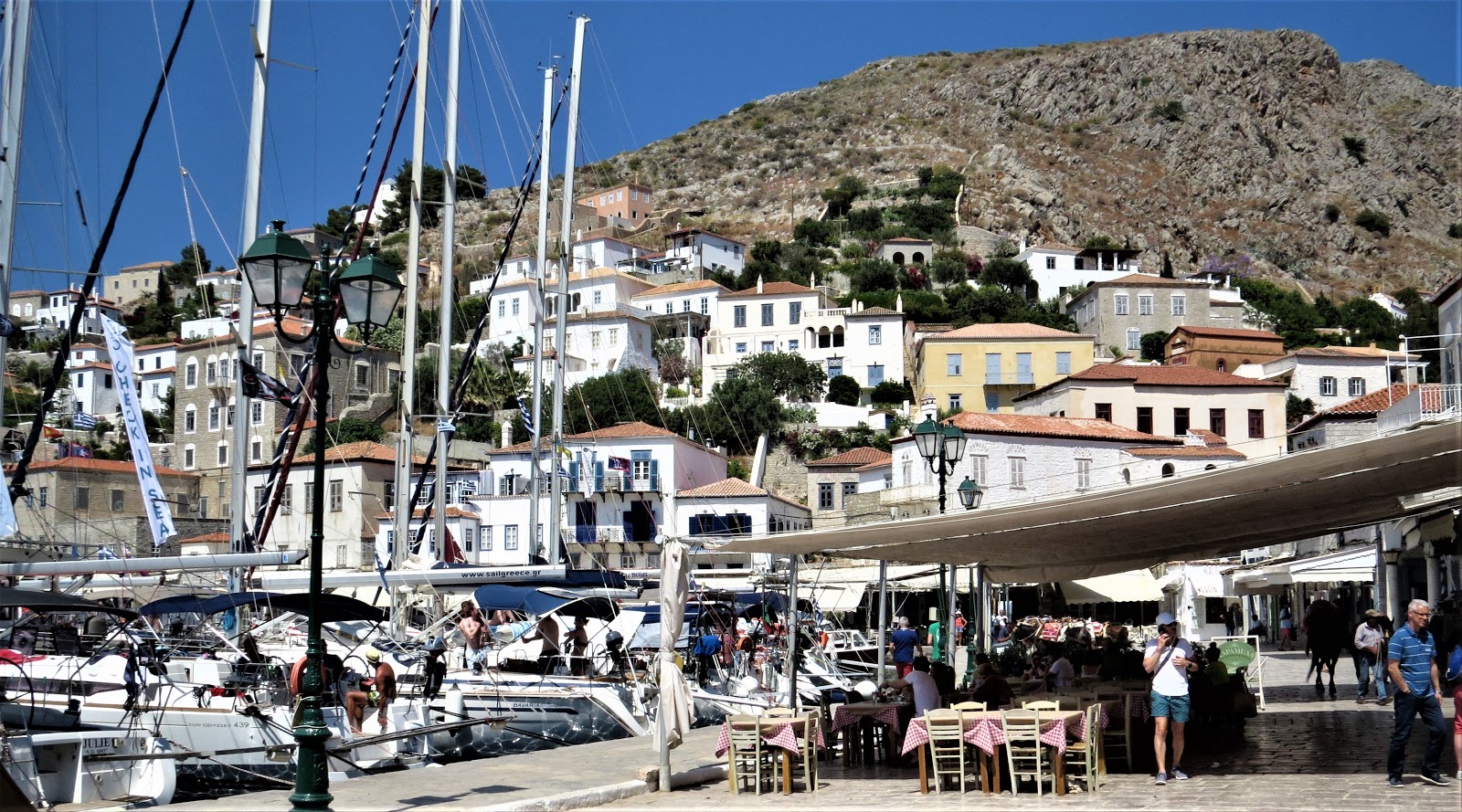
View of the harbor from beneath the awning of a waterfront bar.

Even on an island named Hydra, one must
try to stay hydrated.

The waters around Hydra are
startlingly clear. 

The Eastern Bastion guards one side of the harbor entrance. No idea when those cannon were last fired.

Lounges on the beach at Mandraki. 
Pleasure craft dock alongside restaurants on the harbor.


Hydra is proud of its maritime heritage.

Portraits of prominent Hydriots of the past
(all men, by the way) fill a wall at the
island's Historical Archive.

Donkeys line up at the harbor awaiting work. 

This donkey is carrying what appears to be
building supplies.

This walkway takes people west of the harbor. The land in the distance is the Greek mainland.

A rocky coast doesn't deter Hydriot swimmers. This "beach" is below
a restaurant just outside the harbor.


Greece: The Streets of Chania

Some of Chania's well-shaded shopping streets
resemble bazaars, with shops offering a wide
array of goods, not just souvenirs.

Guidebooks and internet postings about Chania persuaded us to visit as long as we were on Crete anyway. In retrospect, I regret my reluctance to rent a car and explore more of the island, especially the south coast. Like Heraklion, Chania (pronounced KAN-nya) is on the north coast and like Heraklion has a history that includes conquests by Turks, Venetians and other powers over the centuries.

Chania is a lovely little walled city. Its narrow twisting streets, sometimes interrupted by flights of stairs, are as inviting as similar streets anywhere in the Mediterranean. It's not quite true that if you've seen one medieval walled town, you've seen them all, but you will notice a sameness. We arrived by bus from Heraklion and took a taxi from the bus station to one of the gates into the old town. From there, we had to turn at only one side street (think passageway) to reach our hotel, Casa Delfino (Dolphin House).

All the attractions of Chania, from restaurants to the harbor to its maritime museum, were within a few steps of the hotel. One popular activity, walking atop the walls of Firka, an old Turkish prison, couldn't be done during our visit due to repair work. We were here for two nights, and that's about the right amount of time for us. We met a British couple at our hotel who visit Chania frequently for stays of four or five days, spending their time relaxing and wandering the streets of the newer parts of town as well as the ancient.

Here are some photos.
The harbor front seems also to be
Chania's main street.

A lighthouse at the entrance to the harbor.

The harbor as seen from our room at Casa Delfino. Most of
the places under the big awnings are restaurants. 

A minaret is a reminder of the role
of the Ottoman Empire in the history
of Chania.

This happy little red submarine takes adventurous tourists
beneath the waves of the Sea of Crete.

At the Maritime Museum of Crete, models of World War II
ships help visitors understand the sea battles that
happened near Chania. As a bonus, it's housed in
an old Turkish prison called Firka. 

At the museum, paint is carefully applied as a new model ship is about
to go on display.  These models are about as detailed as any I've ever seen. 


Saturday, July 27, 2019

Greece: Ancient and Young Heraklion

The Phaistos Disc, thought to be from the early 17th century B.C.E., has
45 pictorial signs arranged in different combinations into 61 groups (this
side and the reverse side). The repetition of certain groups has led
experts to speculate that it is either a hymn or perhaps a magic
incantation. It's one of the many great discoveries at Knossos.

On our 2019 trip through the Balkans, Jane and I weren't particularly trying to see ancient ruins -- we had seen plenty during three months in southern Italy the year before.  But I was curious about Crete, the largest of the Greek islands, and that put us so close to the Palace of Knossos that we had to see it. We took a high-speed ferry from Santorini to Heraklion, which took less than two hours. Our hotel, the GDM Megaron, was easily visible from where the ferry docked.

The Minoan civilization, which thrived on Crete roughly between 2700 and 1450 B.C.E., is considered prehistoric because there are no contemporary accounts of it. What we know is largely from stories and legends passed down to the classical period, and usually what we have are passing references. One constant, though, is that it was rich, and the jewelry on display at the Heraklion Archaeological Museum seems to back that up.  Our understanding of the reality of the Minoans is almost entirely due to the British archaeologist Arthur Evans, who began excavating a huge mound five kilometers south of Heraklion in the late 1800s and worked the site for 20 years. What he found and his interpretations of what he found received worldwide attention at the turn of the last century: an enormous palace, sophisticated murals, and signs of trade throughout the Mediterranean well before the emergence of the great Greek city-states.

Heraklion, however, doesn't seem ancient at all, despite walls and forts reflecting centuries at the center of battles between civilizations. The people on the streets and in the many sidewalk cafes are young and energetic. There's a vibrancy here that we didn't find at all in the nearby town of Chania, the only other place we visited on Crete.

Our first night here, we sought out a restaurant called Peskesi based on TripAdvisor reviews and its "Fodor's Choice" status in Fodor's. We couldn't get in without a reservation even on a Thursday evening, so we made a reservation for Saturday night. We went around the corner to a little neighborhood place where we feasted on rosemary snails, grilled mushrooms, meatballs and fried rabbit. The next day, Friday, we went to Knossos but were back in time for lunch on the waterfront at Ippokambos (The Seahorse, click HERE), where we had sardines and other grilled seafood in embarrassing quantities. Nevertheless, by dinner time, which in Greece is usually well after 8, and often after 10, we were hungry enough to take a taxi to Erganos (click HERE), a tavern that Fodor's described as a very traditional and catering mainly to a local crowd. We had dolmades (stuffed grape leaves, served warm), grilled mushrooms (always good in Greece), and slow-cooked lamb.
    Finally, the next evening, we made it to Peskesi (click HERE), where we shared a smoked eggplant appeitizer, and Jane had pork with honey and thyme and I had an amazing beef stew. All washed down with hearty Cretan wine.

Here are some photos that don't really do justice to Heraklion or Knossos.

Heraklion is the main port on Crete, and a popular destination for ferries from other
islands. It also has the island's largest airport.

This massive fortress was called Koules by the Turks and the name stuck, though
when Venetians built it in the 1500s, it was called Castello del Molo. It dominates
the harbor of Heraklion and is reached by walking on a long sea wall that
defines the harbor. The strips of blue are the Sea of Crete. This
photo was taken with a long lens from our hotel, the
GDM Megaron, which is right at the ferry docks
and a short walk from downtown Heraklion's
many attractions.

A wooden model at the Heraklion Archaeological Museum
depicts the Palace of Knossos as archaeologists
think it once was.

This clay female figure on what appears to be a swing
suspended from two columns represents the descent
 of a goddess. It's dated to  1500 to 1450 B.C.E. The birds
 atop the columns represent the goddess's attendants.

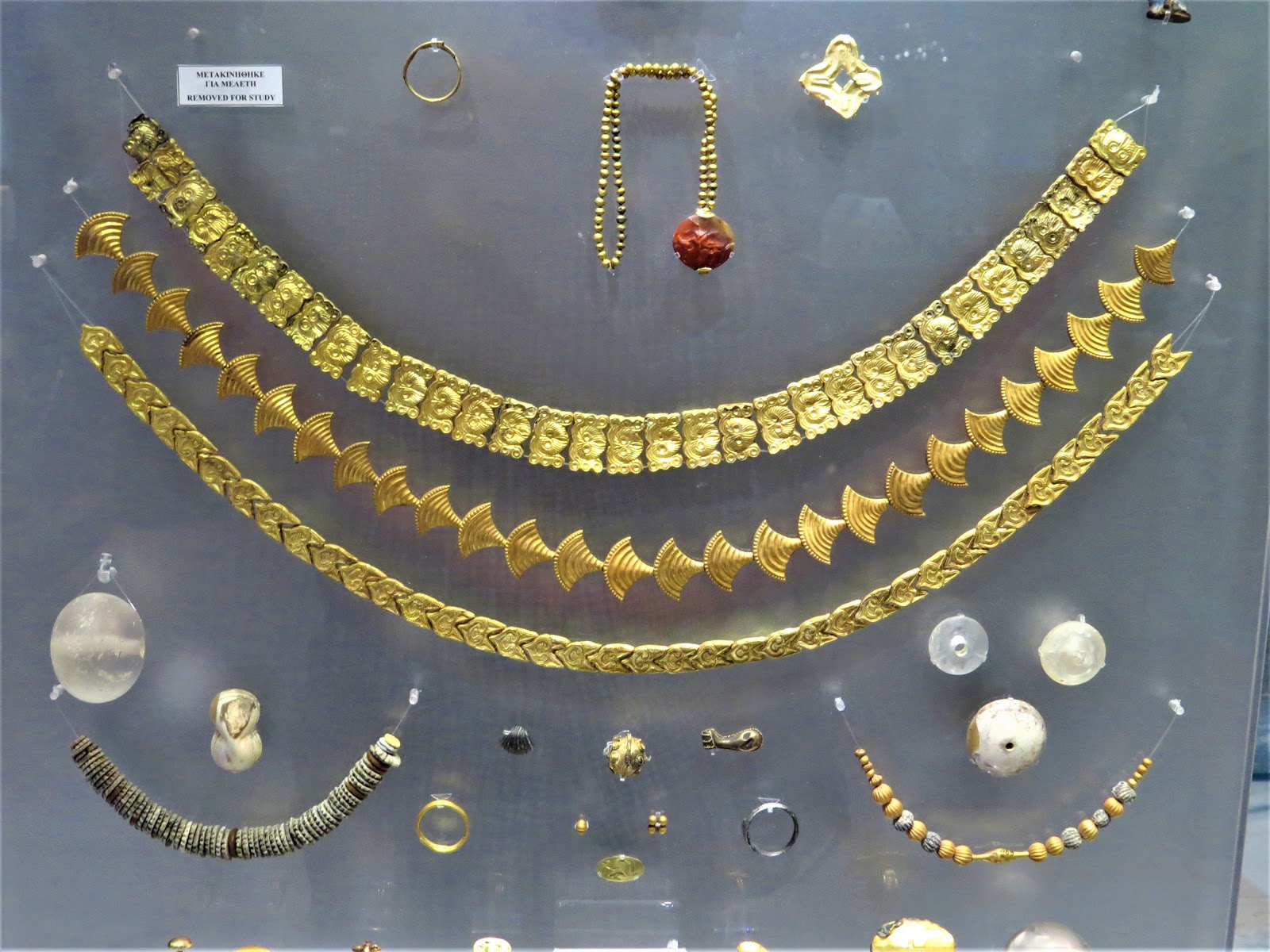
This isn't Cartier or Tiffany's. These pieces and many more were excavated at
the Palace of Knossos. No wonder that the wealth of the Minoans
was legendary among the ancient Greeks.

This dolphin mural is preserved at the museum
in Heraklion.
A reproduction shows the dolphin mural in its original location, what Arthur Evans
called the Queen's Megaron at the Palace of Knossos. Some parts of the palace
have been restored a bit, giving visitors a sense of what it was like more than
3,000 years ago.


Stairs and partial walls at Knossos. This is just one small section of the sprawling site.


Another restoration at Knossos.

This restoration, complete with a restored fresco of a Minoan bull, has
led some archaeologist to decry the "Disneyfication" of the ruins.

A pedestrian street attracts a young crowd in Heraklion, Despite the throngs
who visit to see the Palace of Knossos, Heraklion itself does not
seem like a particularly touristy city.

I have no idea what these women are
dressed for. This was taken around
five in the afternoon.

A bus ride west of downtown took us to the beaches and lidos of Amoudara, where
the crowds seemed almost entirely local. 


Thursday, July 25, 2019

Greece: Santorini's Posh White City

Tourists walk to and from Oia's northernmost point
as others dine just above them. The white stucco buildings
are typical of Oia. 
Think of all the Greek islands: Rhodes, Crete, Corfu, Mykonos, Naxos and literally dozens others, all with their own charms: remote monasteries, beautiful beaches, mountains and valleys. Jane and I are wine buffs, so the first island we discussed in planning our trip was Santorini, which produces some of Greece's (if not the world's) most enjoyable white wines. Another attraction is that it is usually considered the most beautiful of the Greek islands.

So, we went straight from inland Delphi to one of the southernmost islands, which some maps and airlines call Thira but which everyone knows as Santorini. Travel books and on-line research led us to the town of Oia (also spelled Ia and pronounced EE-ah) at the northern tip of the island. Our hotel, Ikies Traditional Houses, is at the southern end of town, just off the 14-kilometer seaside footpath that connects Oia and Fira, the capital of the island. I have the impression that a lot of people start the path, realize how steep it is, and turn around. We did, as had everyone we spoke to about the path. It's probably a wonderful hike and it certainly would get you beyond the jewelry stores and boutiques of the two towns. In Oia, the main walkway is lined with restaurants, jewelry stores, clothing boutiques and souvenir shops. We saw maybe two stores where a local resident might actually find something to buy. I'm just assuming there are local residents somewhere in this shopping mall of a town.

We mostly stayed in Oia, venturing to Fira only to board a catamaran for a sunset sail. Oia is indeed a beautiful town, made up of white buildings that cascade down the sides of mountains, stopping short of the sea. Oia is on the edge of the caldera (as is Fira) that was created around 1600 B.C.E. when a much larger island exploded in an almost unimaginable volcanic eruption. It created a tidal wave that did great damage to the Minoan civilization on Crete and, it is said, started the legend of Atlantis.

Oia spreads out, mostly on the sea side, along its one main walkway, with one street for cars a short walk to the east. There are very few hotels in Oia that don't require a bit of walking and a few flights of stairs to reach.  Our room at Ikies was exactly 96 steps below the footpath, and there were houses and other hotels below us.

Once up on the footpath, a pleasant walk takes you into the town proper, where the pleasant part evaporates as people jockey for ways forward on the increasingly narrow sidewalk. I think that some of the shops make sales to people who came in only to get a little breathing room.  And it's not only that there are a lot of people, it's what some of them are doing. Couples (maybe newly-weds, but who knows?) stop traffic as they take photos of each other at the different sea overlooks. Women in dresses not exactly appropriate for hiking or even shopping position themselves atop stone walls for more photos. And everyone everywhere is constantly at risk of being whacked by a selfie stick. What evil bastard invented these things?

Many resort areas around the world have to live with short seasons. Business have to make enough money during three or four months to last an entire year. No place illustrated this better than Oia, with sky-high room rates and expensive restaurants and shops, though not every eatery was super expensive. Our first evening there, we happened into Thalami (click HERE), a pasta and grilled foods restaurant where we were seated on the open-air upper terrace with great views. Dinner of salad and smoked mackerel with wine was simple but good, and the price wasn't terribly out of line. The next evening we made a reservation at Thalassia (click HERE), recommended by our hotel, and got the outside corner table on the front porch, the best view in the place. I had lamb chops and Jane had grouper. With a bottle of wine, the tab was more than 100 euros, this for a meal that would have been half that price or less in Athens and just as good. About the only bargains around are in the shops that mostly serve locals -- there you can buy some Santorini wines for less than 10 euros a bottle.

We originally planned four nights here, cut it to three nights to save a few dollars, and would have been happy to leave after two nights. It's a beautiful place, but the experience is ruined by the crowds. For us, Heraklion on Crete and the island of Hydra were much better. But that's just us. Loads of people really, really love Santorini. And it's understandable when you see photos of it.

Oia's location on the side of a mountain means there are always
at lot of stairs. Note the fellow on the right in the hat, taking
a photo of a woman in a yellow dress. If digital photography had
not been invented, anyone selling film in Oia would be rich indeed.

Open stairways connect these houses and hotels to the footpath at the top of the hill. 

Some of these houses have rooms created by digging into
the hillside; they're called cave houses. 

We stopped into this little bar for coffee a couple of times. 

Pedestrian traffic on Oia's main walkway.

A woman being photographed (by
someone else in addition to me!)
strikes a pose just off the main walkway.

Looking north toward Oia from the footpath that connects it with the town of Fira.
Not all of the path is as well maintained or as level as this stretch.

On our sunset sail, our boat met up with
others at the "mud baths." Actually, it's just
muddy water warmed by an undersea hot spring.

It's a cold swim from the boats to the warm, shallow and muddy water of the mud baths. 

Someone from our boat takes the plunge.

A day with water so choppy that a third or more of the people on our boat became seasick
ends with a big payoff -- a Santorini sunset. The next day we left for another island, Crete.

Greece: Delphi and the Oracle

Columns at one corner and parts of the foundation are all that remain of the
Temple of Apollo at Delphi, once the most important place in the
classical world.  In the story of Oedipus, it was here that it was
predicted that he would kill his father and marry his mother.
                                   If you're at all familiar with the history of classical Greece or the story of Oedipus, you should be aware of the        importance of the Oracle at Delphi. The Pythia (the high priestess at the Temple of Apollo at Delphi) was the most powerful woman in the ancient world. Although the Pythia or Oracle was well known and revered for centuries beginning in the Eighth Century B.C.E., little is understood about how her prophecies were delivered or how the high priestess was selected. A popular theory is that the Pythia delivered prophesies while under the influence of intoxicating vapors (probably sulfuric gases) coming from the ground, and her ramblings were then interpreted by the temple's male priests, but some sources say the prophecies were delivered coherently and even in poetic verse. 

At any rate, communities all over the Greek world paid tribute to the Oracle with elaborate gifts, often establishing treasuries at Delphi to hold the gold and precious objects presented to the temple. Today, what's left are a few columns and the foundation of the temple itself, a couple of the treasury structures, and many of the offerings presented in tribute to the Oracle. A small but excellent museum near the site has preserved many sculptures and architectural details.

The town of Delphi itself is a pleasant place to stay during a visit to the temple site, though I suspect many people visit the temple as a day trip out of Athens. There are good restaurants and bars with distant views of the Gulf of Iteas and the Gulf of Corinth. We were there two nights, arriving from Athens by taxi. Afraid the next day might be rainy, we made a point of visiting the temple and the museum on the afternoon we arrived. Both are an easy walk from the center of town, where we stayed at Pitho Rooms, a B and B above a gift shop. Our full day in Delphi turned out to be sunny, and we took a bus (changing buses in Itea) to Galaxidi, a fishing town with an inviting waterfront strip of open-air seafood restaurants.
It seems disrespectful to allow weeds to surround the Omphalos of Delphi, believed to have been hurled
by Zeus from the heavens to discover the center of the world. It's also called the navel of the world. 

The Athenian treasury at Delphi once housed votive
offerings sent by the city of Athens and wealthy citizens.

The ruins of the Temple of Athena are on the slope below the Temple of Apollo. 

The Temple of Apollo seems to soar above the valley below.

In about 560 B.C.E., the island of Naxos presented
this spinx, carved from one piece of marble,
to the Oracle. It is the body of lion with the
head of a woman and the wings of a bird.
Mounted atop a column near the Temple of Apollo,
it was 12.5 meters high, about 41 feet. 

These two life-size identical statues from the
sixth century B.C.E. are considered the oldest
monumental votive offerings at Delphi. They
are thought to represent either the pious brothers
Cleobis and Biton of Argos, or the Dioscuri,
whose cult was popular at the time. The
story of the brothers from Argos is poignant. When
oxen were unavailable, they pulled a cart carrying
their mother to a temple. In gratitude, she
prayed to Hera to grant her sons "whatever
is best for a man to receive." They died
in their sleep that night.

The town of Delphi consists mainly of two streets, which meet at each end of town.
The west-bound street is on the right and is much higher than the east-bound
street on the left, which is where our inn was. When we took a bus to Galaxidi, we bought
tickets in the bar next to the bus station, at right. 

Steep side streets connect the town's
two main arteries. That's a tavern
on the left, and a corner of the Gulf
of Iteas in the upper right.


This appeared to be a private residence, home
to someone who loves potted plants.

The harbor in Itea, where we wandered around while waiting for a bus to take us to Galaxidi.
Waterfront restaurants in Galaxidi on the Gulf of Iteas. Just the other side
of the parked cars is the harbor. We had a fried fish feast for Sunday lunch here.