ur big trip for 2019 began with a slight but important detour. We left San Diego on May 17 and flew to Milwaukee to attend son Kyle's graduation from Marquette Law School. A big event for him and all of us. And, since we were a quick shuttle bus ride from O'Hare, we could easily begin our Balkan adventure by flying nonstop from Chicago to Athens on a British Airways/American code share.
The trip began with curiosity about Croatia, particularly the Dalmatian Coast and islands. As long as we were close by, let's do Greece. Montenegro could be a stop between Greece and Croatia. We have a friend who has just established permanent residency in Ljubljana, Slovenia, so we should stop and see him. Trieste is so close, it would be a shame not to see it. And a flight home out of Venice would be a grand way to end the trip. We started in the south in the Aegean Sea and then worked our way north along the eastern shore of the Adriatic. We used almost every mode of transportation in getting from one destination to another: airplanes, boats, trains, buses, and taxis.
Our 2018 trip to Italy involved three months' worth of classical-era ruins and magnificent churches. We didn't want so many ruins this time. We saw the must-see sights (Acropolis in Athens, Temple of Apollo at Delphi, the Palace of Knossos on Crete, Diocletian's Palace in Split), but more of our time was spent enjoying sidewalk cafes, contemporary art museums, the scenery, and splashing in very blue and very clean seas. Conveniently, the euro is the currency in every country we visited except Croatia, which uses the kuna. Fortunately, we didn't have to use much cash since our Visa card was accepted almost every place we went, though some island restaurants and our inn on Hvar required cash.
Bus to
O’Hare for 5:35 p.m. nonstop flight to Athens.
: We arrived in Athens just after noon. We stayed three nights at the InnAthens, a boutique hotel whose entrance on quiet Sourri Street is obscured by a neighboring wine bar. One walks through a covered passage full of the wine bar's tables to reach an open courtyard. The hotel's desk is behind a door off the courtyard; access to rooms and the dining area are behind other doors. We spent our days here exploring the city and, of course, its ancient ruins, all within walking distance of the hotel. Click
Saturday, May 25: We used a taxi for the two-hour drive to Dephi. We could have taken a bus, but the trip would have been twice as long. Our first afternoon there, we saw both the ruins of the Temple of Apollo area (home of the famous oracle) and Delphi's small but excellent archaeological museum. We stayed at Pitho Rooms, a small B and B above a gift shop and within easy walking distance of the ruins and the museum. Other than a way-too-small shower, the accommodations were nice and we had a very private and shady terrace. That Sunday we took two public buses to reach Galaxidi, a small fishing town on the Gulf of Corinth, an inlet of the Adriatic. The gulf is easily seen from Delphi, too, but it's miles and miles away. Click
HERE for Pitho.
 |
The view of the white buildings of Oia from our terrace at
Ikies. The hotel's small pool was just in front of our room, but it
got little use during our time there. Breakfast, ordered the night before,
is served on each room's private terrace. The hotel clings to the
hillside below the town road, and it was 96 steps up from our room to
reach the main walkway into town. Once in our room,
there was a flight of stairs between bedroom and bathroom. |
Monday, May 27: A taxi from Delphi got us to the Athens airport in time for a 5:15 flight to Santorini on Aegean Air. We were met by a driver who took us to Ikies Traditional Houses in Oia, also known as Ia, pronounced EE-ah, and possibly the most photogenic town in the world. We spent our time here walking from one great view to another, and spending an afternoon and evening on a catamaran for a sunset sail, which was pretty much ruined by rough water that prompted a third or more of the passengers to become decidedly seasick. While Santorini is indeed beautiful, it was our least favorite island experience. Oia quickly seemed like a large, high-end mall with luxury retailers and pricey restaurants, populated by too many people taking selfies or women striking fashion poses while their friends or husbands took photos. We were here three nights. Click
HERE for Ikies website.
 |
| Aboard the high-speed ferry from Santorini to Heraklion. |
 |
A fellow guest relaxes with a book at Casa Delfino's
rooftop bar. |
Thursday, May 30: We took the 4:50 ferry to Heraklion, Crete, arriving around 6:30. We stayed three nights at the GDM Megaron Hotel, a large and traditional hotel overlooking the harbor. Heraklion, the capital of Crete, is a busy and youthful city with many good restaurants, a great pedestrian street for people-watching, and an archaeological museum focused on the prehistoric Minoan civilization, relics of which are a short bus ride out of town at the Palace of Knossos. Another city bus took us to the beaches of the Amoudara neighborhood. I heartily recommend a few days in Heraklion to anyone headed to the Greek islands. Click
HERE for Megaron website.
Sunday, June 2: We took an almost-three-hour bus ride west along the northern shore of Crete to Chania (KAN-nya), the former capital of Crete and a walled city where cars are kept outside the walls. We stayed at a small inn called Casa
Delfino, which has a rooftop bar with harbor views. Our room, we were told, was the only one with a water view, making up for the bathroom and bedroom being on different levels. After several long trips in Europe, we've begun to notice a sameness to ancient walled towns, from Obidos, Portugal, to Gallipoli, Italy, to several towns on this trip. Narrow, stone-paved streets; souvenir shops selling mostly the same stuff; sidewalk cafes and restaurants, often with people out front trying to drag in passers-by; and beautiful plazas with beautiful churches or other public buildings. We met a well-traveled British couple at our hotel who said they visit Chania regularly for a few days at a time, finding it a relaxing change from their home in London. For us, a more modern and vibrant city like Heraklion is more attractive than another walled Medieval theme park. That said, it's still easy to be drawn down those narrow streets, curious to see what's around the next corner. Click
HERE for Casa Delfino.
 |
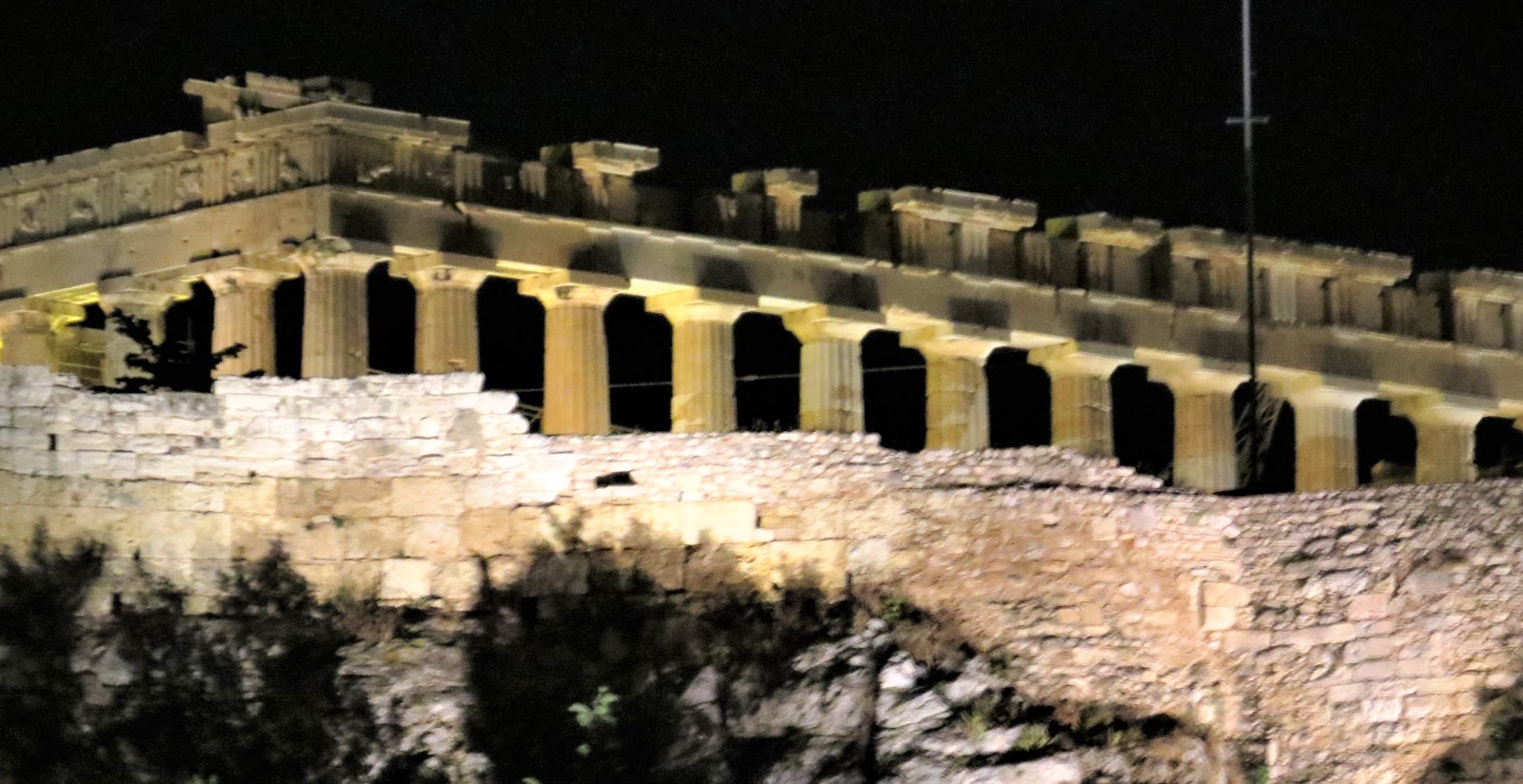
| The Parthenon at night, as seen from our room at Zillars. |
Tuesday, June 4: We flew from Chania to Athens on Aegean, arriving at 10 a.m. This time we stayed at Zillars Boutique Hotel on busy Metropoleos
Street, not far from the ruins of the ancient agora. Its rooftop bar has a good view of the Acropolis and the Parthenon, but we had the same view from our room -- we could see the Parthenon, which is spotlit at night, from our bed. This was our last night in Athens and the view made it quite special. Click
HERE for Zillars.
 |
Breakfast at the Leto is served in this
shady courtyard. Our room had the window
just above the glass doors. |
Wednesday, June 5: Our ferry to
Hydra left Piraeus (the port of Athens) at 1 p.m. and took a little over an hour. We stayed three nights at the small hotel Leto, a few blocks from the harbor. We were met at the ferry by a man with a cart who took our luggage and guided us through what seemed a maze of small streets to the Leto. We quickly learned our way around, though, and once at the hotel we could always find it again. There are no cars on the island of Hydra, no bicycles, no electric scooters, nothing but flip-flops and sneakers. And donkeys, which are used to carry riders as well as just about everything else, including some visitors' luggage. The only motorized vehicles appear to be a miniature garbage truck and two small fire trucks. Hydra (pronounced EE-drah) is a small island, but one once visited regularly by celebrities like Aristotle Onassis and Maria Callas, and one with a important maritime history (it's home to the world's oldest merchant marine academy, founded in 1749). It's a great, low-key place to chill, visiting beaches, walking seaside trails, and enjoying its rustic taverns and its more sophisticated restaurants. Unlike Santorini, few tourists wear stilettos or carry Prada. Click
HERE for the Leto.
 |
The Antigon's breakfast room features a glass floor about 14 feet above
ancient ruins. It's a bit disorienting at first, and it was fun to watch new
arrivals step cautiously onto the glass. |
Saturday, June 8: We took a ferry back to Athens where we had scheduled a taxi to meet us and get us to the airport in time for our flight north to Thessaloniki, the second-largest city in Greece. We stayed three nights at the year-old Antigon
Urban Chic Hotel, which is well located for exploring the city's main attractions like the White Tower as well as the waterfront and Ladadika, an alcohol-infused restaurant/night club district. We chose to visit Thessaloniki because we wanted a Greek experience without swarms of tourists, and we got it. Restaurants and sidewalks seemed filled with locals, many of them university students, not people staring at GPS directions on their phones. Click
HERE for the Antigon, which is indeed both urban and chic.
 |
View from our room at Hippocampus in Kotor. Yes, all
the streets there were this clean and tidy. The woman is
looking at her phone. Is she using GPS to find her way
through the maze of little streets, or is she making
a selfie video? |
Tuesday, June 11: We flew to Tivat, Montenegro, via Belgrade on Air Serbia. From there it was a quick taxi ride to our next stop, Kotor, another charming, ancient and walled coastal city. We stayed three nights at the Hotel Hippocampus. Montenegro made our itinerary because one of my favorite fictional detectives, Nero Wolfe, was from Montenegro, and the Daniel Craig/James Bond movie "Casino Royale" was largely set here, though not in Kotor, a famously picturesque town squeezed between mountains and an arm of the Adriatic Sea. Click
HERE for Hippocampus, which means seahorse.
 |
View of beach from the Hotel Kompas. Some of the
umbrellas and lounges were reserved for hotel
guests. The low white building seemed to be
wedding venue, and the Kompas and other
hotels cater to a lot of wedding parties. |
Friday, June 14: We took a bus to go from Kotor to Dubrovnik, which is about 60 miles away. The trip takes considerably longer than one might think, though, because of the border crossing. We got off the bus and received our Montenegro exit stamps very quickly, but we sat on the parked bus for well over an hour waiting to walk to a window to get our Croatia entry stamps. When we got to the Dubrovnik bus station, we grabbed a taxi for the 15-minute ride to the Hotel Kompas, which is on one of the mainland's best beaches (pebble, though, not sand). We later took taxis back to the old city to walk on the top of its famous wall and again to have dinner, and another taxi to the ferry port for an excursion to one of the Elafiti islands. Mainly, though, we enjoyed the lido in front of our hotel. When one arrives at the hotel by car, you get out on the top floor. The hotel is built against a cliff, and elevators go down past floors of guestrooms to take you to the water at the foot of the cliff. Click
HERE for Kompas.
 |
A swim ladder connects a terrace with the
blue waters of the Adriatic. There were a few sea
urchin on rocks near the ladder, but none farther
out, and the water was warm, deep, clear and delightful.
The Jagodna's terraces were spread out along the cove's
shore, giving each a degree of privacy, which is good
because not everyone kept their swimsuits on. |
Wednesday, June 19: We took a high-speed ferry for the three-hour trip to Hvar, probably the best known of Croatia's many islands. Its main community, Hvar Town, is packed with tourists and its docks are jammed with large yachts from Spain, France, Italy, Greece, and beyond. We stayed three nights away from the town on a quiet crystal-blue cove at Villa Jagodna, a small family-run inn. A taxi is called to take guests to town, though we noticed that several guests had brought their own cars over on the ferry. We were the only Americans there, but the owner said the inn usually gets a lot of Americans in September. Click
HERE for Jagodna.
Saturday, June 22: We took a mid-day ferry to Split -- a ride of about 50 minutes -- where we spent three nights at Heritage Hotel 19 and our days exploring this intriguing city that seems to revolve around the sprawling ruins of Diocletian's Palace. The palace itself is more like a small walled city than a palace. The palace, completed in 305 as a residence for the Roman Emperor Diocletian, was abandoned and fell into ruin after the fall of the Roman Empire. Eventually, people moved in, incorporating the remaining walls into otherwise new homes and other structures. Today it is a warren of restaurants, shops, churches and even hotels, with many architectural elements of the palace still visible. The original basement, amazingly, is largely intact, giving visitors an idea of the size and proportions of what once was the palace above it. Hotel 19 is a few short blocks from the palace but still in the pedestrian zone. We spent our days here exploring the palace and the nearby Marjan Peninsula, most of which is parkland. Click
HERE for Hotel 19.
 |
The stately Esplanade once housed guests
traveling on the Orient Express train. Today it
is still convenient to the train station, though
it is something of a walk to the attractions
of the old town. |
Tuesday, June 25: We flew to Zagreb on Croatia Airlines and checked in for four nights at the Esplanade Zagreb, a grand hotel opened in 1925 to house people taking the Orient Express to Istanbul. We were first given a room on the 6th (top) floor, a floor that originally housed servants who traveled with some of the guests. Ceilings were rather low and our view was of the ugly open-air center of the building -- a giant air shaft with exhaust vents and wiring. Even though we had reserved more than six months in advance, we had gotten one of the worst rooms in our price category. Jane pointed this out and we spent our final three nights in a much nicer room on the third floor (Americans would call it the fourth floor) with a lovely park view. It's a beautiful hotel with a lovely dining room, a first-rate breakfast buffet and doormen who about half the time are there to open the door for guests. The city itself is fascinating. Near the hotels are several green squares, an excellent botanical garden and the still-working rail station where the Orient Express once stopped. North and uphill is the old town, with steep, stone-paved streets, a magnificent cathedral, an open-air market and at least one really good wine bar. The old town is also home to the famous Museum of Broken Relationships, a must-see for most visitors. Click
HERE for the Esplanade.
 |
The small rooftop pool of the Vander hotel is
visible from the castle that overlooks the city. |
Saturday, June 29: We rolled our carry-on bags the block from the Esplanade to the train station to catch the 12:36 train to
Ljubljana. We had first-class tickets that put us by ourselves in a six-seat compartment with a sliding door to the corridor. Just like in the movies, passport inspectors showed up to give us our Croatia exit stamps and our Slovenia entry stamps. It wasn't the Orient Express, but it did seem like travel from another era. We arrived at 3:14 and our friend Ray met us on the platform. He led us to our hotel, the Vander Urbani Resort, in the middle of a lively riverside restaurant and bar area. En route we crossed one span of the city's iconic Triple Bridge. The Vander seemed to be trying harder to be chic (with a glass wall between bathroom and bedroom, for example) than to make guests comfortable. We had asked for a bright room but got one on the first floor (the level above the ground-level lobby) that, even with the drapes open, required the lamps to be on. The two windows looked out on an alley-like street with the next building perhaps four feet away. We were here four nights. The Vander did, however, have a decent restaurant, a good breakfast and a great location. Click
HERE for the Vander.
 |
View from our Hotel Piran room. The concrete
piers give swimmers access to the blue waters
of the Adriatic. The paved area along the
waterfront is used by sunbathers. |
Wednesday, July 3: We took a bus to Piran, the most prominent town on Slovenia's 47 kilometers of Adriatic coast. We stayed two nights at the waterfront Hotel
Piran, one of the most pleasant places we stayed, partly because our room had a generous balcony overlooking a popular concrete "beach" as well as the harbor. Piran is an old city with the ruins of a wall, some narrow stone-paved streets and buckets of charm. Even though connected by ferry to Venice, it seemed more like a resort for Slovenes than for foreign tourists. The first day, the water was amazingly warm. The second day, after a big windstorm the evening before, it was much cooler, Jane said. I stayed out the second day because I scraped a leg pretty badly on rocks the first day. Click
HERE for Hotel Piran.
 |
View of the Plaza of Italian Unity from our hotel window. The government
building on the left was the site of a big demonstration when we arrived --
people were protesting a proposed border wall between Italy and
Slovenia. Police in this photo are fanned out waiting for the politicos
who were the target of the demonstration to leave. |
Friday, July 5: We had our hotel in Trieste send a cab to Piran to pick us up. It was about a 45-minute ride up the Adriatic Coast to Trieste, made quicker because there are no passport controls between these two EU member nations. The driver didn't even have to slow down to cross from Slovenia to Italy. We stayed three nights at the Grand Hotel Duchi d'Aosta, conveniently located on the city's main square, the Piazza Unita d'Italia. One again, we had found a town not overrun with foreign tourists such as ourselves. Trieste turned out to be quite charming: a good contemporary art museum in a 19th-century merchant's palace, a brass band playing "Barbara Ann" and other familiar tunes at a Saturday night block party, and a gigantic cave with bilingual guided tours. Click
HERE for Hotel Duchi d'Aosta.
 |
Our room at Palazzo Barbarigo looked out
at the Grand Canal just above water level. The
striped pole is one of several that guided
boats to the hotel's main entrance,
accessible only by boat. We never used
that entrance, instead coming and going via a
rear door on an dark and narrow pedestrian alley. |
Monday, July 8: We walked to the Trieste station to catch a train around the northern end of the Adriatic to Venice. This train was more modern and less atmospheric than the Zagreb-Ljubljana train.
At the train station in Venice, we got in line to board a vaporetto (water bus) to take us to the stop closest where we were staying, Hotel Palazzo Barbarigo sul Canal Grande, in the relatively calm and relatively uncrowded San Polo district. Our water-level room had a large window that opened onto the Grand Canal. If you visit this over-visited city, this is a good place to stay, about a 40-minute walk from both the Rialto and St. Marks Square. Or, you can take a gondola or a water taxi. We walked. In fact, when we left to catch a shuttle bus to the airport, we walked about 20 minutes to the bus station and discovered that it's practically adjacent to the train station. We could have easily walked to the hotel when we arrived by train, but we didn't know that at the time. Click
HERE for Palazzo Barbarigo.
Thursday, July 11: We flew British Airways from Venice via London Heathrow to San Diego. The short first-leg was unpleasant, with British Airways providing the harsh service offered by cut-rate airlines. Jane asked for water and was offered a bottle in exchange for nearly two British pounds. When Jane said all she wanted was a small glass of water, the flight attendant offered to give her a plastic cup that she could fill "at the tap," presumably in the toilet. We don't think we'll fly BA again if there's any way to avoid it. The longer leg was more pleasant because we had bought economy-plus seats, putting us physically between business class and economy, but closer to economy in terms of comfort and service. Our plane was delayed three hours and BA did a good job of keeping everyone at the gate informed -- the pilot was either in a traffic accident or delayed by one en route to the airport and the substitute pilot needed time to reach the airport -- but BA did not offer access to its nearby lounge. We landed in San Diego around 10 p.m. and were exhausted and safe at home before 11.