Tourist First

Travel notes and advice from around the world. Above, the daily flight from Managua at the San Carlos, Nicaragua, airstrip.

Monday, September 3, 2018

Italy: Holy Palermo!

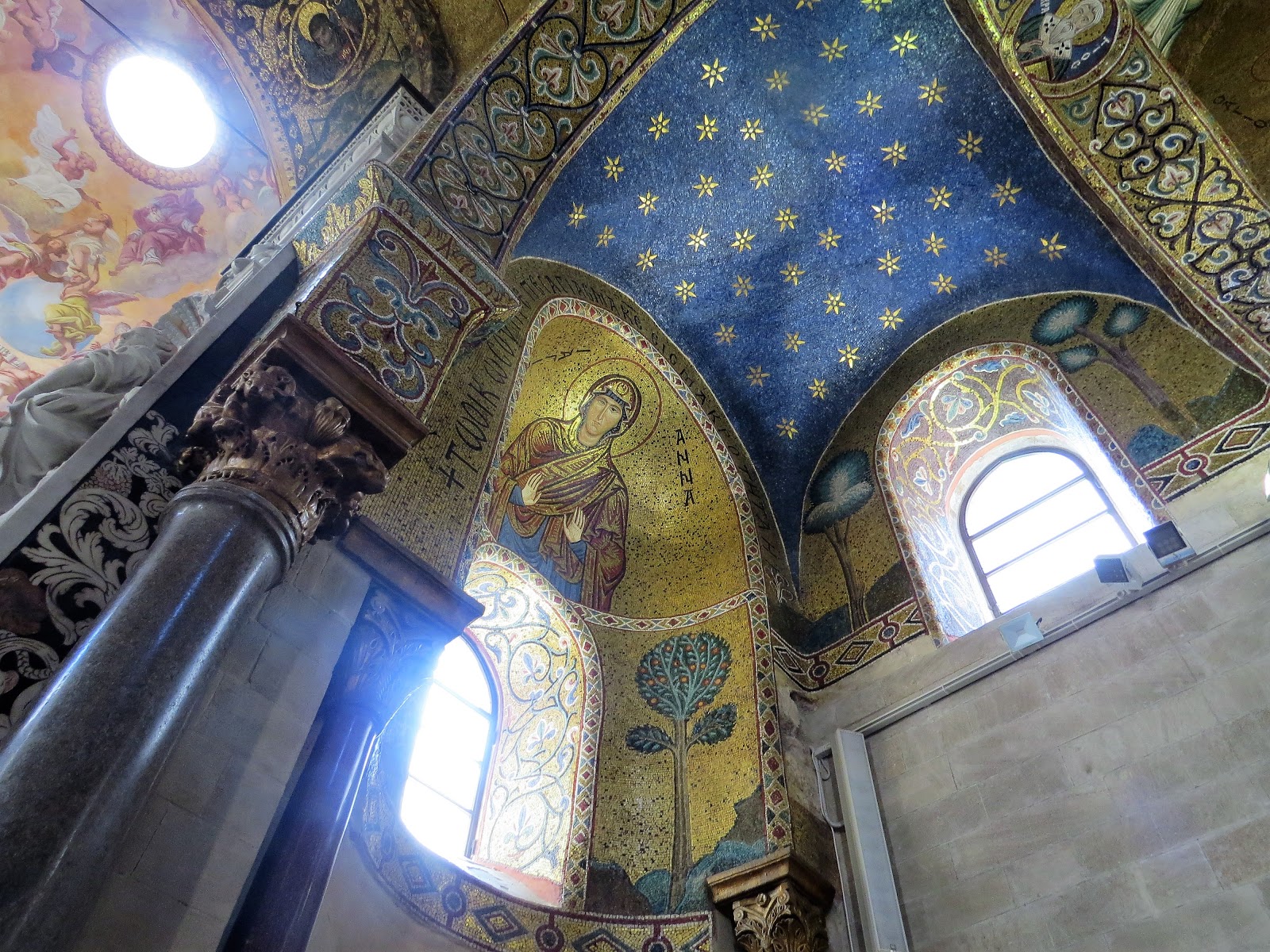
Amazing mosaics adorn the Palatine Chapel in the Royal Palace of Paleremo (also known
as the Palace of the Normans). The palace began as a 9th-century Arab fortress and was converted
into a royal residence in the 11th century after Normans conquered the island. It was the site
 of the court of the cultured but brutal Frederick II, king of Sicily (and later Holy Roman
 Emperor, among other titles) who reigned here for  more than 50 years, ending with his
 death in 1250. Architecturally it is a blend of Islamic and  Romanesque styles. The Palatine
 Chapel is the crown jewel of the Medieval period in the  Mediterranean.
It exists today virtually unchanged over the centuries. 

Palermo was our last stop after three months in Italy. From there we returned to Rome for two nights and then flew home. After a relatively short and pleasant drive from Marsala, we arrived in Palermo, dropped our luggage at our hotel, Palco Rooms & Suites across the street from the Teatro Massima, returned our rental car to Hertz and set out to explore the city on foot.

Buildings in the central (and historic) district reflect the city's unusual history, ruled by Rome, Byzantines, Arabs, French Normans and more. Churches incorporate Arab and even Islamic motifs, sometimes behind a Spanish Baroque facade. The center city is a swirl of singular buildings and amazing art.

Our room at Palco looked out on the Teatro Massima, one of Europe's largest opera houses. The late 19th-century theater was the setting for the final scenes in "The Godfather Part III" when murder was accompanied by an opera performance on stage.  The building is open for tours, which we took, and we got to see the hallway where the murder took place, the royal box where actors sat, as well as the backstage area. The impression is that you're in a giant jewelry or music box.

The Palco's location, at the intersection of the uninteresting Via Cavour and the must-walk Via Maqueda, is close to ideal. North on Maqueda is the "new" city with expensive shops, lovely apartment or condo buildings and few tourists. Via Principe di Belmonte, a pedestrian area of bars and restaurants just off Maqueda, is great for people watching during passeggiata. Go south on Maqueda for ancient and unique churches and the intersection with Corso Vittorio Emanuele, another must-walk street and one that takes you to a small-craft harbor and a tiny beach.

For us, three nights in Palermo at the end of a long trip through southern Italy was enough, but some people make it their only stop in Sicily. We met two young men who were staying in Palermo and had gotten up at 4 in the morning to make it to Catania in time for a Mount Etna tour. They returned to Palermo after the tour. Palermo, as intriguing as it is, is a very busy and not always pleasant city, but it's a must on any tour of Sicily. I'd say the same about every other city or town we visited on this island. Each had its own unique attractions and its own appeal.


A narrow street off Via Maqueda south of Via
Cavour is lined with sidewalk restaurants,
most with people stationed outside trying
to catch the interest of passers-by.

Looking south on Via Maqueda. It looks like the street dead-ends at a mountain. 

There are four of these Spanish-Baroque facades,
one at each corner of the intersection of Via Maqueda
and Corso Vittorio Emanuele, more or less the
heart of Palermo's historic district.

Dining al fresco on a small piazza off Vittorio
Emanuele. The piazza had several vendors
offering fried and grilled seafood.

The same small piazza was also prepared
to provide your dessert. Nutella, anyone?

A bistro window on Via Maqueda.

The Palermo Cathedral is impressively large, but its interior is not particularly interesting. It dates
to the late 12th century, but the history of the site goes back to a 4th-century basilica, then a
6th-century basilica, which was converted into a mosque, then converted back to Christian use
 in 1072, then rebuilt and modified over the centuries. It contains the tombs of kings and
emperors.

At the intersection of Via Maqueda and Via Cavour, the Teatro Massimo has become a tourist
attraction due to its appearance in "The Godfather Part III," in which the camera lovingly
shows the elaborate interior.

The theater's steps figure in the movie's final scene.

The royal box, where we were told Al Pacino sat in the movie.

The small panels in the ceiling slide open to
allow natural ventilation to cool the theater.

These two churches are at Piazza Vincenzo Bellini, just off Via Maqueda. The Church of
Santa Maria Dell'Ammiraglio (left) is also known as Martorana. The little one on the right
with the three red domes, is the Church of San Cataldo. Each is considered an important
example of the blending of Arab and French Norman styles. This photo was taken
from the roof of the Church of Santa Caterina d'Alessandria.

Looking up into the domes of San Cataldo, which was built around 1160. It reflects the reign
of Roger II (1095-1154), king of Sicily, who embraced diversity and encouraged Muslim
artisans to remain in Sicily and included Englishmen and Greeks in his government,
which consolidated all of the previous Norman conquests on the Italian mainland
as well as on Sicily. He was considered one of the greatest kings of Europe at the time.

Catalda is a surprisingly small and rather simple on the inside,
despite the complicated stonework. Today it is not used as
a church and is owned by the Equestrian Order of the Knights
of the Saint Sepulchre of Jerusalem. 

The Martorana's elaborate mosaics rival those of the Palatine Chapel. They were
completed between 1143 and 1148. 

Stars adorn the ceiling. Martorana still has its original
wooden door with Islamic carvings. Unfortunately, the
glass that protects it made it impossible to photograph.

Across the Piazza Vincenze Bellini from Martorana and Cataldo is the Church of Santa
Caterina d'Alessandria (Saint Catherine of Alexandria). It is larger than either
of the other two and once had its own convent. The convent preceded the church, founded in
the 1300s and built where Roger II's greatest admiral had lived. The church,
in full Sicilian Baroque extravagance, came in the late 16th century.

Jonah is about to be swallowed by the whale
in one of several plaques telling Bible
stories at Santa Caterina.

Nuns from the convent observed services from the choir loft high at the rear
of the church. The grating, including that above where they sat, was
apparently intended to prevent nuns from hurling themselves to
the church floor far below. A docent told us that suicide was not
uncommon among the cloistered nuns, some of whom had been
pressured to become nuns by their families.

The ceiling of Santa Caterina goes Baroque in a big way.

Santa Caterina sits between the Piazza Bellini and the Piazza Pretoria,
both of which can be seen from its roof. This fountain is the
centerpiece of Piazza Pretoria. The street on the other side
of the fountain is Via Maqueda. On the other side of Maqueda
is yet another massive church, one that we did not visit.

This courtyard is the heart of Palermo's Royal Palace.

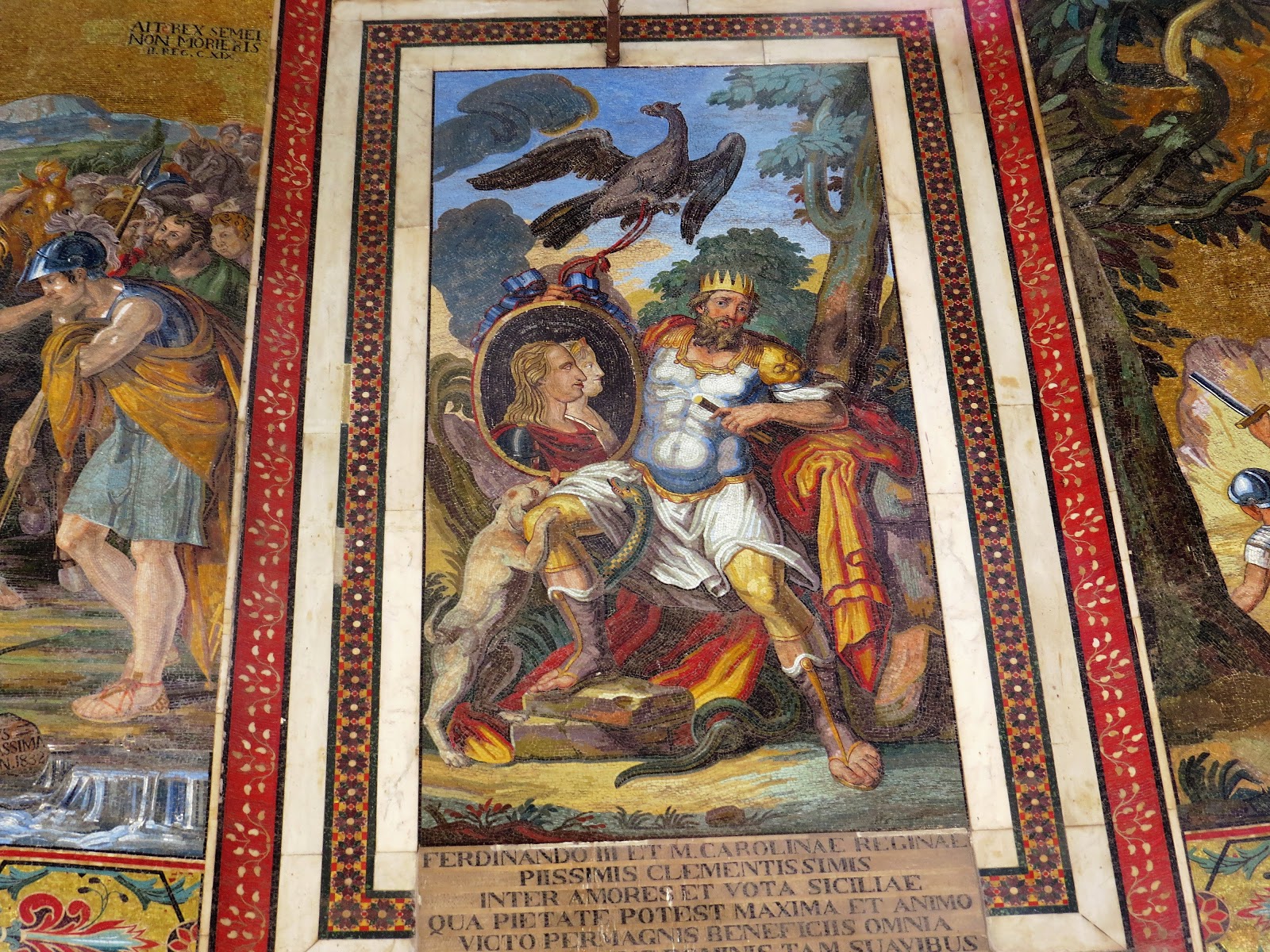
Mosaics in the corridors around the courtyard
depict scenes from Sicilian history.

Another courtyard mosaic.

Biblical scenes are depicted in the mosaics
of the palace's famous Palataine Chapel.

Eve is created from one of Adam's ribs in this Palatine Chapel mosaic.

What is known as Roger's Room or the Room of the Winds is covered with mosaics
that represent King Roger II's scientific and intellectual curiosity. 

One gets the impression that mosaic artists had little contact with real lions.

Palermo's Royal Palace, in addition to being the home of the regional
legislature (which meets in a large room with depictions of the labors
 of Hercules), Roger's Room and the Palatine Chapel, also has exhibition
space. We were there during a showing of Medieval and Renaissance
Sicilian art. This work particularly caught my eye: "Pieta e Simboli della
Passione" by Ignoto Pittore Fiammingo. It was painted in the late
15th century, but the disconnected and floating icons
reminded me of a 20th-century artist: Salvadore Dali. 


Wednesday, August 29, 2018

Italy: Marsala, Wine and More

Marsala wine at a sidewalk table in Marsala. One
of the city gates is in the distance.

You've heard of Marsala. You've probably drank it or used it in cooking or at least had restaurant dishes that use it: chicken Marsala, shrimp Marsala, etc. Marsala, the westernmost town on the island of Sicily, is where the popular fortified wine originated. Marsala tastings and winery visits are among the town's attractions, though I have the impression that not many Americans or other international travelers visit here.

Of course, as with almost every bit of land in this part of the world, there is history. Marsala was once under the control of the North African Phoenician city-state of Carthage, which fought Greece and Rome for control of Sicily in the Punic Wars.  Though that all ended a couple of millennia ago, it is recalled at a small museum on the nearby resort island of Favignana.  It contains bronze rams that were mounted on Roman and Carthaginian ships in 241 B.C.E. when an important naval battle was fought in nearby waters, the Battle of the Egudi Islands. Two hundred Roman ships, powered by oarsmen, defeated four hundred Carthaginian ships in the last naval battle of the First Punic War. The rams were about all that remained when ships sunk in the battle were discovered in the late 20th century. The museum is housed in a former tuna-processing factory, which also has a museum on the history of tuna fishing and processing. You can easily walk to it from the ferry landing, though signs pointing toward it can send you astray.

We visited Favignana as a day trip, taking a ferry from Marsala's small harbor, but we met a couple from Palermo who frequently make the drive to Marsala, ignore the town, and spend long weekends entirely on Favignana. Beaches -- sandy or rocky, your choice -- and loads of inns, restaurants and shops make this a popular getaway for Sicilians.

Other adventures out of Marsala included visiting Salene della Laguna, a traditional sea salt harvesting operation north of town. We walked among the pools where evaporation of sea water was leaving behind salt. We didn't see the seafoam process, in which, on rare windless days, foam forms on some of the pools and is scooped off and dried, producing a rare and expensive fine white salt, not the large grains of salt that often go into grinders. We bought several jars of the "soffi di sale" as gifts and for our own use at home.

After a morning visit to the salt works, we drove about an hour to visit the Gorghi Tondi winery east of town. We're not particular fans of Marsala wine, so we went to one winery that doesn't make any fortified wine, though Gorghi Tondi does make a sweet dessert wine from the grillo grape, which figures prominently in making Marsala. The sweetness comes from late harvest and botrytis cinerea, the "noble rot" that is used in making Sauternes in France. The tasting here was well worth the drive, and we made it home with a half-case of wine embedded in our luggage, including three bottles of the dessert wine.
Lemon-based drinks are sold on the piazza outside
the Duomo in Marsala.

Jane and I are reflected in a mirrored ceiling at a wine bar in Marsala. Those little
bowls all held different snacks.

A wine tasting in the courtyard of
what was once a ducal palace.


A G&T and an Aperol spritz at another sidewalk
cafe on a sidestreet in Marsala. 

This bronze ram was mounted on a pole at the front of a Roman
ship in 241 B.C.E. when the ship was one of many sunk during
a naval battle between Carthage and Rome. The stempost sheath
bears the relief decoration of a Montefortino-type helmet with
three feathers. An  inscription indicates that the ram's construction
was inspected and approved. During an attack on another
ship, a badly built ram -- its pole was essentially an extension
of the ship's keel -- could cause its own ship to break apart.
It and many others are on display on the island of Favignana
 in a small museum in a former tuna-processing factory.

A food truck keeps visitors well fed on the island of Favignana.

Anglers fish from the rocks off a seaside promenade
on Favignana.

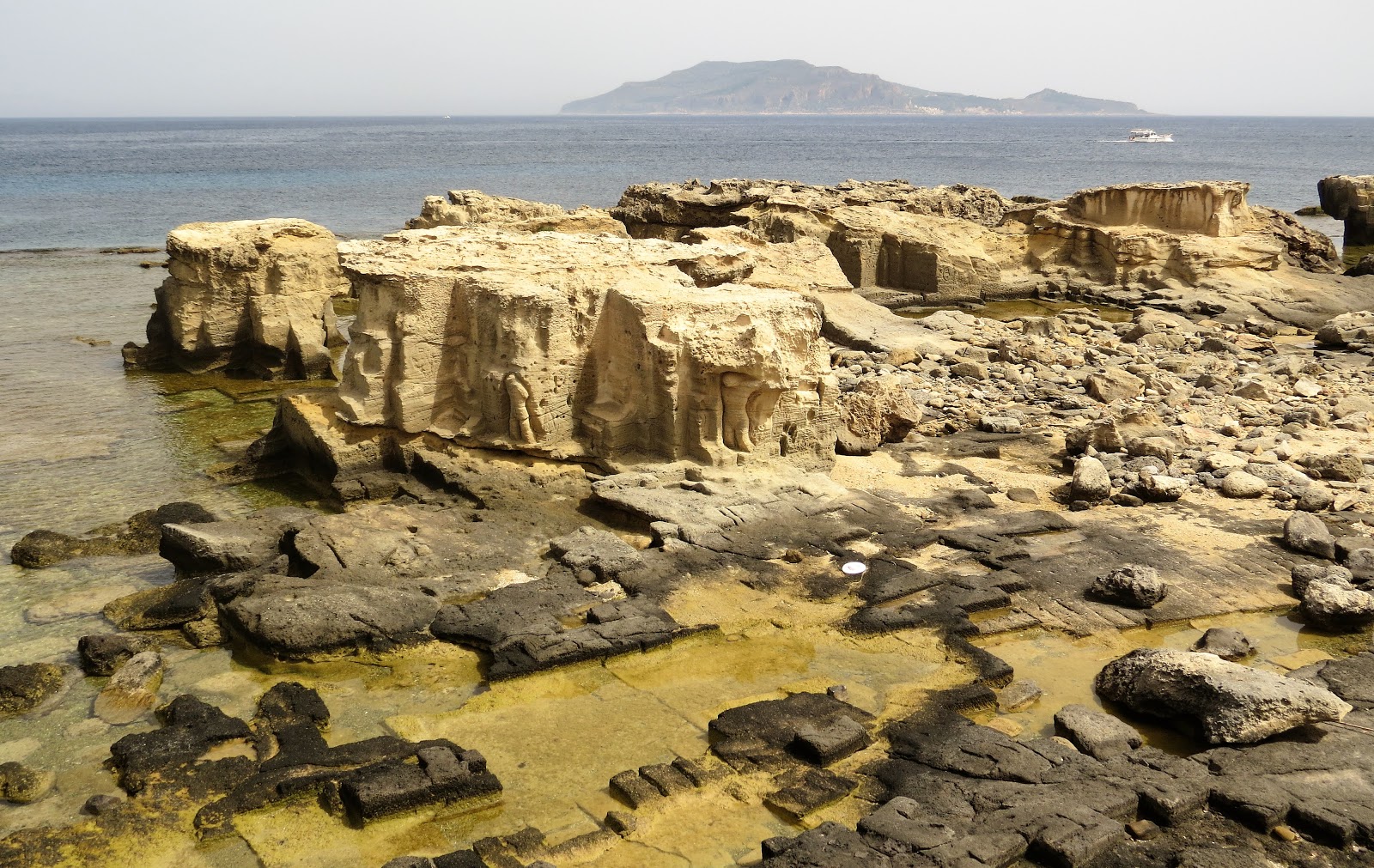
Steps from a seaside sidewalk allow people to venture out onto the rocks and to swim
in the water beyond them. This area seems to once have been a quarry.

Did you notice these carvings in the preceding photo?  My guess is that they were
carved by quarry workers in rock that was too soft to be  harvested.

The straight lines in the stone are signs that this was
once a quarry. 

A hilltop fortress looks down on Favignana's small but busy harbor.

Windmills once provided power to pump sea water from one pool to another at
Saline della Laguna near Marsala. 

The trees in the distance are on an island
that protects Saline della Laguna from
storm-driven waves that could interfer
with its age-old system of drying seawater
to collect salt.


Tuesday, August 28, 2018

Italy: Agrigento, Valley of the Temples

When Icarus used the wings his father made to escape from Crete, he disregarded his father's
warning about not flying too close to the sun. The heat weakened the wax in the wings
and Icarus fell to earth. He seems to have landed here, in front of the Temple of
Concordia, as a large bronze sculpture.  

Tempio della Concordia (Temple of the Concord) is considered the best-preserved Greek temple still existing, owing mostly to its having been used for centuries as a Christian church. It's just one of the many temples and ruins between the modern town of Agrigento and the southern coast of Sicily. Photos of Concordia, which is beautifully illuminated at night and appears to float in a dark sky, should put Agrigento on the itinerary of any trip to Sicily.
 
Most of the temples and other sites are along a walkway that runs the length of the Valley of the Temples, which are considered to be the finest Greek ruins in the world, along with those of the Acropolis in Athens.  Ruins of residential areas and a fine archeological museum are along the road between the valley and the modern town. (The term "valley," by the way, is wrong. The temples are strung along a ridge that overlooks the Mediterranean Sea.)  In October 2020, the New York Times published an article about plans in Agrigento to reassemble stones from a gigantic figure at one of the temples. My photo of one of these reassembled titans is among the pictures below.

We were still in Siracusa when we started having second thoughts about Agrigento, mainly about the fact that the inn we originally booked did not have a pool. Siracusa was very sunny and very hot, though it was right on the sea. Agrigento, a mile or so inland, would be even hotter, we thought, and we wanted a pool. One hotel in Agrigento appealed to us: Villa Athena, which is not only within walking distance of the Valley of the Temples, it has its own entrance to the park and it has day and night views of Concordia and the Temple of Juno. And a pool.  I called and was told that the only room available was a suite at several hundred euros a night. Jane went online and found a "comfort" class room there for less than 200 euros a night. We booked it and cancelled our previous reservation. No idea why the front desk had told me only the suite was available.

Villa Athena is a house from the 1700s that has been expanded with several wings and out buildings to become a very posh hotel. Our ground-level "comfort" room was very comfortable. It was entered via our own terrace from a sidewalk, which meant mostly keeping curtains drawn for privacy. But the room was large, beautifully furnished and had a superb bathroom and shower. And CNN on TV, which we rarely found in the more modest inns where we usually stayed.

The town of Agrigento was a short taxi ride from Villa Athena. We didn't take our own car because parking in old walled towns in Italy is a nightmare.  We did, however, drive to a nearby beach at San Leone. It took less than 10 minutes, but it would have been a terrible walk.


Concordia floats in the distance in this view from Villa Athena. The temple's current
name comes from a plaque found near it, not necessarily associated with it, that was
dedicated to the "harmony of the people of Agrigento." It is considered likely
that the temple was originally dedicated to the Dioskouroi, Castor and Pollux,
although there's another temple here associated with them.

A small fence keeps visitors from climbing the steps and
entering the temple. The Doric columns that surround
the temple appear to be repeated inside.

Another view shows the walls and arches of the interior.
You can see the Mediterranean in the distance.

In the late 500s, a Catholic bishop named Gregorius took over
the temple and consecrated it to Saints Paul and Peter and expelled
the pagan gods Eber and Raps, the most recent subjects of worship there.
It was the conversion to Christian use that saved much of the temple. In
1788, the use as a church ended and most of the Christian elements
were removed. 

The Temple of Hercules boasts columns that were reassembled in the 19th century.

The Tempio di Giunone originally was much like Concordia, but the centuries
weren't so kind to it. Giunone is the Italian version of Juno, aka Hera, and the temple
is referred to by all three names. The goddess in question was the wife of Giove,
Jove, Jupiter or Zeus, depending on your choice of language and whether you regard
the Roman gods as mere adaptations of the Greek ones.  Like most of the
temples here, it dates to the fifth century B.C.E.

The Temple of Castor and Pollux. Or, rather,
a corner of it.

The Tomba di Terone, a small, sealed tomb
in an olive grove below the ridge where
the temples are. 

A centaur appears to be in for a beating
in this illustration on an ancient Greek
bowl at the archeological museum
in Agrigento. It had countless works
such as this, all recovered from local ruins.

This towering figure is one of the titans (the pre-Zeus gods
such as Atlas) meant to adorn the Temple of Zeus at
Agrigento. Today, the temple is an unremarkable pile
of stones, but archeologists have figured out what it was
and how it was meant to look.  

This model of the Temple of Zeus shows that it would have been more or less closed, like no
 other Greek temple of its time. It also would have been the largest. It is thought that it was
 never 100 percent completed. Note the figures between the columns.
 Those are the titans, earlier gods pressed into serving Zeus.

This child's sarcophagus was carved in marble, probably in Rome, in the second century B.C.E. The
front shows the child with his teachers at school, at left, and on his deathbed at right.

This side of the sarcophagus depicts the child as a newborn, The mother is sitting at
right, and a wet nurse holds a cloth to wash the child.

The other side of the sarcophagus shows two figures guiding the child, who is in a small
chariot pulled by a sheep, on his journey to the kingdom of death.


On the western outskirts of Agrigenta is the town of Realmonte and the Scala dei Turchi,
the Stairs of the Turks.  Moorish invaders who were mistakenly thought to be Turks
climbed these cliffs during raids and attempted invasions.

Today the cliffs are a destination for sightseers and sunbathers.

San Leone, a couple of kilometers from Agrigento,
has sandy beaches, several nice lidos and plenty
of sun. The waves are not great for swimming,
but a breakwater at one beach calms things down.


Agrigento is a town with personality, though the number of
out-of-business shops was dismaying. We had two very
good dinners at different places here, and we twice had
aperitivos in the piazza in front of these artful stairs.

Via Atenea is the main pedestrian
 and passeggiata street.
W knew that lights such as these signal a
feast day, but as strangers in a strange land, we almost never knew
what feast day was being celebrated. Clearly, the party hadn't
started yet when I took this picture.