Tourist First

Travel notes and advice from around the world. Above, the daily flight from Managua at the San Carlos, Nicaragua, airstrip.

Thursday, February 2, 2017

St. Vincent and the Grenadines: Moonhole


 Flying into Bequia’s small airport, we could spot a few of the nearby Moonhole houses from the air. Most, though, are hidden by trees or are designed so in tune with the landscape that they all but disappear.
       A visitor seeing the community for the first time might think it is the ruins of some long-ago civilization. All the houses are made primarily of stone and concrete with whalebones used sometimes as banisters. Large fishing net floats are imbedded like sidelights around doors. Some windows have Plexiglas panels to give some relief from the trade winds; others are totally open or filled with louvers. Most doors are Dutch-style, with the top half left open to catch the breeze. Furniture is mostly built-in and made of stone and concrete and topped off with pillows.
        Though this quirky little community has been in various forms of turmoil since its founder’s death in 2001, the threat that Moonhole might really disappear seems to be fading.
       Its founder, Tom Johnston, was an advertising man back in the “Mad Men” era. In 1964 he abandoned Madison Avenue to build a house and live under a large natural stone arch on this obscure island Bequia (BEK-way), one of the Grenadine islands in St. Vincent and the Grenadines. The arch is called Moonhole because at times the moon can be seen through it.
    
Tom Johnston,the original
Moonhole house and Moonhole
itself are depicted in a
painting hung on the wi-fi
terrace above the Moonhole
office.
Using local workers and his own untrained sense of design, Johnston built his house. Sports Illustrated magazine wrote about it in 1967 (click HERE for article). He and his wife, Gladys, had to abandon that house in the early 1970s after a large stone fell from the arch and crashed through their bedroom ceiling, narrowly missing Gladys. By that time he had built several other houses, and he and Gladys moved into one of the other houses.
       Using a crew of 30 or more local workers, Johnston eventually designed and built 17 houses.  Some were purchased by friends; some were available for rent. An open-air art gallery with a whalebone-fronted bar occupied a prime viewpoint atop what is now the Moonhole Company’s office and was once the scene of community gatherings and dinners. Today it’s used by Moonhole guests seeking a wi-fi hotspot.
       Johnston’s death sent Moonhole into something of a tailspin, marked by litigation among property owners and the Moonhole Company and the Johnstons’ Conservation Trust. Some of Johnston’s original home buyers are too old or ill these days to visit; some houses have fallen into disrepair while others are maintained and rented out by the Moonhole Company. Stone-paved waterside walkways are falling apart, leaving visitors to clamber around gaps.  The original house under the arch still exists, but it’s off limits, as is the entire area near the arch due to the danger of falling stones.
       So why come here?
      It’s an incredibly beautiful place. The houses flow up and down the hills in a way that I doubt many formally trained architects would ever imagine. Living rooms have open holes in the ceilings so built-in planters get water when it rains. The beach offers swimming and snorkeling. Steep stone stairways take the place of gym exercise equipment. A helpful staff will arrange taxis, buy groceries and confirm your airline seats. To visit the Moonhole Company's website, click HERE. Take a look at the photos of the rental houses to get an idea of the artistry that went into this place.


Stone steps lead to one of the stone houses
at Moonhole. Beach house, where we stayed,
is at the same level as the entrance
to the community, so we didn't spend a lot
of time on stairways such as this.

       We shared Beach House, the only house on Moonhole’s sandy beach, with our friends Mary and Dick Greenberg from Fort Collins, Colorado, for a week in January 2017. It has two bedrooms, each with a full bath. The sun powers electrical outlets strong enough to recharge our phones and tablets, but there’s not enough power for hair dryers or very bright interior lighting. The beds are comfortable kings with trustworthy mosquito netting. Toilets are flush and showers are cold, relying on captured rainwater. There are solar bag showers, which you fill with water, put out in the sun, and then use the attached hose and shower head to give yourself a warm shower – but the cold-water showers aren’t that cold at all.
       Food and drink were no problem at all. Our housekeeper/cook, Zoreatha, and Dalia, her assistant, took care of everything.  She had a chicken dinner ready for our first night complete with a sauvignon blanc and asked what else we liked. We all agreed on seafood and I asked about conch. The next day we had conch – I’m not sure of the preparation but it was tender (yes, tender conch!) pieces of conch in a light sauce. Delicious. For another meal she prepared pieces of lobster in a similar way.
       As for drinks, Jane and I showed up with a bottle of rum from the duty-free in Barbados. Orange juice, pineapple juice and “tropical punch” were already in the fridge, so we had a very happy happy hour with fruity rum drinks, sitting out on lounges on what felt like our own private beach. On our first trip into Port Elizabeth, the main town on the island, we hit Vintage, a wine and spirits store on the waterfront Belmont Walkway, and came back with what turned out to be not nearly enough alcohol. So we made other trips.
       For variety, we had dinner a couple of nights in Port Elizabeth, both times at Fig Tree. It’s not the only or even necessarily the best place on the island, but it certainly suited us. For more on restaurants on Bequia, see the Happy on Bequia post below (click HERE). 
        The Moonhole experience, at least at Beach House, was sort of like camping at the beach, but oh so much better. 
      Here are my snapshots from Moonhole.

This seating area on the wi-fi terrace was once the setting for community dinners and other events at Moonhole.


Whalebones are used in the construction of the bar on the wi-fi terrace. Note the foot rail, also whalebone.

A cache of whale bones stored on the wi-fi terrace will be
used in future restoration and construction, according to
Carroll Rooth of the Moonhole Company.

What was once a walkway along the waterfront below the wi-fi terrace is in disrepair. Wouldn't
you assume that you'd stumbled upon some sort of ancient ruins?  The structures to the left
were built as artists' studios.

Tom Johnston's original stone structures still stand, but not all
are still in use.


What appeared to be an old barbecue pit is disintegrating on the waterfront below the wi-fi terrace.

The Johnston's original house and the area beneath the Moonhole arch are off limits due
to danger from falling stones.

Our friend Mary picked up conch shells along the rocky waterfront below the wi-fi terrace.


The multi-level lounge at Beach House. Stone and wood furniture with colorful cushions. 

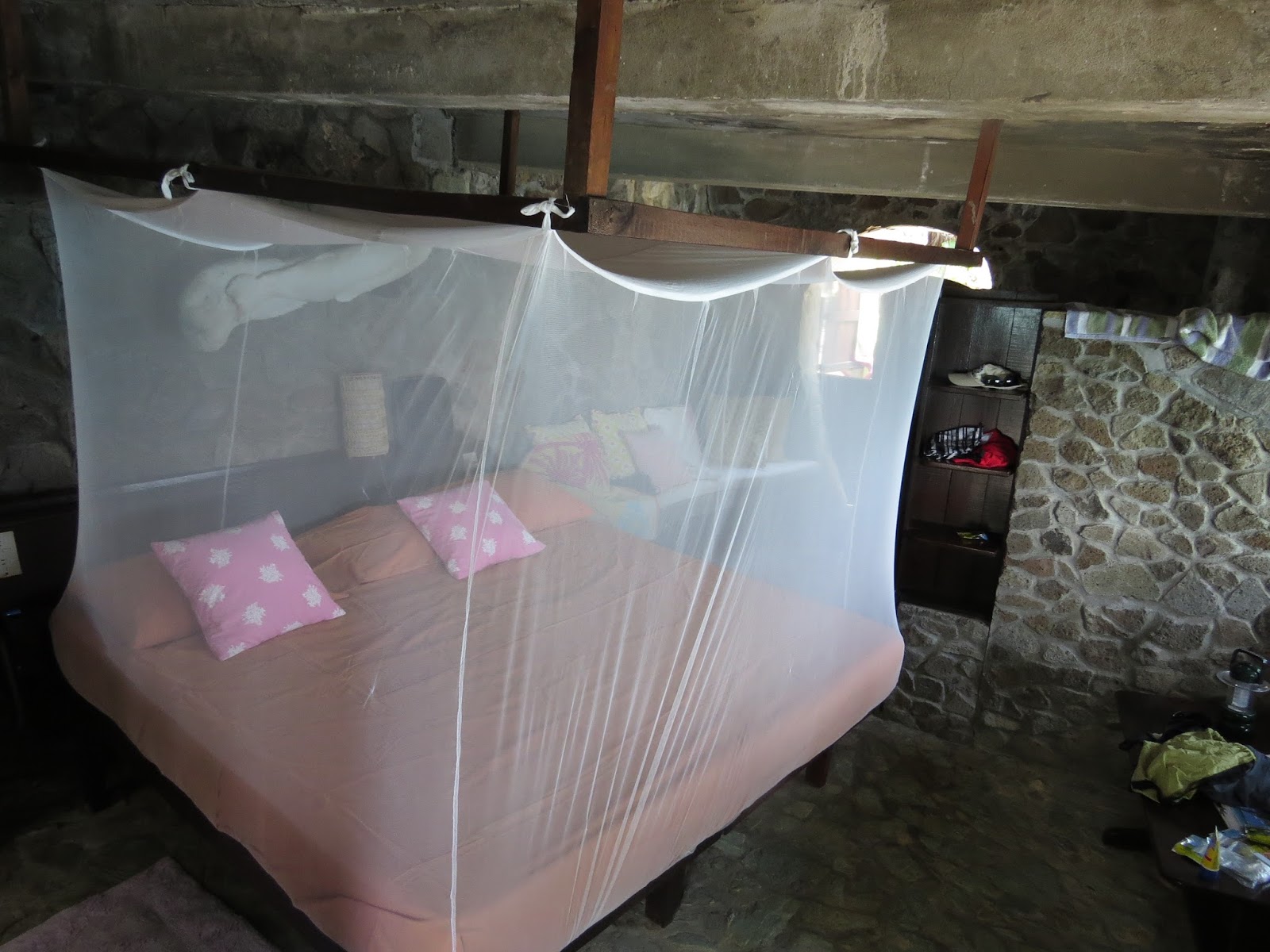
Our room at Beach House. You have to go outdoors to reach either of the two bedrooms from the main living area.
The mosquito netting worked well, though I think the almost constant sea breeze is what minimized our mosquito bites.
Beach House. At the right is the Greenbergs' room. Straight ahead
is an entrance to our room with the top half of the Dutch door open.
Above the Greenberg's room is a terrace with a stone table and a bench.

Tom Johnston adorned his houses with art, including this whale bone carved to resemble a humpback whale.

The "front door" for Beach House. The little window to the lower right was in our room. 


The beach just steps from Beach House. Did we choose the right house or what? 
Another view of the same beach.

The main living area at Beach House. Note the fishing net floats that frame the doorway. Panels
of Plexiglas swivel to restrict or allow sea breezes into the room.
A visitor strikes a pose along one of Moonhole's
stone walkways.
The dining area at Beach House. Note the Flintstone-like seating.
Actually, it's quite comfortable.


Wednesday, February 1, 2017

St. Vincent and the Grenadines: Happy on Bequia

      A January 2017 getaway was needed, someplace sunny and warm. On two previous trips to St. Vincent and the Grenadines, Jane and I visited Bequia for a few hours.  The first was a day trip from St. Vincent to visit Moonhole, the fantastical community of stone homes at the southern tip of the island. Our second visit was a lunch stop while sailing the Grenadines..
     This time, we planned two weeks on Bequia (BEK-way). First, a week in a house at Moonhole, which we shared with friends, Mary and Dick Greenberg of Colorado. The second week, on our own after the Greenbergs left, was at Firefly, a small hotel on a mountainside farther north. 
      Click HERE for Dick Greenberg's blog posting about the week at Moonhole.  My own post on Moonhole should appear in this blog just above this posting.
      Bequia, which has about 5,000 residents, is about seven square miles and is at latitude 13 degrees 17 minutes north, meaning that it's close enough to the equator that nights and days are about 12 hours each and the temperatures are about the same year-round. Like most Caribbean islands, it's volcanic in origin. U.S. dollars are readily accepted, but I think that taxis and merchants don't give a very favorable exchange rate. So we used an ATM (usually where you get the best exchange rate) to get Eastern Caribbean dollars. 
      Here are some links to places on Bequia
      The Moonhole Company (click HERE) handles rentals for houses at Moonhole. They come with a housekeeper/cook, though guests pay the grocery bill. Wine, beer and rum can be bought in Port Elizabeth.
      Firefly (click HERE) is a small inn and restaurant. We stayed there six nights. The room was lovely -- the double shower even had its own door to the terrace -- but the restaurant's dinner menu became monotonous. Lunch is much better thanks to a selection of curried rotis.  I can recommend both the curried goat roti and the curried chicken roti. The hotel/restaurant staff here was exceptionally professional and friendly. The hotel provides guests with cellphones preloaded with phone numbers for a good taxi service as well as numbers at the hotel. Take the phone to the pool so you can order drinks from the bar. Otherwise, it's a steep 40-step climb to fetch your own. 
     The Fig Tree (click HERE) was our favorite restaurant. We ate there twice with the Greenbergs and then again on our last night. We had grilled lobster each time. Hardly anyone was there for our first two visits, but it was packed on our third visit, possibly due to live music -- two excellent guitarists/singers who performed songs by Bob Marley, Paul Simon and others.
      Max's Pizzeria (click HERE) is next door to the Fig Tree. We ate there once and had the lobster pizza, which is much better than it sounds. An island institution, it's now owned and operated by a young couple from San Diego. Highly recommended for its lively ambiance as well as the food.
      Sugar Reef (click HERE) is within walking distance of Firefly.  It's more formal and less friendly than Firefly and everyplace else we ate. The food, however, was good even it it wasn't quite what we expected. Lobster came cut into pieces and dressed and placed back in its shell and was overall the smallest serving of lobster we saw.
      Jack's (click HERE) is the only place to eat on Princess Margaret Beach. It's known for its fried chicken, but I enjoyed an excellent fish sandwich and very cold Hairoun, the local beer. Jane had a Nicoise salad with fresh grilled tuna.
      Keegan's (click HERE) is a guesthouse and cafe on Lower Bay. We had dinner there waiting for the Bequia Music Fest to start at the nearby De Reef bar. Grilled lobster was huge and Jane was particularly happy to get the entire beast, not just the severed tail. 
      Getting to Bequia is not easy. There are no direct flights from the U.S. to St. Vincent or any of the Grenadine islands. Jane and I flew to Barbados where we were scheduled to take at SVGAir flight to Bequia. That flight was overbooked, however, and we were bumped onto an ad hoc Air Mustique Barbados-Bequia flight. The Greenbergs were never able to get tickets for a Barbados-Bequia flight, so they flew into Barbados, spent a night in a hotel, and the next day took an early flight to St. Vincent. From there they caught a ferry for the one-hour trip to Bequia. On the way home, it was we who had to overnight in Barbados because the different airlines' flight times didn't line up.
     Getting to Bequia, however, is definitely worth the effort. This island, where everyone seems to know everyone, is the friendliest place I've ever been. There's none of the grinding poverty that is seen elsewhere in the islands, even on St. Vincent itself. Houses are often brightly painted and appear in good repair. There's not a huge huge gap between homes for residents and vacation homes for outsiders. When we found the most recommended wine shop closed when it should be open, a lady at an office next door explained that the usual wine shop clerk was injured. She called around to locate the owner. She didn't reach her right away, but later in the afternoon when we were walking by again, she said the owner had just been there and this time was able to contact her to come back. She did and we were able to stock up. In our experience, taxis don't expect payment when they take you from a remote hotel into Port Elizabeth. No, you can pay them later when they take you back to the hotel. People wave when you pass by. "Hello" and "good afternoon" are always answered. Hands are shaken. It's an island of friends.
      Here are some of my snapshots from the trip.

Our eight-passenger Air Mustique flight to Bequia.


Barbados as seen just after takeoff on our flight to Bequia.
     
An egret takes in a view of the harbor at Port Elizabeth, the main community on Bequia, 

Rib bones from a whale frame the entrance to the Whaleboner bar. Bequia's fishermen
 are allowed to hunt for whales, though we heard none had been killed for several years. 

A colorful local? No. It's Dick, a Colorado Rastafarian. 

Attendees at the annual Bequia Music Fest, a three-day event at several
venues. These women are waiting for the show to start at De Reef on Lower Bay.

The Signals, a band from Dominica, at the music fest. 

Sugar Reef is a restaurant and inn on Industry Bay. The most elegant dining room we saw on Bequia.

The bar and dining area at Firefly, where we stayed for six nights.

The pool at Firefly is 40 stone steps below the restaurant.

Cruise ship passengers spent a morning at Princess Margaret Beach.

Princess Margaret Beach got its name after a visit from the late princess, who was associated more
with nearby Mustique than with Bequia.

Jack's is the only place to eat at Princess Margaret Beach, and that's not a bad thing. The beer is icy cold
and the "fish burger" is really a large grilled piece of mahi-mahi. 

The dock at Jack's. A waterside walkway that once connected
 Princess Margaret Beach with Port Elizabeth has fallen into
disrepair, so a lot of water taxis use this dock.


Boats moored in Admiralty Bay off Port Elizabeth. People who watch the sunset carefully
can see the green flash as the last rays of the sun skim waves far away.


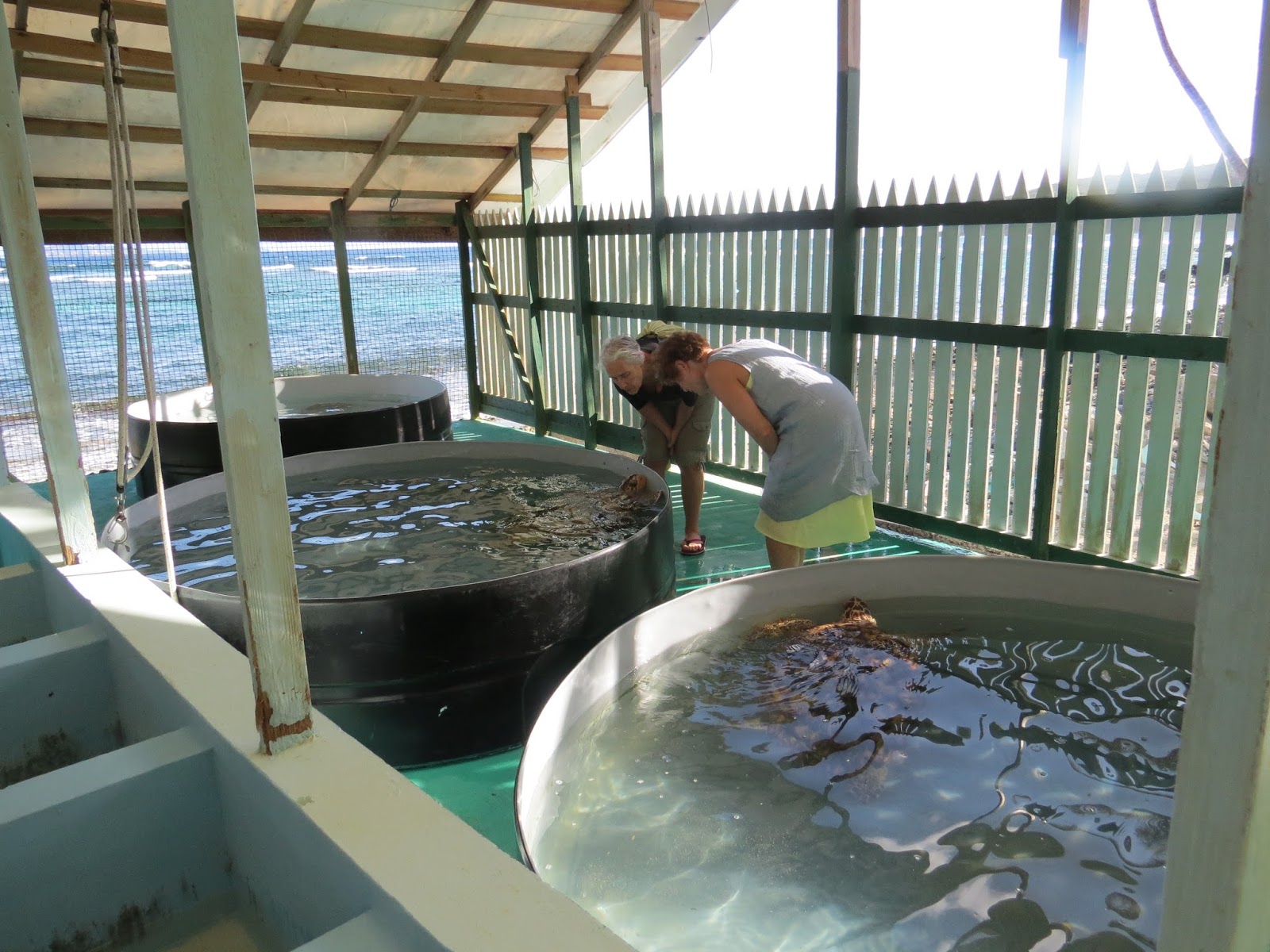
The hawksbill sea turtle rescue operation provides a nice break from the sun and sand, as
well as an opportunity to give a few dollars to support the sanctuary. 


Jane and Mary check out the occupants of one of the tanks.

Our room at Firefly. Those are coconuts on the little table.

View from Firefly, which looks east.  Firefly is developing the waterfront area with new villas;
dredging will make the water deeper for swimmers and provide sand to widen the beach.


Tuesday, May 31, 2016

Mexico: Baja California Sur, Mostly Uncrowded in May

The beach at Balandra, near the northern tip of the Pichilingue peninsula in Baja California Sur. Note
the two people at the top of the rock. Beaches such as this near La Paz were uncrowded during our May
2016 trip, and almost everyone at these beaches appeared to be locals or vacationing Mexicans.
 
 In May 2016, after the San Diego celebration of daughter Katy's marriage to Ali, Jane and I headed south. We flew Alaska Air from San Diego to Los Cabos at the southern tip of the Baja Califonia peninsula. May is not quite the high season in Baja California Sur. While Cabo San Lucas seemed about as crowded as it could be and San Jose del Cabo was also pretty busy, we got discounted hotel rates in Todos Santos and La Paz. Their high season is months earlier, when whales are giving birth in the warm waters.
     La Paz is not nearly as big a tourist destination as Cabo San Lucas or even San Jose del Cabo. At restaurants in the city, many or most of the other guests are likely to be Mexican, and you'll see few gringos at the beaches north of town. Souvenir shops are few and far between, even along the waterfront. For some people, La Paz may offer what seems like a more "authentic" Mexican experience, while Los Cabos has an international ambiance. There is no subtlety in Cabo San Lucas: the focus is on booze, sun and separating visitors from their money. Parts of Cabo San Lucas, with its Luxury Avenue mall and stores like Cartier, could be mistaken for Miami. San Jose del Cabo is more charming, but almost all the people shopping, eating and drinking are from El Norte.
The rooftop pool and bar area at Hotel Guaycura in Todos
Santos. The house margarita (a classic lime margarita)
can be recommended. 
    We picked up a rental car (be prepared to pay for mandatory insurance in Mexico even though the rental company may not tell you about it in advance, as well as to have as much as a 2,000-U.S.-dollar hold placed on your credit card) and drove the hour or hour and a half to Todos Santos, where we stayed one night at Hotel Guaycura (click HERE for its website) in the central historic district. Guaycura also has a restaurant and beach club a few miles away on the Pacific Ocean.  We had our first dinner in Mexico at La Casita (click HERE), a few blocks from our hotel. We can heartily recommend the ribs if not the cactus quesadillas. On the way back to the hotel we stopped for a drink at the Hotel California, which is much more touristy than the Guaycura.
   
Early morning on a Monday found the streets of
Todos Santos very quiet. 
     Todos Santos is a picturesque small town that seems totally dependent on tourism. Lots of shops and places to eat and drink. The Pacific beaches a short drive away are said to be nice if not terribly safe for swimming, but we didn't get over to them. After one night in Todos Santos, we drove northeast to the Gulf of California (Sea of Cortez) side of the peninsula and the city of La Paz, the capital of Baja California Sur. La Paz, which has more than 200,000 residents, is on its own little peninsula, jutting north into the Gulf of California, giving the city a west-facing waterfront and nice sunsets despite being on the east side of Baja.
      We stayed farther north on the Pichilingue peninsula at a sprawling resort called CostaBaja (click HERE). It's a golf, sailing and fishing destination (we do none of those), but it's also an excellent base for exploring the beaches even farther north as well as going back south into the city. We stayed there three nights, had two dinners in La Paz, and spent two days visiting the beaches at Balandra and Tecolote, the latter of which has a great view of Isla Espiritu Santo, a desert island known for its sea lions, other wildlife and many bays. Boat excursions to Espiritu Santo are popular, but we settled for a distant view.  In La Paz, we had one dinner at a lively tourist place on the waterfront called Tailhunter (click HERE), where anglers are invited to bring their catch in to be turned into dinner. The second-floor balcony has a great view of strollers on the Malecon (seaside promenade) and sunset views of La Paz Bay.  A second dinner was a few blocks from the waterfront at Las Tres Virgenes (The Three Virgins; click HERE), a fine-dining establishment that serves probably the best food in town and offers a lot of Mexican wines, many from the celebrated Guadalupe Valley.  Our third and last La Paz dinner was at a sushi restaurant at CostaBaja.
The hotel building at CostaBaja. The resort, just north of La Paz
on the Pichilingue peninsula, includes an 18-hole golf course,
a shopping area with several restaurants, a beach club, a marina,
 condos and private homes. In May 2016 our large room with
a balcony was only 95 U.S. dollars a night, and the
hotel seemed almost empty. It's a short drive from here to
nearly deserted public beaches.

Balandra Beach has no food concessions, just beach umbrella and kayak rentals. Tecolote Beach, above,
has a handful of restaurants. We had lunch twice in the largest one, whose high thatched roof is
visible here. Like Balandra, the beach was nearly deserted midday on weekdays in May. At Balandra,
the water is amazingly shallow (like six to 12 inches) for maybe a hundred yards out into a cove. At
 Tecolote, the water gets deeper much closer to shore, and there is a view of Espiritu Santo island.
Balandra, where no food is sold, has a much cleaner beach; Tecolote has more litter, though
the water itself seems just as clean.
   
Walking in the warm and shallow water at Balandra where we rented kayaks
for an hour of paddling around the cove. One attraction here is a large rock
that the sea has eroded so much that it now resembles a mushroom. We saw it
from our kayaks, but it can also be  reached by walking around a rocky headland. 
That's the Luxury Avenue mall on the left, overlooking
the marina at Cabo San Lucas. The marina is surrounded
by a promenade lined with bars, restaurants and tour
companies, all of which seem to have people accosting
passers-by with sales pitches. There's probably as
 much English spoken here as Spanish. 
The Mexican flag flies over the main square in San Jose del Cabo.
On Thursday evenings the square hosts a large art market and
the many galleries in town stay open late. 
     We had driven mostly on Mexico 19 from the airport at San Jose del Cabo, to Todos Santos, and then all the way to La Paz. That route took us west and along the Pacific before crossing the peninsula. Our next destination was San Jose del Cabo and we mostly took Mexico 1 along the eastern side of the peninsula. GPS  and most guidebooks will tell you to take Mexico 19 again; the reason is that Mexico 1 is a serpentine mountain route with hairpin turns and low speed limits. Nonetheless, it was nice to see new scenery.  All of Baja Sur, by the way, is pretty much desert. Loads of cacti, dry gulches and dead-looking weeds.
Rooms at Casa Natalia in San Jose del Cabo overlook a courtyard.
Farther down the courtyard is a small but pleasant swimming
pool. Between the street and the courtyard are the hotel lobby
and its bar and restaurant. Tip for getting a room here: ask
for a room above ground level for a good bit more privacy.
     In San Jose del Cabo, the last two nights of this trip were spent at Casa Natalia (click HERE), a charming inn on the town square. The location could hardly be better, though it required finding street parking for our rental car.  On our one full day in Los Cabos, we drove over to Cabo San Lucas (via the "corridor" of resorts that connect the two towns) hoping to rent kayaks to paddle out to The Arch, a rock formation at Land's End, but the kayak rental person said the harbormaster wasn't letting kayaks go there because of high winds. If you want to browse souvenir shops for items you might also find at Pier One or Amazon, or if you want to drink yourself into an early-afternoon stupor, San Lucas is the place for you. We headed back to quieter San Jose.
     Both of our two dinners in San Jose are worth mentioning. One was at La Pesca (click HERE for TripAdvisor listing), a fish restaurant a short walk south of the square on Boulevard Antonio Mijares, the same street as our hotel. We shared a tuna tartar appetizer (sauced tuna chunks and pineapple; absolutely excellent) and a red snapper that was roasted in savory sauces. Again, wonderful. Our other dinner in San Jose was at La Lupita Taco and Mezcal (click HERE), where a long list of interesting tacos are offered individually. Not surprisingly, there's also a good list of mezcal-based cocktails along with a longer list of mezcal brands.  The evening we were there, a band was setting up in the open-air garden, though when we left around 9 the live music still hadn't started.  Still, a lively and pleasant place and, as at La Pesca, very good food.
     There's more to Baja Sur than the ostentation and alcohol of Cabo San Lucas, the cafe life in San Jose del Cabo, the charming streets of Todos Santos and the beaches around La Paz.  It's the climate. It was hot and dry while we were there, and it was cold and rainy at our home in Maryland. For my money, that's the best reason to visit.